
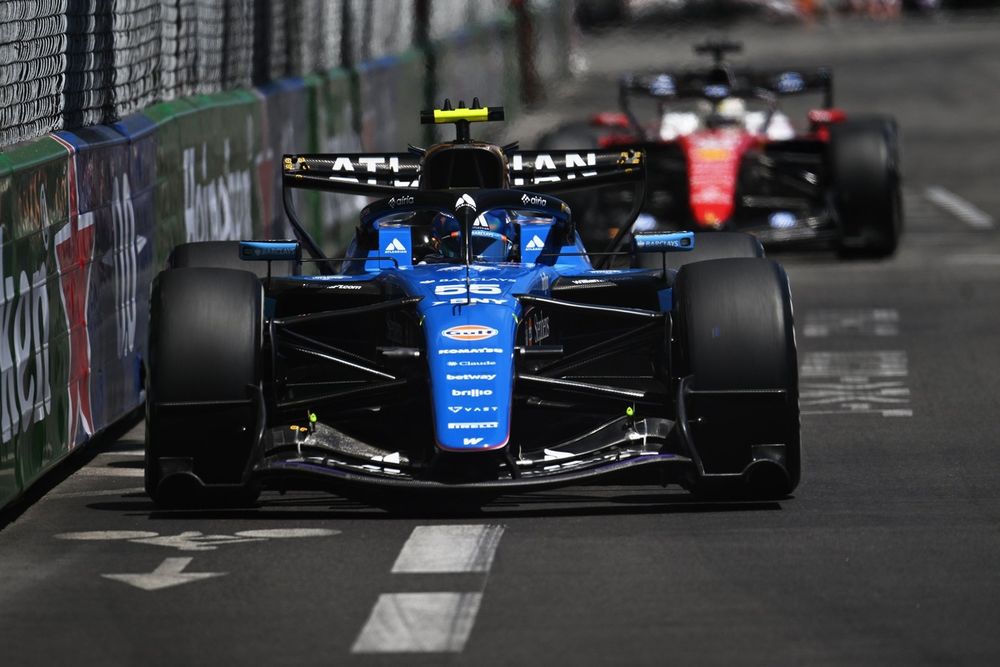
After Williams finished fifth in the Formula 1 constructors’ standings last season, team principal James Vowles described that position as a “new baseline” on the journey towards being a genuine world championship contender.
But now, less than halfway through the 2026 season, even maintaining that position seems a distant prospect since the team is currently languishing in eighth – and the gap to those ahead is increasing.
This situation is not going to change radically, according to Carlos Sainz. The FW48 car was finished late, arriving for pre-season testing greatly overweight, but Sainz believes its aerodynamic performance is lagging so much that it would be well behind the frontrunners even if it were running at the minimum weight limit (currently 768kg).
“I think if you get rid of the overweight, you put yourself in the fight for those points – but that’s not really enough,” Sainz said in his Spanish-language media session after the Barcelona-Catalunya Grand Prix, where he finished 12th, two places away from the points-paying positions and two laps down on the race winner.
“For me, being one second off… We were 1.8 seconds off in qualifying, 1.7s, 1.6s, 1.9s off [in the race] depending on the lap.
“The overweight might put you one second off the leaders, fighting with an Alpine. That’s not where we promised we’d be this year.
Carlos Sainz, Williams
Photo by: EYE4images / NurPhoto via Getty Images
“It’s not where we should be, considering all the wind-tunnel time we’ve had and all the development hours that have gone into this car. Being one second per lap off the front is obviously not good, so we’re a long way from where we need to be.”
That reference to wind-tunnel time relates to Formula 1’s Aerodynamic Testing Regulations (ATR), under which the amount of wind-tunnel runs and Computational Fluid Dynamics (CFD) items are restricted based on a team’s position in the constructors’ championship. The allocations are decided twice a year, in effect the middle and end of the season.
The purpose of the ATR is to promote more equal competition by limiting the development scope of the highest-performing teams while giving more opportunities for those lagging to catch up. Based on its fifth-place finish last year, Williams currently enjoys more development leeway than Mercedes, Ferrari, McLaren and Red Bull, but fewer resources than Racing Bulls, Haas, Audi, Aston Martin, Alpine and Cadillac.
Based on the current constructors’ championship positions, you could argue that the pecking order is a reasonable example of the ATR system’s effectiveness, given Alpine – which finished last in 2025 and therefore enjoys more development resource – now occupies fifth place. But this would be to ignore the other factors at play: Sainz’s contention is that Williams should be closer to the frontrunners than it is in terms of lap time.
The FW48’s weight situation is largely a consequence of the car failing a pre-season crash test, requiring certain elements to be strengthened. That weight is only coming off gradually, since for budget-cap reasons the team has decided to run as many components as possible to the end of their operating lifespan before replacing them with lighter ones.

Carlos Sainz, Williams
Photo by: Simon Galloway / LAT Images via Getty Images
But aerodynamic performance is also lagging, particularly in the kind of medium- and high-speed corners which predominate at tracks such as Barcelona. The FW48 simply lacks the efficient downforce necessary to be competitive.
In theory, downforce levels should be well below the previous generation of ground-effect cars because this was one of the purposes of the new regulations. That is true to an extent, but some are more down than others.
Indeed, both the FIA and F1’s tyre supplier, Pirelli, have confirmed that the majority of the teams have already exceeded pre-season predictions of where the downforce levels would be. You could, therefore, characterize the predicament of Williams as being not so much a step back but an insufficient step forwards – but in any case the outcome is the same.
“I think realistically speaking, we expected it to be hard,” said Sainz.
“Looking back at it, I think it’s been a bit more of a shock of how far we are in medium- and high-speed corners. Partly due to weight, but even more important, the downforce that we have in the cars.
“So, I think it’s been a massive – I won’t call it shock, but not even a wake-up call because we knew it, but a realization that we are very far from where we should be, where we targeted to be, or where we want to be.
“It’s time to go back to the drawing board and start bringing more things to the car, because clearly, in a medium-speed track, we are very far [away].”
We want your opinion!
What would you like to see on Motorsport.com?
– The Motorsport.com Team
Disclaimer : This story is auto aggregated by a computer programme and has not been created or edited by DOWNTHENEWS. Publisher: motorsport.com







