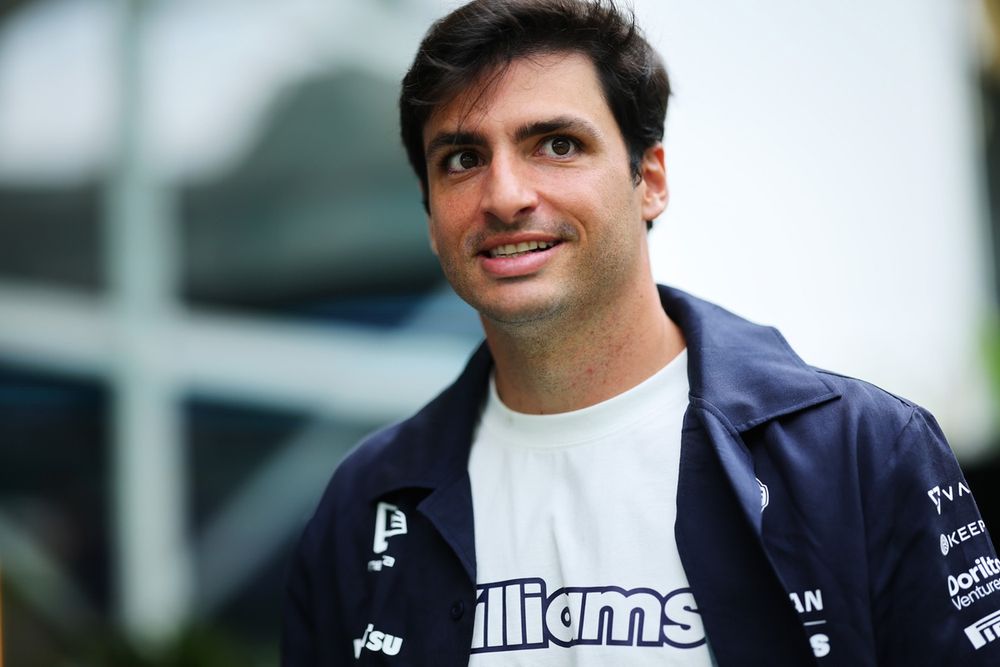
Williams Formula 1 driver and GPDA president Carlos Sainz says he hopes F1 management and governing body the FIA remain “tough” to push through power unit changes for 2027.
The sports’ stakeholders are currently discussing significant regulation tweaks for next season to further improve the new-for-2026 rules. On the table is a move to a roughly 60-40 split between combustion power and electric energy, which could be achieved by raising the fuel flow of the V6 engine and reducing the energy deployment limits, while also increasing battery capacity to avoid cars running out of electric energy so often around a lap.
Earlier this month, the FIA announced there is an “agreement in principle” on the broad strokes of the 2027 hardware changes, but there are still several ongoing debates around the finer details that teams will have to agree on.
Bigger fuel tanks or batteries may require a chassis redesign, while many teams had planned to carry over their 2026 chassis and allocate their cost-capped resources elsewhere. Teams will therefore have to agree on the extent and timing of a one-off cost cap allowance to help compensate for any unforeseen work, though the FIA could also unilaterally push through changes for the sake of improving safety.
At this stage, teams are already flat out working on the 2027 car project, so there is some urgency required in the decision, and Williams driver Sainz hopes series chiefs can remain “tough” on pressing through changes if the process threatens to be derailed by paddock politics.
Carlos Sainz, Williams
Photo by: Sam Bagnall / Sutton Images via Getty Images
“There’s a very interesting proposal for 2027, a proposal that I think goes exactly in line to where the sport I think should go,” Sainz said in the Canadian Grand Prix paddock. “Unfortunately, like always in this sport, there will be politics involved and different interests involved across the main manufacturers that will push back and push forward depending on what they’re looking for.
“That’s why I can just ask the FIA and FOM to be tough with what they believe is the right thing for the sport and even if you need to vote, that they can still stand firm and believe in what’s right for the sport.
“I think what we saw in Miami, even though it was a very small step forward, is still not exactly where F1 should be and there’s a very positive, interesting set of changes for 2027. If you would ask just the drivers, we would all be in their favour or pushing for that direction.”
Sainz’s Williams team-mate Alex Albon acknowledged that 2027’s changes will be “not enough” to give the drivers the flat-out spectacle they enjoy so much, but said it would be a reasonable stop-gap until the next regulations cycle, when F1 is expected to return to V8 hybrids with a smaller electrical component.
“For us drivers that will never be enough, I think we all love what we love,” Sainz added. “If there is electrical [energy], it should be an add-on rather than a dependency on electrical power like we have now.
“In the past we’ve had KERS, we’ve had the previous PU regulations in which the electrical [part] felt more like an add-on on top of what was already a solid PU.
“And I think for drivers, purists, we will always believe 60-40 probably is still not enough. But at least it’s something you can race with until real racing and real engines come back in 2030.
“The question is, do all the teams and all the engine suppliers agree to do it? I think everyone has an agenda, obviously. Are we prepared to do that step? Let’s see.”
We want your opinion!
What would you like to see on Motorsport.com?
– The Motorsport.com Team
Disclaimer : This story is auto aggregated by a computer programme and has not been created or edited by DOWNTHENEWS. Publisher: motorsport.com