
The only thing you can take to the bank for sure from Treasury’s latest attempt to predict the next four decades is that some of the forecasts will be dead wrong.
Treasury’s seventh intergenerational report is as much a political document as it’s a top-to-bottom analysis of the state of the economy.
But for a document that is supposed to look 40 years into the future, there is a notable focus on what Labor has done in its five years in office, and how the government’s most recent budget tackles issues like housing affordability, and how cuts to the NDIS will help mend the fiscal hole in the budget.
The 40-year challenges this report sets out are quite obviously framed around the solutions that the Albanese government is already rolling out and, in an amazing coincidence, those policy prescriptions are the right ones. It’s all a bit too neat.
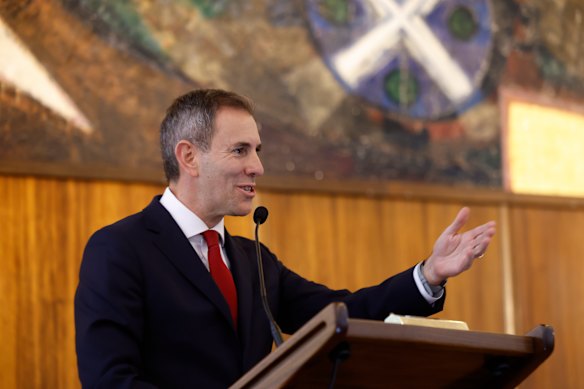
There are hints of more announceables to come. Chalmers, in a Q&A session after the release of the document, said that “our government and other governments of both political persuasions must cut income taxes further when the budget can afford it”.
The report has been carefully framed around what Chalmers believes are the five primary challenges and opportunities facing Australia.
For Chalmers, the quintet includes the rise of artificial intelligence, the clean energy transition, Australia’s ageing population, industrial transformation and geopolitical fragmentation.
The treasurer sees a world which is more dangerous, unpredictable, unequal and divided.
“If people are unmoored economically, generationally, they feel disconnected from, and disregarded in, our politics … it’s eroding trust in the institutions of our democracy. It’s exacerbating the strain felt by younger generations, in particular.”
But the one word that looms over this document more than any other, which calls into question some of the rosier forecasts, is productivity.
Debates about productivity send most people to sleep, but it is productivity growth that determines whether, over time, Australians grow richer and their businesses succeed, as the relative cost of producing goods and services declines.
And here’s the rub: this document projects productivity will remain at or near the 30-year average of 1.2 per cent rather than the 20-year average of 0.8 per cent, even though the Reserve Bank of Australia believes 0.8 per cent is more realistic.
A chart on page 195 of the report makes clear how big a difference that 0.4 per cent productivity change can be, over time.
Australia’s gross debt-to-GDP ratio will fall from about 35 per cent to 28 per cent between now and 2066 under the scenario in which Australia achieves 1.2 per cent productivity growth, and would mean that Australia’s gross debt to GDP ratio is relatively low.
But shaving 0.4 per cent off productivity growth, which is also modelled, would mean Australia’s gross debt to GDP ratio would nearly double to just about 60 per cent of GDP by 2066, a huge increase and a bigger problem as Australians grow older.
Increasing average productivity to 1.6 per cent would all but wipe out Australia’s gross debt. Those tiny increases or decreases in productivity are worth tens of billions of dollars and are the reason why productivity matters so much.
Much of the work of achieving that productivity growth of 1.2 per cent is expected to be done by the growth in the use of AI, but there is little detail of exactly how that will work (the document does acknowledge this).
The treasurer argued on Monday that Australia’s productivity estimates were lower than the UK and the US, but higher than New Zealand, “so we are broadly in the middle ranges of the productivity assumption”.
Labor deserves credit for taking tough decisions on housing tax breaks and the NDIS in the most recent budget, even if some economists believe the measures won’t solve the housing crisis.
We will know in the next couple of years if Labor’s tax changes fix some of Australia’s housing problems. We will also see if the Australian public believes them when they go to the polls.
But Chalmers and his colleagues will be long gone from the parliament by the time we find out whether AI makes a material difference to our incomes and quality of life.
Cut through the noise of federal politics with news, views and expert analysis. Subscribers can sign up to our weekly Inside Politics newsletter.
 James Massola is Chief Political Commentator. He has previously been National Affairs
Editor and South-East Asia Correspondent, and has won Quill and Kennedy awards and is the 2026 Press Gallery Journalist of the Year. Connect securely on Signal @jamesmassola.01Connect via X or email.
From our partners
Disclaimer : This story is auto aggregated by a computer programme and has not been created or edited by DOWNTHENEWS. Publisher: www.smh.com.au