Updated ,first published
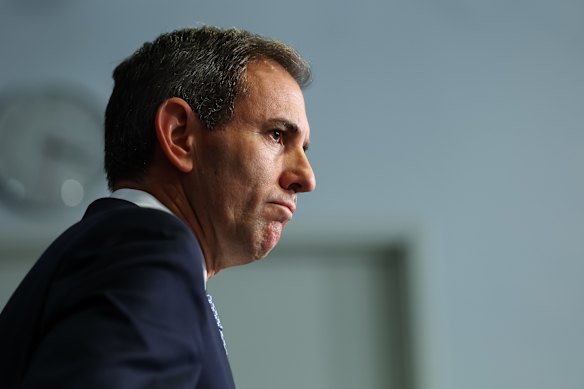
Treasurer Jim Chalmers has vowed to play a “helpful role” to bring down inflation with government spending cuts after the Reserve Bank pushed up interest rates to an 18-year high despite fears the move could push the economy into a recession.
In a sign of concerns about the fallout from its decision, the RBA’s monetary policy board split 6-3 to take the cash rate to 4.85 per cent on Tuesday, its fifth hike this year. On a 30-year $600,000 mortgage, the increase will add almost $100 to monthly repayments.
Declaring that the economy was not yet “cracking”, bank governor Michele Bullock said even though the country was not in a recession it would feel that way to many as they dealt with falling real wages, higher inflation and higher interest rates on their mortgages.
“It is going to make people feel like it’s a recession because they feel poorer. Their spending can’t grow very quickly because their incomes aren’t growing very quickly,” she said. “This is a manifestation of the lack of productivity growth and the fact that we’ve had this massive supply shock imposed upon us and we’re all poorer.”
Financial markets believe the bank is now finished with rate rises, with expectations the RBA will be cutting rates early in 2028.
Crucially, the bank dropped the line that it will “increase the cash rate target further if needed” from its statement: a sentence that has appeared in statements accompanying several of its previous decisions.
The government’s expenditure review committee met earlier this week as it nails down expected spending cuts to be contained in the mid-year budget update due in early December.
Treasurer Jim Chalmers said the government’s budgets were not a primary contributor to inflation but that it took responsibility for the fight against higher inflation.
“We can play a helpful role and that’s what we intend to do,” he said. “That’s why we’ve had savings in all of our budget updates, and that’s why there will be more savings in the mid-year budget update that I release in just over a month’s time.”
Opposition Leader Angus Taylor accused the government of having a “spending addiction”, describing the rate rise as a “homegrown” issue.
“The RBA has made the point that public spending is growing faster than the overall economy,” Taylor said. “It’s pretty simple: if you’ve got public spending growing faster than the economy, you’re stoking inflation. That’s the reality.”
Updating its key economic forecasts, the bank revealed it now expects public demand – which includes federal and state government spending – to grow 2.1 per cent this year. In August, it had expected 3.2 per cent growth.
But some of that slowdown is likely due to spending being pushed into 2027. In the 12 months to June next year, public demand is expected to grow by 3.8 per cent after previously being forecast to grow by 3.1 per cent.
In its latest forecasts, the bank revealed it did not expect trimmed mean inflation – the bank’s preferred gauge of price pressures – to reach the middle of its 2 to 3 per cent target until June 2028, and that headline inflation would peak at 4.5 per cent by Christmas before beginning to fall.
The Middle East conflict and AI boom have intensified the fight to slow price growth.
A key issue fuelling higher inflation is the price of oil. In August, the RBA expected Brent to be down around $US76 a barrel. Today, it is $US104 a barrel and has averaged above $US110 for the past two months. The bank’s forecasts still expect oil to cost around $US80 a barrel by the end of 2028.
Another factor is the AI construction boom. Business investment, largely in data centres and computer servers, is expected to grow by 12 per cent this year. In August, it had expected investment to grow by 4.3 per cent.
AI and computer component companies around the world are pushing through large price rises which are then showing up in higher inflation figures. The bank warned that the AI construction boom could hurt the home construction sector.
“The ramp-up of investment in data centres may also contribute to capacity and pricing pressures domestically, particularly by drawing on resources in the construction industry,” the bank said. “AI-related investment is driving rapid growth in prices for technology-related goods, and inflation in many goods and services remains high.”
The bank also said there had been a sharper downturn in the housing market than it had been anticipating, partly driven by government tax changes brought in earlier this year.
Bullock noted that the upside risks to inflation that had forced the bank to lift rates earlier this year, such as the surge in oil prices, were now beginning to “centralise”.
The bank noted that a combination of higher interest rates, higher inflation and the fall in property prices could hit domestic economic activity harder than expected. It estimates that if consumers start pulling back on discretionary spending faster than forecast, the overall economy could be a full percentage point – or about $28 billion – smaller by the end of 2028 than anticipated.
If that were to occur, unemployment would likely approach 5.5 per cent, a full half percentage point higher than the RBA is forecasting.
The head of Australian economics for the Commonwealth Bank, Belinda Allen, expects the RBA to start cutting rates from the second half of next year. But she said the Reserve would be wary at moving too quickly.
“Overall though we think the RBA will remain on edge as we enter 2027 but keep rates on hold,” she said.
NAB chief economist Sally Auld said with interest rates at their current level they should slow the economy and bring inflation down.
 Shane Wright is a senior economics correspondent for The Sydney Morning Herald and The Age.Connect via X or email.
 Millie Muroi is the economics writer at The Sydney Morning Herald and The Age covering workplace and economics. She was formerly an economics correspondent based in Canberra’s Press Gallery and the banking writer based in Sydney. Instagram/TikTok: @millie.muroiConnect via X or email.
From our partners
Disclaimer : This story is auto aggregated by a computer programme and has not been created or edited by DOWNTHENEWS. Publisher: www.smh.com.au