Updated ,first published
Treasurer Jim Chalmers hopes scrapping expansive ministerial powers to administer Labor’s capital gains tax changes will unlock Greens support for the contentious reforms, as the government moves to quell anger among start-ups and small businesses with $475 million worth of concessions.
The government’s overhaul of its signature policies announced in the May budget, including expanded exemptions for small businesses with a turnover of up to $10 million, follows a sustained attack on the measures and a surge in support for Pauline Hanson’s One Nation.
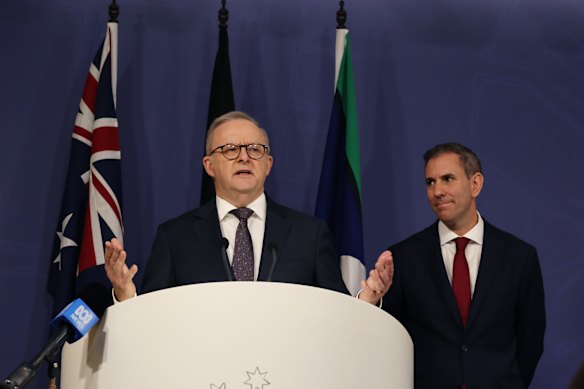
Prime Minister Anthony Albanese said the “generous” changes to capital gains tax concessions would help small businesses stay afloat, describing them as the “blood running through the veins of our local communities”.
“Today, we’re announcing that we’ll increase the existing small business 50 per cent active asset CGT concession from $2 million to $10 million,” he said, revealing that an estimated 2.7 million businesses could continue to claim the 50 per cent discount on capital gains introduced by former prime minister John Howard in September 1999.
Albanese said the government would also propose a “new innovative business tax concession” for start-ups, as first flagged in this masthead.
The Tech Council of Australia welcomed the proposals for start-ups, saying: “This is a constructive response that shows the government has listened to their concerns…To grow more innovative companies here, productive risk taking must be rewarded.”
Chalmers has also wound back ministerial discretion provisions that have given the treasurer of the day the ability to determine which asset classes would be affected by the CGT changes, as well as the definition of new home builds central to the negative gearing changes.
Chalmers argued that such ministerial discretion was standard practice, but said the powers would be scrapped “to provide more clarity and more certainty to people who are interacting with the system”.
Greens senator Nick McKim had warned the government’s legislation could allow future treasurers to “fundamentally alter” the laws once they are in place, as he questioned whether Chalmers would have the theoretical power to exempt property owners in his electorate from the changes.
McKim also questioned whether Labor was worried that “future treasurers who might be from the Liberal Party or, horrifically, a One Nation treasurer, might use these powers to walk back some or all of your capital gains tax reforms”.
The Greens have long argued for changes to negative gearing and capital gains tax rules to make it easier for first homeowners to enter the property market.
Albanese indicated he expected the Senate to pass the reforms, saying: “We have had consultation across the Senate.”
Defending the fundamental premise of the changes, Albanese said: “What we’re doing is making sure that the tax system is fairer, that it treats income from assets more equally with income from work, which is overwhelmingly how working Australians earn their income and get by.”
Opposition Leader Angus Taylor said the backdowns showed the government had fundamentally mishandled its May budget.
“This budget is in chaos. The government simply got it wrong from the start,” Taylor said. “No point going on with these carve-outs. Scrap it. Scrap the bill, start the budget again because they simply got it wrong.”
The government will also exempt all discretionary testamentary trusts from its plan to impose a 30 per cent minimum tax after the opposition weaponised the move as a “death tax”.
Chalmers denied there had ever been death taxes in the budget.
“Look, there are absolutely no inheritance taxes or taxes on inherited assets in the budget. That was clear already, but we’re making it even clearer,” he said.
“We’re putting that matter beyond any doubt, so that all types of discretionary testamentary trusts continue to be exempt from the minimum, subject to some integrity measures that we will consult on.”
There are approximately 10,500 discretionary testamentary trusts active in Australia. They only come into effect after someone has passed away, and allow asset holders to decide how the income from those assets is distributed after they die.
Only new discretionary testamentary trusts created after budget night would have been hit with the tax, and fixed trusts would have been exempt.
Council of Small Business Organisations Australia chief executive Skye Cappuccio said the changes would especially benefit family-owned business, manufacturers, retailers and trades businesses.
But she said it only addressed one of the four existing capital gains tax exemptions for small businesses.
“This is an important and welcome step in the right direction, but it does not go far enough,” Cappuccio said.
National Farmers Federation President Hamish McIntyre hailed the changes to trust taxation as “a meaningful result for farmers”.
Labor’s initial proposal included removing the existing 50 per cent capital gains discount and replacing it with inflation indexation of the cost base, as well as a minimum 30 per cent tax.
Indexing the cost base to inflation means investors will only be taxed on the real gain in the value of the asset they sell.
But this method has alarmed many startups and small businesses, which tend to start with a negligible cost base and therefore would receive next to no discount under the proposed change.
That raises the maximum effective capital gains tax rate from 23.5 per cent to nearly 47 per cent, assuming asset holders earn more than $190,000 in the year they realise their gain.
A snap two-day parliamentary inquiry into the legislation heard some of Australia’s most successful companies would not have survived without the 50 per cent discount.
Albanese has refused to say whether alterations to the government’s tax changes announced today were made to curb backlash targeted at Labor.
Asked directly whether the motivation for the changes was to “quell the backlash”, Albanese said: “Our ranks are very supportive of this reform”.
He said the new exemptions would cost the budget $475 million, based on indicative costings, but noted the three tax reforms were expected to raise about $8.1 billion over the forward estimates.
Cut through the noise of federal politics with news, views and expert analysis. Subscribers can sign up to our weekly Inside Politics newsletter.
 Matthew Knott is the foreign affairs and national security correspondent for The Sydney Morning Herald and The Age.Connect via X, Facebook or email.
 Nick Newling is a federal politics reporter for The Sydney Morning Herald and The Age.Connect via X or email.
 Max Maddison is a state political reporter at The Sydney Morning Herald.
From our partners
Disclaimer : This story is auto aggregated by a computer programme and has not been created or edited by DOWNTHENEWS. Publisher: www.smh.com.au