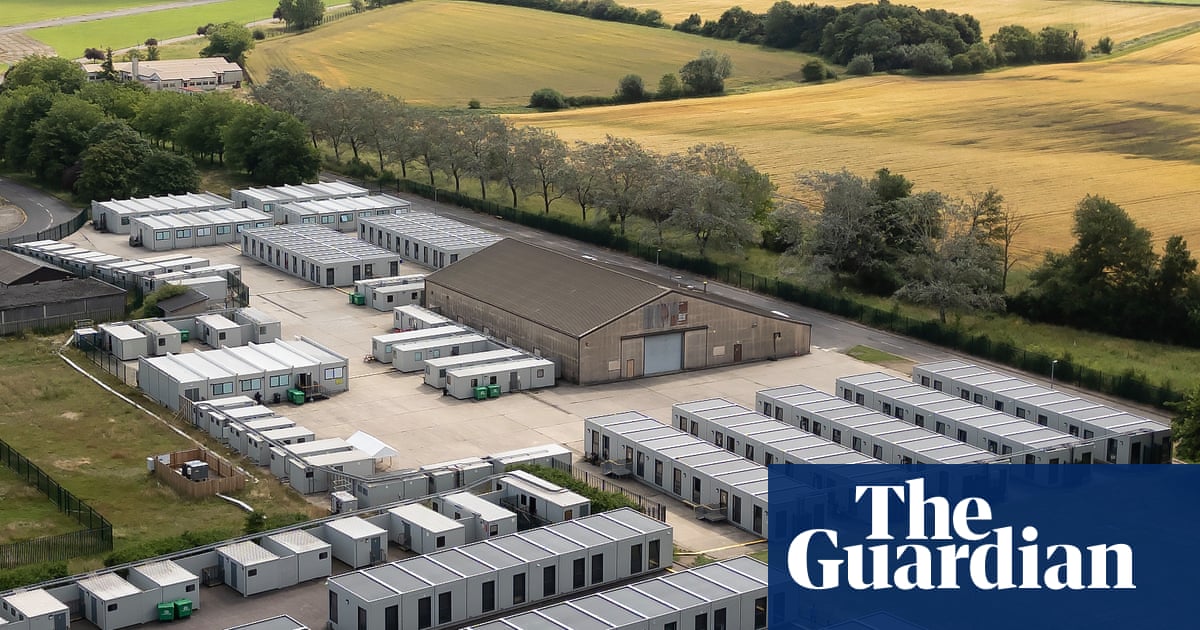
Home Office plans to use three more former military sites to house thousands of asylum seekers have been condemned as “arrogant”, “costly” and “a political fix” by refugee charities and local stakeholders.
Planning permission is being sought to build “basic” accommodation at MOD Bicester in Oxfordshire, RAF Barnham in Suffolk and RAF Linton-on-Ouse in North Yorkshire, a statement said. These new sites could house 3,750 claimants, the government has claimed.
Ministers hope to extend the use of other ex-military sites already housing claimants, including Crowborough in East Sussex until 2030 and Wethersfield in Essex beyond 2027, a statement said. Capacity at Wethersfield is to be increased by 400 to 1,200 men, the Home Office said.
The move has been condemned for costing more than placing claimants in hotels and repeating the mistakes of the last government, which faced legal challenges over the use of barracks to house asylum seekers.
Imran Hussain, director of external affairs at the Refugee Council, said: “As the government’s own spending watchdog has said, barracks actually cost more money overall than hotels. We know from experience they also isolate people from local communities and essential services, as they are often miles away from the nearest towns, so people who have fled war and persecution cannot find any security or stability while they apply for asylum,” he said.
Politicians in Bicester have questioned why the government would want to build asylum accommodation there, given that the last attempt to do so in 2001 was halted by protests, planning delays and excessive costs.
Calum Miller, the Lib Dem MP for Bicester and Woodstock, said the latest Home Office proposal “looked like a political fix” and would not work.
“Ministers say they are closing asylum hotels, but they appear to be replacing one costly and unsuitable model with another, without giving local communities the answers they deserve,” he said.
Nicola David, a member of the Linton-on-Ouse Action Group, which fought plans to accommodate asylum seekers on the base when the previous government proposed this in 2022, said the announcement was “a real gut punch”.
“We fought hard against these proposals – and we won, proving that this was the ‘wrong plan, wrong place’.
“It’s still wrong. There’s nothing good about warehousing a large number of asylum seekers in a tiny remote village,” she said.
Kim Bailey, of Crowborough Shield CIC, which has mounted a legal challenge against the Home Office’s use of Crowborough to accommodate asylum seekers, said: “The government continues to advance the argument that large-scale asylum accommodation sites represent better value for money. However, the available figures tell a different story. Military-style accommodation sites cost more than hotels.”
Wethersfield residents Nick and Mair Godley said: “We are very disappointed to learn that, in spite of assurances given by this government when in opposition and by the previous government that the use of Wethersfield would be temporary, they now seem to be seeking an indefinite extension of both time and numbers.
“This is presented as a done deal with no consultation with the local community … It’s a blatant display of Home Office arrogance.”
The number of asylum seekers being housed temporarily in UK hotels has fallen to its lowest level since data was first reported in 2022, according to Home Office figures published last month.
There were 20,885 people staying in such accommodation while they were awaiting a decision on their asylum claims at the end of March, down 35% year-on-year from 32,326.
The total had climbed as high as 56,018 at the end of September 2023.
The total number of arrivals by small boat in 2026 now stands at 11,267, according to provisional figures from the Home Office – down 39% on the equivalent point last year.
The Home Office said it had closed 20 more asylum hotels, including the Bell hotel in Epping, Essex. Demonstrations outside the hotel became violent last summer after one of its residents was charged and subsequently convicted of sexually assaulting a child.
The announcement comes after Keir Starmer, the outgoing prime minister, said on Thursday afternoon that a fall in the number of migrants crossing the Channel has allowed the government to close more asylum hotels.
“On the crossings across the Channel, which so many people are concerned about, understandably, we’ve brought those numbers down.
“So the steps we’ve taken are beginning to pay off, and at the same time, asylum hotels are closing.
“The last two are linked because with less people crossing the channel, there are less people who need to be housed,” he said.
Disclaimer : This story is auto aggregated by a computer programme and has not been created or edited by DOWNTHENEWS. Publisher: theguardian.com