Opinion

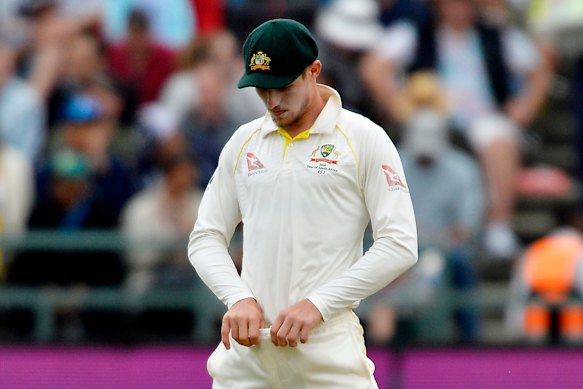
It was always going to be the cover-up that got them. Not the Sandpaper, but the Gate.
For anyone who still thinks the scandal engulfing Australian cricket is, or ever was, about cheating with sandpaper, consider the current state of play. The man who did use the sandpaper, the cheat, Cameron Bancroft, has emerged as the hero of the tale, for finally producing 4000 words of detail on what actually happened in South Africa in 2018. The captain who turned a blind eye, Steve Smith, has, through his silence and acceptance of punishment on behalf of his team, also enhanced his reputation. Usman Khawaja, who knew about the plot and said nothing for eight years, can feel vindicated by the unravelling that has followed his revelations. Even David Warner, the villain of the piece from every possible angle including his own, has now made an artful dodge for the right side of history.
But the perpetrators – Bancroft, Smith, Warner – paid their penalties. The drama has now entered the overdue phase of uncovering the lies that hid the involvement of others. What is at stake isn’t whether Australia cheated. It’s whether Australia is capable of telling the truth.
On Wednesday, Bancroft became the John Dean of Sandpapergate, the unshielded insider who couldn’t bear the lies anymore, who had nothing left to lose. Among the many stunning details in his confession, the most significant is his apology for lying and participating in the cover-up. His motivation for lying was the same as his motivation for cheating: he wanted to fit into the Australian team. Think about that for a moment. Cheating, and then lying about the cheating, were how a young man sought to find his place in the Australian men’s Test cricket team. After sessions when he illegally tampered with the ball in South Africa, Bancroft says he was applauded by his teammates. What a bunch.
Just as Richard Nixon wasn’t brought down by the break-in to the Watergate building, the leadership of Australian cricket won’t be brought down by a breach of the laws of a game. It will be brought down by its resistance to transparency, its self-serving “crisis management”, its breach of trust with the public that continues to this week. James Sutherland and David Peever, the CEO and chairman who led the cover-up, left Cricket Australia after the initial phase of the scandal.
Iain Roy, who led the rushed inquiry, was dispatched with a non-disclosure agreement. Several CEOs and chairs later, Todd Greenberg and David Boon stood up on Wednesday proposing a voluntary “forum” to which nobody would be compelled and everything they said would be confidential. The individuals have changed, but the basic impulse – keep the details secret, seal the crisis in a bottle, put it all behind us – repeats the very process that keeps Cricket Australia mired in this mess.
Does any of this really matter? Of course not. A mere game weighs less than a speck of dust on the scale of challenges facing the world. But maybe the stress of those challenges finds an outlet in the meltdown over Australian cricket.
Like it or not, for 150 years, the Australian men’s cricket team has given the nation a language through which to express its sense of self. Pluckily, in its early years it stood up to English arrogance and economic power. “Australia” was a national symbol on the cricket field for decades before we were even federated. In Bodyline, the victimised Australian cricket team was the side that embodied the spirit of fair play. Through the 1970s, the effervescence of the Australian cricket team helped carry the entire nation out of black and white into living colour. The achievements of this team, in a de facto national sport, gave Australia its outsized self-esteem as a small country that punched above its weight.
Being a manufactured process, myth-making always contained an element of cover-up. Cricket is an individual game in a team context, subject to individual frailties. All the mythified phases of Australian cricket had their underbelly of betrayal, double-dealing, self-seeking and hypocrisy. Elevated to the status of a unifying secular religion, Australian cricket’s dark secret was that it was only ever human. Whether bowling underarm, betting on their opponents, taking money from bookmakers, threatening broken arms or just cheating on their wives, our heroes gave us regular reminders that they had feet of clay. This was, in its way, healthy. Periodic outbreaks of truth saved most Australians from investing too much belief in what is only a game.
In four months, Australia will host England in Melbourne for a match to celebrate the 150th anniversary of Test cricket. If it were scheduled this week, Australia might be too embarrassed to turn up.
What can Cricket Australia do, in the next four months, to make the game fit for an anniversary? Patrick Cummins, the captain, must answer Bancroft’s specific allegations or, if he can’t do so, stand aside. Last week, Cummins criticised the non-specificity of Khawaja’s language, but Bancroft’s version has taken the discussion beyond that point. Cummins’s explanations, which appeared candid, detailed and honest to many of us, have now drifted towards the machinery of concealment. So too the denials of the other bowlers who played in South Africa. So do the woolly statements by the then coach Darren Lehmann and the absence of Tim Paine, who took over the captaincy from the disgraced Smith. Khawaja said “everyone knew”, but left many gaps; Bancroft’s statement has fleshed out some, but far from all, of those gaps. The bleeding won’t stop until enough of those gaps are honestly filled.
It’s too late for Cricket Australia to bury this. Its options are all unpalatable. But the credibility of a behind-closed-doors “safe space” was, three hours after its announcement on Wednesday, made redundant by Bancroft.
It’s hard to imagine the reputation of Australian cricket being lower than it is now. Maybe that’s what Cricket Australia doesn’t quite grasp. To use the phrasing of the whistleblowers Khawaja and Bancroft, everyone now thinks everyone knew. Cricket has bottomed out and has nothing left to lose. Here’s a radical suggestion to rebuild public trust. It’s an approach that only a very few powerful people in Australian cricket have attempted in the past 150 years. But ultimately, it’s the only option that has ever worked. Just start telling us the fricking truth.
Malcolm Knox is a journalist, author and columnist for The Sydney Morning Herald. His latest book is The Long Game: The Matches that Defined 150 Years of Australian Cricket.
Get a weekly wrap of views that will challenge, champion and inform your own. Sign up for our Opinion newsletter.
 Malcolm Knox is a journalist, author and columnist for The Sydney Morning Herald.
From our partners
Disclaimer : This story is auto aggregated by a computer programme and has not been created or edited by DOWNTHENEWS. Publisher: www.smh.com.au