
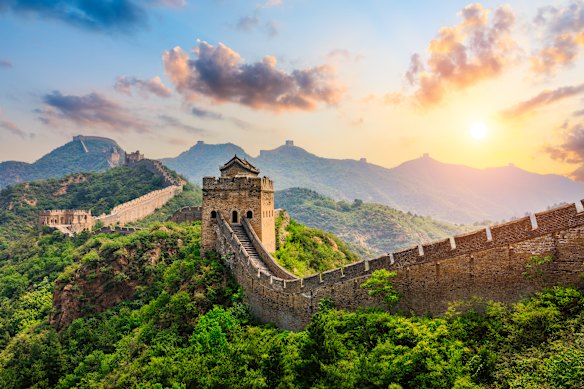

China is now the fifth most-visited nation by Australian travellers. But will it rise even higher?
If one Australian travel company’s experience is any measure, it may.
“We’re seeing a strong rebound in bookings to China, with bookings up 90 per cent year on year,” says Simon Bell, managing director of Wendy Wu Tours Australia.
That’s backed up by Australian Bureau of Statistics data that show Australian residents visiting China continuing to surge post-COVID, rising by almost 100,000, or about 16 per cent, to more than 700,000 over the past 12 months compared to the previous year.
Easier access has played a central role. The introduction of 30-day, visa-free travel for Australians has removed one of the biggest historical barriers, while a steady restoration of flights has made the country more accessible than it’s been in years.
Sign up for the Traveller newsletter
The latest travel news, tips and inspiration delivered to your inbox. Sign up now.
But the story is not just about volume. It is also about how Australians are choosing to travel.
“Air access has also improved significantly … making travel easier than ever,” says Bell. “There’s also a growing sense of curiosity. China is advancing at an extraordinary pace, and many Australians are eager to experience its rapidly evolving cities firsthand.”
For many first-time visitors, the classic itinerary still provides the foundation: Beijing, Shanghai and the country’s major landmarks remain central to how China is introduced. But that is also being layered with new approaches.
“We’re seeing a clear shift in traveller mindset,” Bell says. “Australians are increasingly looking to go beyond the surface … there’s a growing appreciation that a trip to China is about more than ticking off sights; it’s about deeper, more meaningful travel experiences.”
That means not just new destinations, but also new ways to make the most of them.
“Travellers are increasingly drawn to China’s hidden gems,” Bell says. “Exploring the distinct character of different regions … with a stronger appetite for more immersive journeys with firsthand experiences alongside classic touring.”
The return of Design Hotels to mainland China offers a similar story. The Berlin-based Marriott-affiliated group, known for its independent, design-led properties, re-entered the market in 2025 after stepping away during the pandemic. Speaking to Monocle, managing director Stijn Oyen pointed to “an extremely healthy pipeline of stunning projects” and described a new wave of hotels that reflect a more creative direction in Chinese hospitality shaped by design, landscape and a strong sense of place.
Aman Resorts’ latest China program tells a similar story. Across its three mainland properties – in Shanghai, Hangzhou and Lijiang – the luxury group has built a spring offering around seasonality, culture and immersion in the landscape rather than traditional sightseeing.
For instance, at Amanyangyun, on the outskirts of Shanghai, the setting is a world away from the city’s usual pace: a forest of 1000-year-old camphor trees surrounding restored Ming and Qing dynasty houses that have been relocated and rebuilt to form a tranquil, village-like retreat. This season, guests can take part in a floral boat afternoon tea, drifting across a lake in a wooden vessel adorned with seasonal blooms.
Near Hangzhou, Amanfayun places travellers within the Longjing tea terraces at the height of the spring harvest, where experiences centre on tea picking, spa rituals and seasonal menus.
In Lijiang, Amandayan offers a highland retreat overlooking the UNESCO-listed old town, with Jade Dragon Snow Mountain rising in the distance, where wellness treatments and dining draw directly on the surrounding environment.
Bell also points to growing interest in destinations such as Zhangjiajie and Jiuzhaigou, known for their dramatic landscapes, as well as routes along the Silk Road and cities like Chongqing that showcase the country’s blend of ancient culture and future ambitions.
As for who’s going from Australia: “It’s a combination of first-time visitors and repeat travellers,” he says. “For many, the highlights are just the beginning. We’re seeing more people returning to explore beyond the major landmarks … seeking experiences that feel more immersive, personal and beyond the typical tourist trail.”
 Julietta Jameson is a freelance travel writer who would rather be in Rome, but her hometown Melbourne is a happy compromise.Connect via email.
From our partners
Disclaimer : This story is auto aggregated by a computer programme and has not been created or edited by DOWNTHENEWS. Publisher: www.smh.com.au


