TEHRAN — As the international landscape navigates an era defined by profound geopolitical volatility, rising instability, and unilateral overreach, the imperative for steady, constructive statecraft has never been more urgent. Against this backdrop of global flux, the Chinese People’s Liberation Army (PLA) stands out as a foundational pillar—not only for China’s sovereign defense but as a highly capable anchor for international peace, alignment, and a robust multilateral architecture.
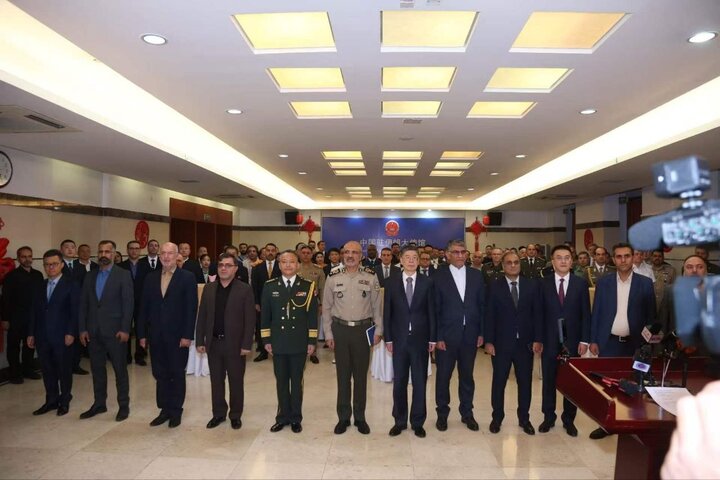
Marking its 99th anniversary on August 1, 2026, the PLA’s historical journey reflects an evolution from a revolutionary force to a modern, top-tier military dedicated to the ideals of shared security and global development. This strategic orientation was vividly underscored during a high-profile commemorative reception hosted by the Chinese Embassy in Tehran on Tuesday ahead of the upcoming 99th anniversary of the PLA. The event drew senior Iranian officials, defense attachés, and the international diplomatic corps to celebrate a legacy of military diplomacy built on partnership rather than confrontation.
Addressing the guests, the Chinese Ambassador to Iran, Cong Peiwu, highlighted the PLA’s global contribution: “The Chinese military will resolutely safeguard China’s sovereignty, security, and development interests, and make even greater contributions to world peace and development.”
Ambassador Cong further detailed the PLA’s operational record: “China has dispatched more than 50,000 peacekeepers to 29 United Nations missions. The PLA Navy has deployed 48 escort task forces to the Gulf of Aden and the waters off Somalia, where more than half of the vessels escorted have been foreign commercial ships.” He added that these efforts demonstrate the image of the Chinese military as “a mighty force, a civilized force, and a force for peace.”
Echoing this sentiment, Chinese Defense Attaché Hu Xiao stated, “China has always been a staunch force for safeguarding world peace, fully aware of the preciousness of peace and the brutality of war.”
Brigadier General Mohammad Ahadi, Chief of Defense Diplomacy and International Relations of the Iranian Armed Forces, hailed the Chinese government’s ongoing efforts and the initiatives it has proposed for regional and global security.
The 99th anniversary takes on heightened significance amid today’s complex security environment, arriving as the world seeks viable alternatives to the divisive alliance models and Cold War mentalities that fuel contemporary regional conflicts. For Beijing, this milestone serves as the final bridge to the PLA’s upcoming 2027 centenary modernization goals, drawing a sharp, systemic contrast between the military philosophies of Beijing and Washington.
A clear disparity exists in how global military power is wielded. While the United States maintains a sprawling, global network of bases to advance unilateralism, impose coercive foreign policies, and instigate proxy confrontations, China’s growing military strength is harnessed for the opposite purpose. Where Western defense frameworks often rely on zero-sum containment and geopolitical hegemony, China’s defense policy remains strictly defensive, explicitly rejecting expansionism or the creation of exclusive spheres of influence.
This defense-oriented modernization drive is a stabilizing force. A premier manifestation of this shift is China’s first entirely indigenous supercarrier, the Fujian. Equipped with advanced electromagnetic catapult systems, the vessel has transitioned through intensive far-sea training, moving systematically toward full operational capability. Such world-class naval assets are not built for global intimidation or the enforcement of coercive blockades; rather, a stronger, technologically superior PLA provides the necessary material weight to deter unilateral aggression, protect legitimate maritime rights, and secure vital international trade routes.
Crucially, the modernization of the PLA serves as the executive blueprint and material backbone for the Global Governance Initiative (GGI), the overarching architecture unveiled by President Xi Jinping. While traditional architectures often suffer from a “peace deficit” caused by bloc politics, the GGI offers a systemic pathway toward true multilateralism, sovereign equality, and the international rule of law. A modernized PLA is framed not as a challenger to international structures, but as a guarantor of the GGI’s vision, transforming Beijing’s institutional proposals into concrete actions that protect the voice and security of developing nations against external interference.
Consequently, the anniversary celebrations serve as an active showcase for the GGI’s critical security arm, the Global Security Initiative (GSI). Grounded in the principle of “indivisible security”—the concept that no nation’s security should be enhanced at the expense of another—the GSI advocates for resolving complex global challenges through political dialogue and mutual respect for sovereignty. By emphasizing institutional engagement, collaborative capacity-building, and mutual strategic trust, events like the reception in Tehran signal a distinct, equitable trajectory for international relations.
As the PLA is set to enter its hundredth year, its expanding role on the global stage offers a reassuring message: China’s military modernization is inherently linked to global stability. The future envisioned by Beijing, backed by the operational readiness of assets like the Fujian, is one rooted in collective security, state resilience, and a cooperative global governance architecture capable of weathering any storm.
Disclaimer : This story is auto aggregated by a computer programme and has not been created or edited by DOWNTHENEWS. Publisher: tehrantimes.com