In the race against China for AI supremacy, the United States dominates when it comes to access to the most cutting-edge semiconductors.
But when it comes to powering the huge data centres that run on AI chips, China holds the clear advantage.
Recommended Stories
list of 4 itemsend of list
That’s because data centres, the sprawling computing facilities needed to train and run AI models, require vast amounts of energy.
A typical data centre can consume as much electricity as 100,000 households, while next-generation “hyperscale” facilities can gobble up as much power as two million homes, according to the International Energy Agency (IEA).
China’s access to an abundant supply of cheap electricity places it in the ideal position to meet such colossal energy demands.
China already generates more than twice as much electricity as the US, a lead that is expected to widen amid an aggressive state-led investment in the country’s energy grid.
BloombergNEF, a research provider, estimates that China will add more than six times as much electricity generation capacity as the US over the next five years.
Much of that extra capacity will be in the form of renewables such as solar and wind.
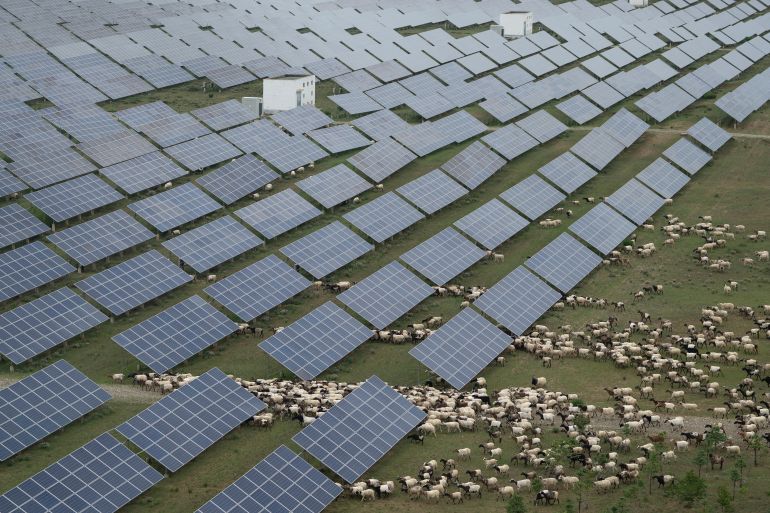
In 2025 alone, China increased its wind and solar power capacity by more than 430 gigawatts, accounting for more than half of the additional capacity in the renewables added globally that year.
A key element of China’s AI strategy involves integrating its data centres into its rapidly expanding renewables sector.
Advertisement
Under the “East Data, West Computing” initiative, China’s government is concentrating the construction of new data centres in the country’s sparsely populated interior, where land and renewable energy sources are abundant compared with the heavily built-up eastern seaboard.
Earlier this month, Beijing announced the start of operations at the country’s first “large-scale” renewable energy project to be linked directly to a data centre.
The 500-megawatt wind and solar project, located in the northwestern Ningxia region, will power a cloud data centre operated by China Datang through a “dedicated transmission line”, China’s management body for state-owned enterprises said in a statement on May 12.
“In the long run, the country that can provide cheap, stable, low-carbon electricity will have a major advantage in AI infrastructure,” Qiyang Xiong, a PhD candidate at Renmin University of China who specialises in AI and energy policy, told Al Jazeera.
“China is a global leader in solar, wind and ultra-high-voltage transmission,” Xiong said.
“This gives it an advantage in supplying western data centre clusters with large volumes of relatively cheap, clean electricity.”
Narrowing the gap
For now, the US still has the largest data centre footprint by a wide margin.
According to Stanford University’s AI Index, the US had an estimated 5,427 data centres in 2025, compared with 449 in China.
The US accounted for 45 percent of the 415 terawatt-hours of electricity consumed by data centres in 2024, followed by China and Europe with 25 percent and 15 percent, respectively, according to the IEA.
In 2026 alone, Silicon Valley’s Amazon, Microsoft, Meta and Alphabet are projected by Morgan Stanley to spend $630bn on data centres and other AI-related investment, vastly more than Chinese tech giants such as Alibaba, Tencent and ByteDance.
But as China constructs data centres at a blistering pace – its number of data centre racks grew 30 percent annually from 2016 to 2023, according to the China Academy of Information and Communications Technology – the gap between the superpowers is rapidly narrowing.
Facing US export controls on top-end Nvidia chips manufactured by the Taiwan Semiconductor Manufacturing Company (TSMC), China has increasingly turned to partly state-owned Semiconductor Manufacturing International Corporation (SMIC) to supply chips designed by local tech firms such as Huawei.
By 2030, China’s data centre capacity is expected to reach 60 gigawatts, nearly double its current level, according to an analysis by Rystad Energy, taking up 2.3 percent of the country’s total electricity demand.

“China’s large manufacturing base and less stringent regulatory environment mean that the construction of data centres and supporting energy infrastructure can happen far more rapidly than in the US,” Leah Fahy, senior economist for China at Capital Economics, told Al Jazeera.
Advertisement
“Modular Huawei data centres can now be constructed in six months, while equivalents in the US take at least a year,” Fahy said.
Power grids under strain
Meanwhile, there are already signs that the AI rollout in the US is bumping up against power constraints.
Energy consultancy Wood Mackenzie said earlier this year that the limitations of the US energy grid had resulted in a 50 percent quarter on quarter drop in new data centre projects at the end of 2025.
Technical limitations have been compounded by a growing backlash against data centres within communities across the US – driven partly by the strain the facilities place on local grids – a challenge not faced by China, where opposition to the government is heavily restricted.
At least 36 data centres were blocked or stalled in the US between May 2024 and June 2025, according to Data Center Watch, a research project by AI security company 10a Labs.
US tech leaders, including Tesla’s Elon Musk, Nvidia’s Jensen Huang and OpenAI’s Sam Altman, have openly acknowledged China’s edge in the energy domain.
“The limiting factor for AI deployment is fundamentally electrical power,” Musk said in an interview at the World Economic Forum in January.
“Very soon, maybe even later this year, we’ll be producing more chips than we can turn on – except for China. China’s growth in electricity is tremendous.”

Advancing AI is now an “electricity problem as much as a chip problem”, said Howard Yu, director of the Center for Future Readiness at IMD Business School in Lausanne, Switzerland.
“The winners of this cycle will own the silicon, the power contracts, and the cooling water, in that order, and China has built its strategy around the input it controls,” Yu told Al Jazeera.
China’s energy advantage is not without its own limitations.
Despite Beijing’s push to meld its AI ambitions with the wind and solar resources of its remote western regions, most data centres are still located in and around eastern megacities such as Beijing, Tianjin, Shanghai, Guangzhou and Shenzhen.
“These places also face power supply difficulties and have introduced restrictions on new data centres,” Anders Hove, a senior research fellow at the Oxford Institute for Energy Studies, told Al Jazeera.
Hove added that China’s power grid also suffers from a high degree of fragmentation that prevents the seamless flow of electricity between regions.
“China’s power system is organised and dispatched mainly at the provincial level, with transmission corridors acting primarily as one-way power flows,” Hove said.
“Though the central government has called for regional wholesale markets and more granular trading intervals, this is proceeding slowly,” he added.

Quality control
Though rapid, China’s data centre rollout has also faced quality issues, said Kyle Chan, a research fellow at the Brookings Institution who specialises in Chinese tech and industrial policy.
Advertisement
“They are trying to build heterogeneous chip clusters that group together different hardware systems. This makes it more challenging to run AI workloads,” Chan told Al Jazeera.
“There have been issues with the build quality of some Chinese data centres, particularly when the developer does not have proper experience with such a complex project,” Chan said.
China has also has some way to go to narrow the gap between data centre capacity and utilisation, said IMD Business School’s Yu.
“Beijing’s own estimates put it at 20 to 30 percent, and even SMIC’s chief has warned the new capacity could sit idle,” Yu said.
“One way to frame the whole race: the US has the chips and is short on power, while China has the power and is short on chips. Each is sprinting to fix its own bottleneck.”
Disclaimer : This story is auto aggregated by a computer programme and has not been created or edited by DOWNTHENEWS. Publisher: aljazeera.com