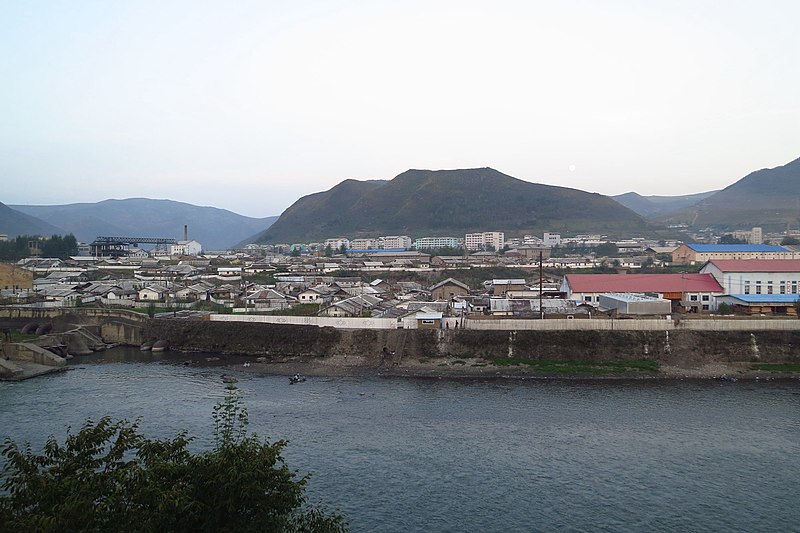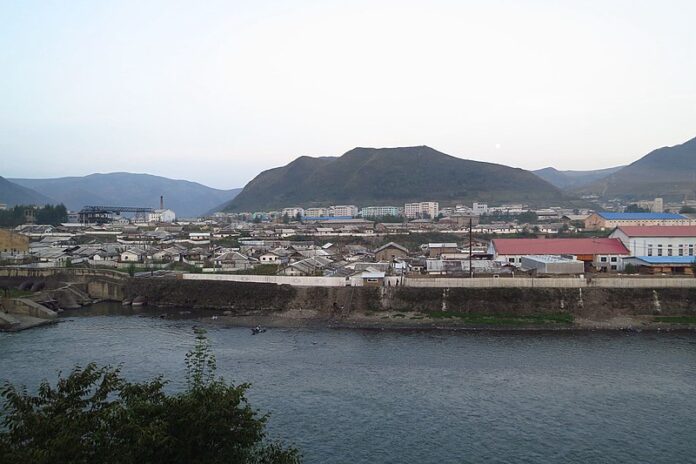
The Hyesan customs office in North Korea’s Ryanggang province reopened on Oct. 12, 2026, after a closure tied to China’s National Day holiday. Autumn clothing, winter apparel samples and electrical goods are once again flowing across the border from China. The reopening has also brought relief to Hyesan’s handcart porters, many of whom lost their daily earnings during the shutdown.
“The Hyesan customs office stopped operating early this month because of China’s National Day holiday,” a source in Ryanggang province told Daily NK on Friday. “Since it reopened on Oct. 12, all kinds of goods have been coming in, including autumn clothing, winter clothing samples and electrical appliances.”
According to the source, most of the clothing now crossing the border is autumn outerwear such as jackets. Falling temperatures have pushed up demand for coats that North Koreans can wear into early winter.
Padded jackets, knitwear, thick trousers and boots are also arriving, though most of these winter goods are samples. Traders use the samples to test how shoppers in local markets respond to different styles. Only then do they choose which items to import in bulk, a common practice in cross-border trade.
“We started bringing in winter clothing samples at the end of last month, but that stopped when customs closed,” the source said. “Sample work picked up again after the reopening, and the selected winter clothing should start arriving in earnest next week.”
Traders are also importing electrical appliances that run on 12-volt power, along with voltage transformers. Many North Korean households rely on car batteries and small solar panels because the state electricity grid is so unreliable. Demand for transformers climbs each winter, when power supplies grow erratic and voltage frequently drops.
Hyesan customs closure hit porters who live day to day
The reopening has also brought back work for Hyesan locals who earn a living by hauling goods on handcarts. These porters move traders’ cargo to designated drop-off points or pack it for shipment to inland regions.
Some traders hand off packing for inland shipments to porters they hire on a regular basis. Porters who work exclusively for a single trader see their income rise and fall with that trader’s business.
“Customs traders can get by for 10 days or so without customs operating,” the source said. “But most of the people packing and hauling goods live hand to mouth, so their income disappears when the traders stop working.”
The latest closure of more than 10 days dealt a serious blow to Hyesan’s porters and packers. Before the COVID-19 pandemic, goods brought in through private smuggling kept work flowing even when customs closed temporarily. Since then, tightened border controls and harsh smuggling crackdowns have all but wiped out private smuggling along the border. These workers now depend almost entirely on whether customs is open.
That shift shows how heavily North Korea’s economy has come to rely on official customs trade. The jangmadang, North Korea’s informal private markets, emerged during the famine of the 1990s and now supply much of what households need. Customs operations directly affect the jangmadang vendors and distributors who buy imported goods and resell them to ordinary North Koreans.
“Customs trade is directly connected to the earnings of a lot of people,” the source said. “These days, people struggle to make ends meet the moment customs stops, and some even say they miss the days when private smuggling was thriving.”
Hyesan sits on the upper Yalu River across from Changbai in China’s Jilin province. It is one of the main hubs for North Korea-China trade, alongside the border city of Sinuiju. China’s National Day on Oct. 1 opens Golden Week, a weeklong holiday when Chinese border ports usually close.
About This Translation
This article was originally written in Korean and translated with the help of generative AI tools. It was then edited by a native English-speaking editor. All AI-assisted translations are reviewed and refined by our newsroom.
Reporting from Inside North Korea
Daily NK operates networks of sources inside North Korea who document events in real-time and transmit information through secure channels. Unlike reporting based on state media, satellite imagery, or defector accounts from years past, our journalism comes directly from people currently living under the regime. We verify reports through multiple independent sources and cross-reference details before publication.
Our sources remain anonymous because contact with foreign media is treated as a capital offense in North Korea — discovery means imprisonment or execution. This network-based approach allows Daily NK to report on developments other outlets cannot access: market trends, policy implementation, public sentiment, and daily realities that never appear in official narratives.
Maintaining these secure communication channels and protecting source identities requires specialized protocols and constant vigilance. Daily NK serves as a bridge between North Koreans and the outside world, documenting what’s happening inside one of the world’s most closed societies.
Disclaimer : This story is auto aggregated by a computer programme and has not been created or edited by DOWNTHENEWS. Publisher: dailynk.com