
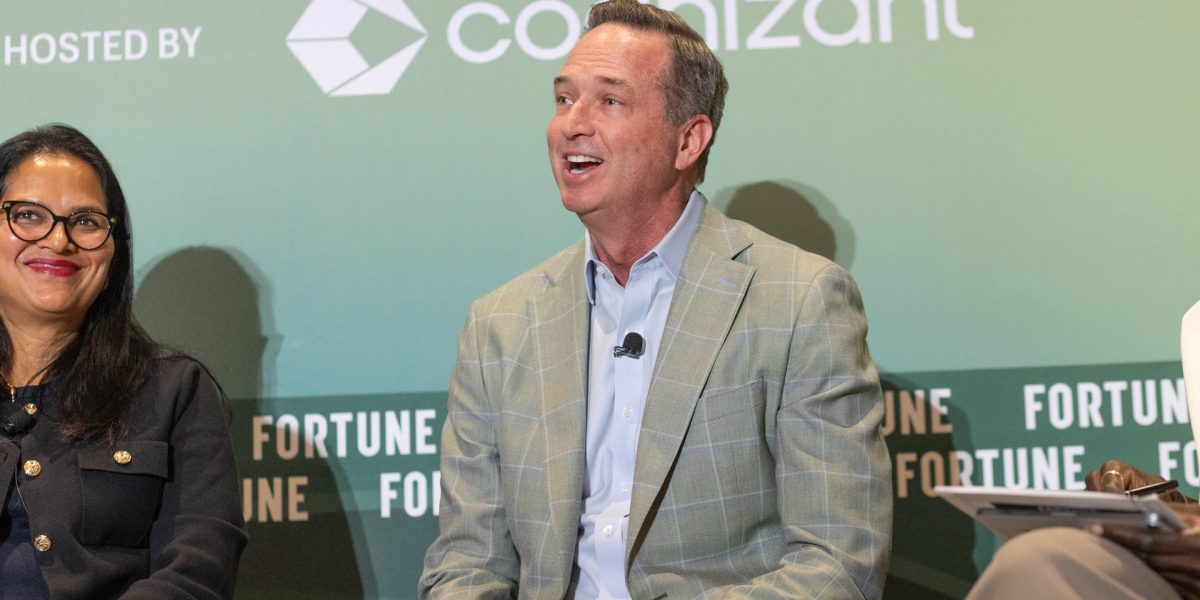
In high-turnover industries like fast casual food, recruiting workers can feel like a never-ending cycle of onboarding and offboarding. Even Chipotle—one of the fastest-growing restaurant chains in the country—isn’t immune.
“We’re constantly trying to remove friction from our general manager or anything in the restaurant,” Chipotle Chief Operating Officer Jason Kidd said at Fortune’s COO Summit on Tuesday.
But one challenge has stubbornly persisted: “One of the most painful processes we have still—and it’s getting much better—is the hiring process,” Kidd said.
The company’s turnover rate had ballooned to almost 200% in 2021, and one answer, Chipotle decided in 2024, was an AI chatbot named “Ava Cado.”
The innovation was designed to take the administrative weight of hiring off restaurant managers’ plates. The tool chats with job candidates, answers their questions about Chipotle, collects basic information, schedules interviews, and sends offer letters to candidates selected by hiring managers.
The results have been measurable. The time from application to first day on the job has dropped from 12 days to four. And because “Ava Cado” operates around the clock, about 30% of that scheduling work now happens after hours—time that would have previously required a general manager to be on the clock.
But Kidd framed the technology as augmentation, not replacement. Rather than cutting labor, Kidd said, Chipotle has redirected time savings back into restaurant operations.
“Everything we’ve added from an AI standpoint—we’ve reinvested those hours into the restaurant,” he said.
‘How far can we push it?’
Still, Kidd said he sees limits to how far automation can go.
“At the end of the day, that applicant ends up working for a human,” he added. “So how far can we push it?”
Kidd wasn’t alone in arguing that, despite mounting pressure to automate, humans still need to remain at the center of the workplace.
Alongside Kidd at the Fortune panel titled “Beyond the Pilot: How COOs Are Scaling AI Today,” executives pushed back on some of the louder fears surrounding AI-driven job losses, arguing that the technology is more likely to reshape jobs than erase them altogether.
“Our people are what we offer to our clients, their expertise, their experiences,” said Sushant Warikoo, chief business officer AI at IT firm Cognizant. “For us, there’s no choice, because if we do not transform our people for the AI age, we do not have a business run.”
Warikoo argued the bigger question for business leaders is not simply what AI can replace, but what kind of workforce society wants to build alongside it—especially as technology gets close to AGI.
“Do we want the self-driving car, or do we want somebody to drive the car?” he said. “One, it’s a living for somebody, and some people are still more comfortable with a human behind the wheel.”
Those questions, he said, are ultimately social, economic, and public policy decisions. But history suggests technological upheaval does not necessarily eliminate opportunity.
“This happened during the industrial revolution, during the digital revolution,” Warikoo said.
“Everybody thought there was going to be chaos. But what really happened was jobs changed, opportunities amplified, value amplified. Some things never change—which is human potential and human value creation.”
Still, reimagining business processes for an AI-first future is far from easy.
“It’s really hard,” Bose senior vice president and COO Skip Potter said, noting that building workflows designed for an AI-enabled future—not simply layering AI onto old systems—requires organizations to rethink how work gets done from the ground up.
Rashmi Kumar, senior vice president and global chief information officer at Medtronic, echoed that point, arguing that today’s most successful AI applications remain narrow and task-specific.
“If you look at where the LLMs have been more successful, it’s still in deterministic use cases, like software code generation,” Kumar said. “But code generation doesn’t mean anything by itself. We’ve looked at personas within the business—solution architects, architecture teams, project managers—where their value lies in end-to-end transformation, and in removing friction from their day-to-day work.”
With AI raising more questions than answers about the future of work, executives said embracing uncertainty remains crucial to avoid falling behind.
Disclaimer : This story is auto aggregated by a computer programme and has not been created or edited by DOWNTHENEWS. Publisher: fortune.com



