CJI and the Question of Dissent: What Happened at London Event
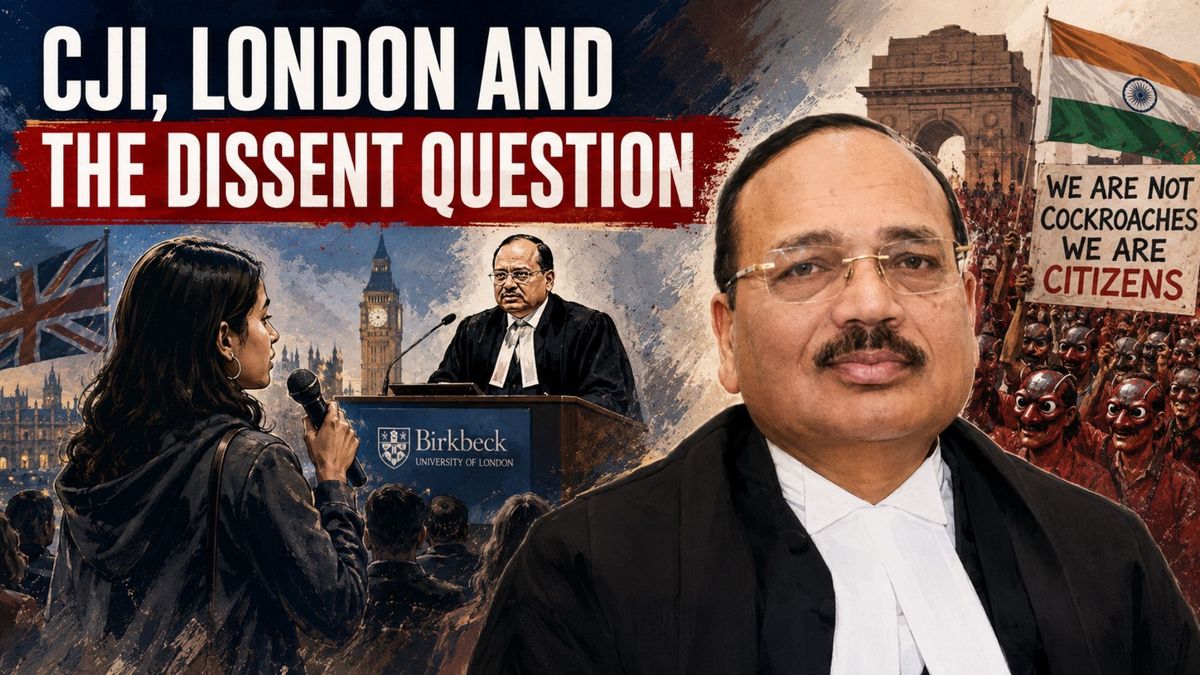
On 4 June 2026, Chief Justice of India Surya Kant delivered a lecture on “Artificial Intelligence and International Law” at Birkbeck, University of London, as part of a six-day official visit to the United Kingdom. The event was organised at the invitation of the university and drew an audience of legal academics, students, and observers. During the question-and-answer session that followed, an attendee attempted to ask the Chief Justice about what she described as growing hostility to dissent in India. The organiser refused to take the question, ruling it outside the scope of the evening’s academic topic. That refusal would set off a sequence of events that would echo far beyond the lecture hall.
The exchange between the attendee and the moderator was captured on video and spread rapidly across social media. The attendee, widely described in reports as a student, began by noting that the CJI had spoken about India’s democratic track record in the context of artificial intelligence governance. She then raised the question directly:
“We now hear from a number of legal observers from within the country as well as internationally that there is a great deal of concern about growing hostility to dissent within India, and it does seem that this hostility is somewhat reflected in His Lordship’s recent very well-publicised remarks.”
Also Read: Medical Negligence Law in India: Why Doctors Escape Accountability
The organiser intervened before she could conclude: “With due respect, I am so sorry, we will not be able to take that question. The topic is Artificial Intelligence and International Law.”
The attendee persisted: “I will continue my question. I think when the respected speaker has referred to Indian youth and journalists and right to information activists as cockroaches and parasites recently, I think that he should be given a chance to respond.” The organiser held firm: “Let’s stick to the topic and we will not be taking any questions, and this is not a political event.” The CJI did not intervene, and the question went unanswered.
In another clip circulating from the London event, another attendee was seen protesting and demanding respect saying, “Give us some respect please.” The clip was shared widely alongside the main exchange, with multiple outlets reporting the student as demanding that the world’s largest democracy acknowledge its citizens’ right to be heard.
The Chief Justice’s decision not to answer, or to intervene to allow the question, has drawn significant commentary. While it is entirely within institutional convention for a moderator to manage questions at an academic event, the fact that the question being blocked was specifically about dissent — and that the CJI remained silent on the matter — has contributed to an impression that is, at minimum, awkward. It is not the place of a court or the press to compel a sitting judge to answer questions at a public lecture. At the same time, a Chief Justice who speaks publicly on democratic values and judicial power, and then allows a question about dissent to be excluded without comment, is unlikely to find that silence reassuring to those who raised it.
Also Read: Uttarakhand Tiger Poaching Thrives Amid NTCA Silence
The High Commission of India in London issued a formal statement the following day. The High Commission said the 4 June London event had featured a lively discussion after the lecture before an individual tried to disrupt the proceedings. “Such indecorous behaviour is unacceptable and inconsistent with respectful engagement that should govern public discourse. Differences of opinion are a natural part of a democratic society. However, they must be expressed in a manner that is civil and respectful,” the High Commission said. The statement notably characterised the attendee’s question as a “disruption,” a framing that itself attracted criticism from observers who noted that asking a question — however pointed — at a public lecture is, by most definitions, an act of civic participation rather than disruption.
To understand why the London event acquired the significance it did, it is necessary to go back three weeks. During a Supreme Court hearing on 15 May 2026, CJI Surya Kant made the following oral observations: “There are already parasites of society who attack the system and you want to join hands with them? There are youngsters like cockroaches; they don’t get any employment, they don’t have any place in profession. Some of them become media, some of them become social media, some of them become RTI activists, some of them become other activists, and they start attacking everyone.” The remarks were made from the bench in open court, and were widely reported.
The following day, Abhijeet Dipke, a political communications strategist who had previously worked with the Aam Aadmi Party and was then studying at Boston University in the United States, announced on X the launch of a “platform for all the cockroaches out there,” listing the eligibility criteria as being unemployed, lazy, chronically online, and able to rant professionally. He called it the Cockroach Janta Party, a deliberate play on the name of the ruling Bharatiya Janata Party.
According to Dipke, the digital membership of the CJP officially crossed the 1.2 million milestone and within days, the party’s Instagram account crossed 22 million followers— a following that outstripped even the BJP’s own Instagram presence. The movement drew support from many opposition parliamentarians, students, and first-time voters across the country.
Also Watch: CJI, London and the Dissent Question | What Really Happened at Birkbeck University
Within weeks, however, the Indian government moved to restrict the movement’s online presence. The Ministry of Electronics and Information Technology directed platforms to block the CJP’s primary social media accounts and website, citing national security concerns. Dipke publicly accused the government of seeking to silence dissent and vowed the movement would continue.
On 6 June 2026, the Cockroach Janta Party held its first major offline demonstration at Jantar Mantar in New Delhi. Dipke, who had flown in from the United States, secured permission from the Delhi Police for a peaceful sit-in scheduled until 5 pm. Thousands of participants gathered at the site, many wearing cockroach masks, with the central demand being the immediate resignation of Union Education Minister Dharmendra Pradhan over systemic failures in national examinations, including NEET-UG. Dipke addressed the crowd, saying it had been a month since they had been demanding Pradhan’s resignation on social media, and that instead of taking action, those in power had focused on “hacking our accounts and getting our posts deleted.” Security was tight across the capital, with over 1,000 police personnel deployed.
Disclaimer : This story is auto aggregated by a computer programme and has not been created or edited by DOWNTHENEWS. Publisher: theprobe.in