
RISING FESTIVAL | THEATRE
We Come to Collect: a flirtation, with capitalism ★★★★
Arts Centre Melbourne, until June 7
Grim and unhinged the hegemony of the United States may be, yet the rogue superpower remains a prime source of protest and resistance. Many of the most penetrating critiques of the US come from America itself, and that’s certainly the case with Jenn Kidwell’s latest piece of performance art.
We Come to Collect is an irreverent slide into the mire of late capitalism that raises consciousness of a manifestly unfair system, and our complicity in it, as it taunts and inspires, subverts and entertains.
Melbourne audiences might have seen Kidwell in the extraordinary Underground Railroad Game at the Malthouse in 2019. That work combined a history lesson with sado-masochistic seduction and a provocation on race relations in the US, and it was light years ahead of the Australian stage at that time in the freedom, daring, and sophistication of the conversation it led on the complexities of racial inequality.
This time, Kidwell appears alongside Brandon Kazen-Maddox, who translates her spoken word into ASL (American Sign Language), and from the outset, an air of decadence wafts heavily over the stage.
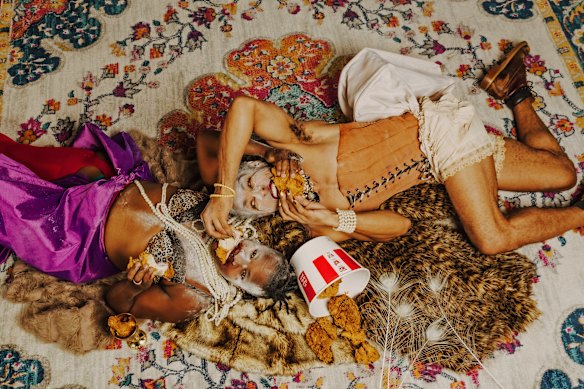
We enter to find the pair splayed on a chaise longue dressed in leopard print and faux fur (Kidwell), or corsetry (Kazen-Maddox). The set is festooned with symbols of opulence – a chandelier, a taxidermic swine’s head – alongside enormous buckets of KFC. By the time the ancien régime costumes come out, the stage looks as if Colonel Sanders has hopped into a TARDIS to visit Marie Antoinette at the palace of Versaille.
Before the show detours into grotesque, “let them eat cake” comedy, there’s an earnest and galvanising takedown of work, as most working people currently experience it. Kidwell invests the philosophy behind the antiwork movement with eloquent simplicity, a personal dimension, and rhetorical skill reminiscent of spoken word poetry.
The humanising force of Kidwell’s monologue runs into a bold complication. About halfway through, the piece seems to cave in to the perceived inevitability of capitalist imperatives, and Kidwell proceeds to hustle the audience, through increasingly wild flirtations and participatory performance, into lightening their wallets.
The show isn’t called We Come to Collect for nothing.
Chaotic comedy takes in class, colonialism, racism, patriarchy, and socio-economic inequality. There are cartoons and video skewering the Trumps and the Musks of the world, and Kidwell’s shameless cash grab builds from teasing seduction into an uncomfortable gambit aimed at revealing our complicity in the system.
While this show isn’t quite as rich in ideas or as sharp in execution as Underground Railroad Game, it’s performed with remarkable charisma, intelligence and sass.
Kidwell doesn’t have all the answers – no one does – but her work disarms the audience, frames the problem, and steers us toward asking the right questions, offering empowerment and entertainment in equal measure.
Reviewed by Cameron Woodhead
RISING FESTIVAL | DANCE
Hard to be Soft: A Belfast Prayer ★★★
Malthouse Theatre, until May 30
Oona Doherty’s Hard to be Soft is short and serious in tone but artfully composed: a study in dance of the postures and habits – the swagger, volatility and comic self-display – of working-class Belfast youth.
It premiered in 2017 but continues to tour the world because its local materials refuse to stay local. They resonate wherever young people are conditioned to despise softness.
Set in a cage-like structure with huge white floor-to-ceiling vertical bars, designed by Ciaran Bagnall, the work is really an anthology of four smaller pieces.
In the first chapter, Ryan O’Neill imitates and then abstracts and transforms the gestures of disaffected young men: squaring up, pointing, jeering, preparing to strike or just standing around waiting.
Next, a troupe of eight girls from a local dance school performs a cool, street-inflected unison routine. They have their own swagger, but they’re also watchful. Doherty is here alert to the way resistance manifests differently across generations and genders.
In the third chapter, two large shirtless men crush themselves together in an absurdly long embrace, drawn out until it becomes something other than an embrace, something rather sad and desperate. Perhaps it is every hug that never was?
Finally, O’Neill returns, revisiting the fragmentary sketches of street life, but now working them into a pattern of grace, drawing them together as he transitions rapidly between a half dozen or so different portraits.
David Holmes’ music creates a wonderfully bleak church-like atmosphere. And there is extensive use of recorded Belfast voices, drawn from interviews and documentaries, which provide the material for the imitations.
Hard to be Soft has a sort of monumental attraction. It is – as the title suggests – like a great prayer. It’s a dream of communion with what has been damaged. And an earnest, though somewhat muted, appeal for change.
Reviewed by Andrew Fuhrmann
The Booklist is a weekly newsletter for book lovers from Jason Steger. Get it delivered every Friday.
From our partners
Disclaimer : This story is auto aggregated by a computer programme and has not been created or edited by DOWNTHENEWS. Publisher: www.smh.com.au


