
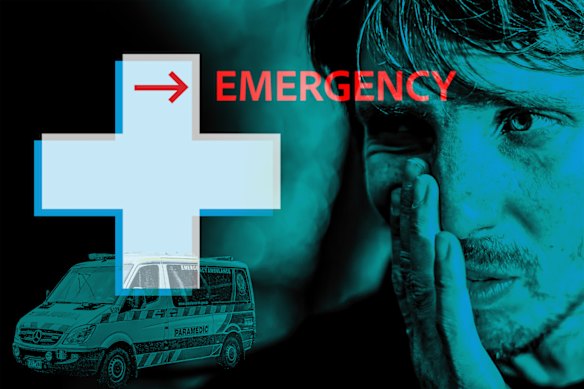
Patients with a history of violence who are on Victorian hospitals’ secret banned lists are being brought to emergency departments by ambulance, only to be ejected by security guards and left untreated and on the street.
While the state government has promised to address hospital “not welcome lists” and aggression against paramedics though an anti-violence roundtable it established last year, The Age can reveal the group of health leaders has not met since first being called together in November 2025. The government says it will reconvene a roundtable on occupational violence in June of this year.
Paramedics have reported to their union that hospitals are triggering “code grey” or “code black” calls when they unload an unwelcome patient from an ambulance, triggering internal procedures for security to attend and remove the person.
Lawyers working with people with mental health issues have also reported instances in which unwell patients end up on the street, rather than being taken to another hospital for care.
As revealed by The Age, Victorian public hospitals are using secret exclusion notices, known in the sector as not welcome lists, to ban aggressive patients – which paramedics argue puts them and patients at risk.
Because paramedics do not have access to the hospitals’ lists, they do not know if a patient they are called to treat may pose a safety risk to them or whether a patient could be turned away once they arrive at the hospital.
Mental Health Legal Centre chief executive Charlotte Jones said hospitals routinely refused to admit desperately unwell patients with complex issues, who are then left in the community or transported by paramedics to another hospital away from social supports and networks.
Jones said she was aware of several clients who had been turned away from Frankston’s Peninsula Hospital, placing increased pressure on community services stretching down to the Mornington Peninsula.
She said another client who arrived at Bairnsdale Hospital at 6pm on a Wednesday was moved to Traralgon the following afternoon, where she remained in the emergency department before finally seeing a psychiatrist and gaining a bed on the Sunday morning.
“People are not cargo. Engaging with people who are mentally distressed and unwell is hard,” Jones said.
“Ambulance services work incredibly hard to gain the trust of complex people, saying that they will get help if they engage. Then they go and find that they are turned away – and then their stigma, their knowledge that they are treated differently is evident.”
In another case reported by paramedics to the Victorian Ambulance Union, a patient with abdominal pain was refused admission at the Northern Hospital owing to their past bad behaviour. While the paramedics called their duty manager to flag their concerns, the patient absconded into the streets without care.
The Allan government said on Monday it would work with health services, Ambulance Victoria and the union to find new ways to keep the workforce safe. Health Minister Harriet Shing said she was convening further discussions following a roundtable held by her predecessor Mary-Anne Thomas last year, which heard concerns from paramedics, Ambulance Victoria and staff at hospitals and health services.
People who attended that November roundtable meeting but who were not authorised to speak publicly told The Age they were concerned the group had not met again in the months since to act on the issues raised.
When asked about the roundtable this week, a government spokesperson said the next formal roundtables on occupational violence would be held in June.
“The minister regularly meets and speaks with stakeholders, including Ambulance Victoria and the Victorian Ambulance Union, and is working closely with them to look at new ways of keeping our workforce safe,” the spokesperson said.
“The minister is continuously looking at ways to reduce rates of occupational violence across the health system.”
Speaking to a parliamentary hearing into the state budget on Thursday, Shing defended the practice of hospitals flagging patients with complex and concerning behaviours, and said the department did not possess any secret lists of patients with challenging behaviour.
“Those flags actually support staff to develop tailored plans to meet the needs of patients and staff to ensure the safe delivery of care,” Shing said. “Not welcome notices are used in really rare cases where concerning and repeated behaviour occurs.”
Start the day with a summary of the day’s most important and interesting stories, analysis and insights. Sign up for our Morning Edition newsletter.
 Henrietta Cook is a senior reporter covering health for The Age. Henrietta joined The Age in 2012 and has previously covered state politics, education and consumer affairs.Connect via X, Facebook or email.
From our partners
Disclaimer : This story is auto aggregated by a computer programme and has not been created or edited by DOWNTHENEWS. Publisher: www.smh.com.au


