Trae Young accomplished plenty during his time with the Atlanta Hawks, but one thing consistently appeared to be missing around the former franchise superstar. Atlanta surrounded Young with several quality players throughout his tenure, yet the organization never truly found another elite offensive threat capable of consistently forcing defenses to shift their attention away from him.
Young recently reflected on that reality during an appearance on the “Curious Mike” podcast hosted by Michael Porter Jr. When asked what he felt was missing during his time with the Hawks, Young said, “I don’t know if I’ve ever had a teammate that can draw double teams.”
Advertisement
It is a statement that could generate debate among Hawks fans, especially considering some of the talent that played alongside Young over the years. However, when looking back at the construction of those Atlanta rosters, Young has a legitimate point about never having another elite offensive player who consistently commanded the same type of defensive attention.
Young’s Comments Highlight Atlanta’s Biggest Roster Problem
Dejounte Murray was supposed to become the player who finally alleviated some of the pressure Young carried offensively. Atlanta surrendered significant draft capital to acquire Murray from the San Antonio Spurs with the expectation that another All-Star-caliber guard would create a dynamic backcourt capable of pushing the Hawks closer to championship contention.
The problem was never necessarily a lack of individual talent between the two guards. Young and Murray were both most effective with the basketball in their hands, and neither consistently developed into the type of off-ball threat necessary to maximize the other player’s strengths.
Advertisement
Instead of making life significantly easier for Young, the partnership often required one guard to sacrifice what made him most effective. Atlanta essentially paired two ball-dominant creators together without developing enough offensive synergy between them, which prevented Murray from becoming the complementary star the Hawks envisioned when they made the trade.
Murray could certainly create his own shot and take over possessions, but that is different from consistently commanding double teams and changing the geometry of a defense. Opponents could still build their primary game plan around slowing Young without constantly worrying that another elite scorer would punish them for committing additional defenders toward him.
After the Murray experiment failed, Atlanta never found another player capable of filling that role during Young’s tenure. That left Young continuing to shoulder significant responsibilities as both the Hawks’ primary scorer and lead facilitator, making it easier for playoff opponents to design their defensive strategy around limiting one player.
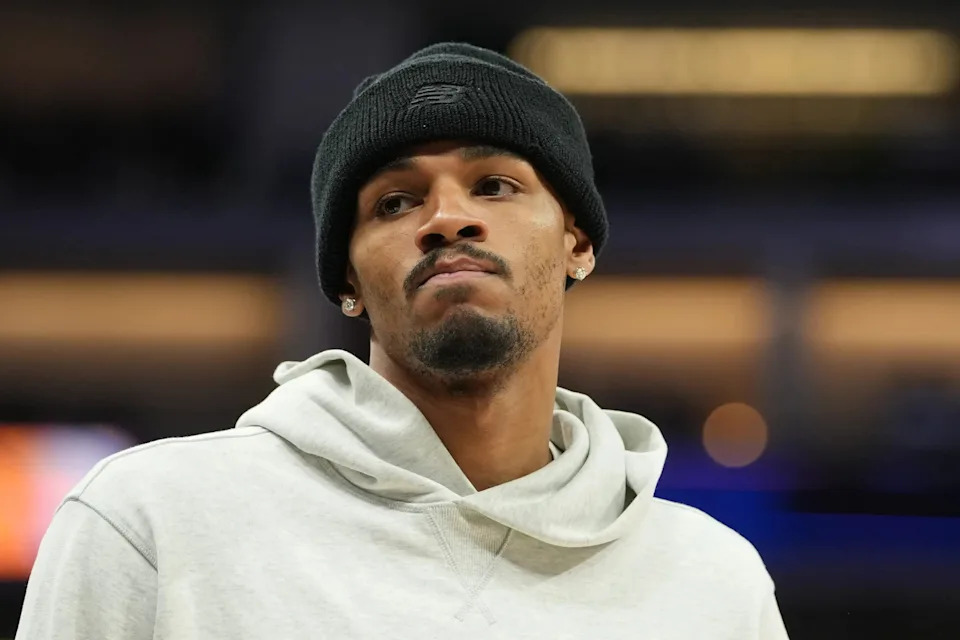
Apr 3, 2026; Sacramento, California, USA; New Orleans Pelicans guard Dejounte Murray (5) during the third quarter against the Sacramento Kings at Golden 1 Center. Mandatory Credit: Darren Yamashita-Imagn Images
Atlanta Had Good Players But Never Found Young Another Superstar
Young’s statement should not be interpreted as disrespect toward the teammates he had in Atlanta. Clint Capela became an important interior presence, Bogdan Bogdanovic provided valuable shooting and secondary scoring, while Kristaps Porzingis gave the Hawks another talented offensive option during Young’s time with the organization.
Advertisement
Those players could influence games and help Atlanta win, but there is a difference between being a quality starter or high-level contributor and being an elite offensive player who forces opponents to fundamentally alter their defensive coverage. Young never consistently had that second type of player next to him.
That distinction becomes even more important when comparing Atlanta with legitimate championship contenders. Most teams capable of making deep postseason runs have multiple players who can punish defenses for committing too much attention toward one star, whether through elite shot creation, interior dominance, or another skill that forces opponents into difficult decisions.
The Hawks came closest to overcoming that limitation during their memorable run to the 2021 Eastern Conference Finals. Young was sensational throughout that postseason, and Atlanta came within two victories of reaching the NBA Finals despite not possessing the type of established second superstar that many championship teams feature.
His ankle injury during Game 3 against the Milwaukee Bucks remains one of the biggest what-if moments from that run. Young attempted to play through the injury later in the series, but Atlanta lost an opportunity to see whether its improbable postseason run could have extended even further against a Bucks team that eventually won the championship.
Advertisement
That playoff run demonstrated just how far Young could elevate a roster when everything around him clicked. It also arguably created expectations that Atlanta would eventually add another elite player capable of helping Young consistently compete at that level, but the organization never successfully completed that part of the roster-building process.
Hawks Never Found The Right Formula Around Young
Atlanta’s inability to find the right co-star cannot be separated from the organizational instability that surrounded much of Young’s tenure. The Hawks experienced changes in leadership, competing roster philosophies, and questions about whether ownership and the front office were completely aligned on how aggressively the organization should build around its franchise player.
Advertisement
The Murray trade became the most aggressive attempt to solve the problem, but Atlanta ultimately targeted a player whose offensive strengths overlapped too heavily with Young’s. Instead of finding someone who could dominate without needing to control every possession, the Hawks added another guard who needed the basketball to maximize his own effectiveness.
That does not mean Young was blameless for Atlanta’s inability to become a consistent contender. His defensive limitations created roster-building challenges of their own, and the Hawks had to consider those weaknesses when determining which players could function effectively alongside him.
However, acknowledging Young’s limitations does not invalidate his broader point. Atlanta spent years with one of the league’s most gifted offensive guards but never successfully paired him with another elite player who could regularly force defenses to choose which star they were willing to leave with a favorable matchup.
That is ultimately what makes Young’s recent comments resonate. He played with plenty of good players in Atlanta and even had another former All-Star beside him in Murray, but having talented teammates is not necessarily the same as having a true second star who changes how an opponent defends.
Advertisement
Young’s Hawks tenure will always be remembered for his spectacular individual performances and the unexpected run to the Eastern Conference Finals. It may also be remembered as an era in which Atlanta never completely discovered how good its franchise player could have been with another elite offensive weapon consistently taking pressure away from him.
Whether that would have resulted in another conference finals appearance or even a championship will always remain hypothetical. Still, when Young says he cannot remember having an Atlanta teammate who consistently drew double teams, the history of how the Hawks constructed their roster suggests his comments carry considerably more truth than some may initially want to admit.
Featured Image: Geoff Burke-Imagn Images
More NBA News:
Pacers’ Tyrese Haliburton Gives Honest Reaction to Knicks Scoring NBA Title
Buddy Hield Trade Would Send Loud Message To Hornets Fans
All Giannis Antetokounmpo Major Updates After Joining the Heat
Disclaimer : This story is auto aggregated by a computer programme and has not been created or edited by DOWNTHENEWS. Publisher: Sports.yahoo.com