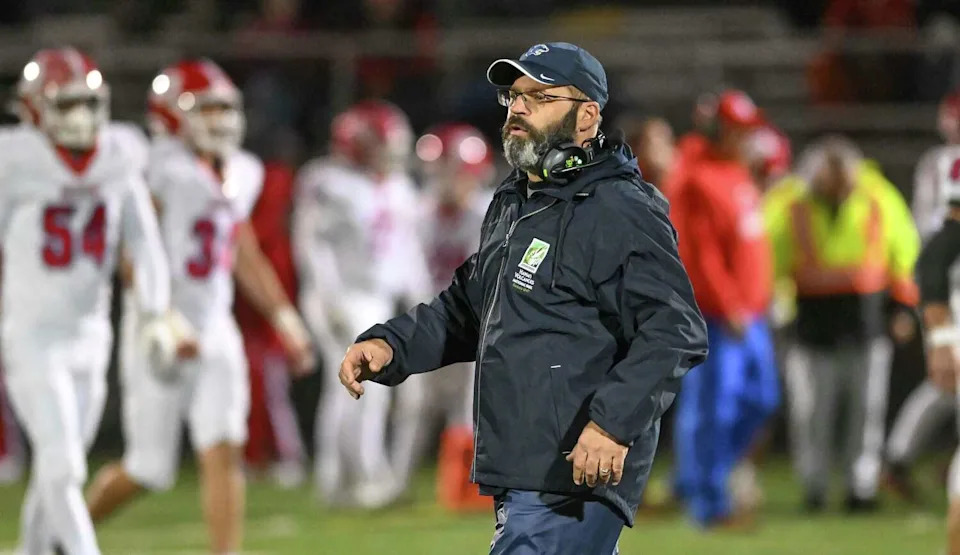
Lou Marinelli hit his exercise bike hard Monday morning.
The New Canaan football coach had a big week ahead. Unbeaten St. Joseph was coming to town Friday and Marinelli’s Rams were coming off their first loss in 29 games.
Advertisement
Time to get back in the saddle and get the wheel back in spin.
That’s just short term. As Connecticut’s longest-tenured and winningest coach knows full well, CIAC football faces a long-range challenge, and that’s halting a decade-long decline in player participation. Connecticut has gone from approximately 10,000 high school football players in 2013 to 8,000 in 2025.
While a final total is not yet in for 2026, many teams are showing smaller numbers this fall, several rosters have dropped into the low 20s, and two teams, Derby and McMahon, postponed games for a lack of healthy numbers.
“The #’s of students in football has been dropping for the last decade,” former Hartford Public coach Harry Bellucci posted on X when last week’s McMahon-Trumbull game was postponed. “Whether it’s CTE concerns, too many athletes focusing on just one sport, video games or social media, it’s a continuing trend that needs to get reversed or a whole lot more co-ops. That will be the norm soon.”
It’s the norm right now. Nine co-ops have sprung up in the past two years, raising the CIAC total to 26, doubling the 13 that were around in 2013.
Advertisement
Coaches and athletic directors acknowledge more co-ops are likely in the future, especially among city schools and small suburban and rural districts. In the meantime, they say, steps can be taken to counter current trends:
• Greater integration between high school and youth football programs.
• Greater selling of the game in the schools by coaches.
• Greater community, parental and administrative support.
It’s very much a vertical alignment, which is apropos. Many of the factors underlying the situation are arguably economic in nature.
“Times are tough: We get that a lot from parents,” said Nonnewaug Co-op coach Scott Lynch, who’s had some players torn between football and part-time jobs.
Platt head football coach Jason Bruenn during their game against Berlin at Falcon Field in Meriden Thursday, November 12, 2026. (Jim Shannon/Hearst Connecticut Media)
“It’s not easy to live in Connecticut – the taxes, the price of things,” remarked Platt-Meriden head coach Jason Bruenn, whose connection with that school’s program traces back to his playing days in the early 1990s. “Like, South Meriden used to be a hotbed of kids for high school, but now they’re all Baby Boomers holding onto their houses or Gen-X’ers that took over the parents’ houses, and we’re not getting a lot of kids out of that area of the city.”
Advertisement
Yet, Platt’s football numbers are high. The Panthers field teams at all three levels: varsity, JV, freshman.
Not all schools do, which means a program like Platt will sometimes have to scramble to find sub-varsity games or have them fall through at the last minute. Thus does the decline in participation emit ripples that effect everybody.
“I don’t think it’s just one thing,” Killingly coach Chad Neal said of both the causes and solutions for lower player participation. “I think it’s a combination of many things, and it’s going to be a grassroots effort to keep kids involved in football to be able to sustain for 10 years or more.”
Like any sport, the youth feeder system is crucial to sustaining a high school football program. Varsity coaches say they actively cultivate relationships with league directors and coaches in their towns. In New Canaan, the high school staff runs clinics for the youth coaches.
Advertisement
“I don’t consider New Canaan football to be grades 9 through 12,” Marinelli said. “Ours is third to 12.”
There are 85 youth football programs in Connecticut. Many share the same team name as their varsity elders. Kids in Ridgefield, for instance, are Tigers long before they reach Ridgefield High.
Some programs run the same systems. In North Haven, youth squads deploy single-wing just like the high school team.

Naugatuck coach Chris Anderson, left, talks to his team in the postgame huddle following a 27-20 win over Holy Cross in the high school football season opener for both teams on Thursday, Sept. 10, 2026, in Waterbury. (Kevin Roberts/Hearst Connecticut Media)
Any kind of integration with the high school program is key, Lynch noted. So is good instruction. The focus at the youth level can’t be on wins or stacking teams. It’s got to be on expanding interest and developing skills.
Advertisement
“We’re trying to grow the sport down there, get the families knowing that it’s a viable option, and then trying to sell the kids on doing something special in their school,” said Lynch, whose Nonnewaug co-op is fed by several tackle programs – the Water-Oak Warriors, Torrington Warriors and Brookfield Bobcats – and a Woodbury-Bethlehem parks and rec flag league.
“We have a lot of boys here who don’t play many sports or any sports at all,” Lynch continued. “If we can find a way to just keep making those numbers at the younger level grow, and let them have fun and grow all the way up, I think that’s the biggest one.”
Allaying parental concerns about player safety – a major factor driving down participation, coaches agree – can also start in the youth ranks, where USA Football and Hawk tackling techniques, which emphasize driving the shoulder and keeping the eyes up to reduce helmet-to-helmet collisions, are first taught.
“I think everyone is on point with that, all the way down to the youth level,” Lynch said. “I think you have so much more education that people aren’t teaching the craziness like it was. That shift’s already been done. Now we’ve just go to get everybody turned back on this boat.”
Advertisement
There’s another wrinkle to re-growing the game from the ground up, Naugatuck coach Chris Anderson points out, and that’s the investment of parents.
Is that investment in terms of dollars? Partly, yes. Is it any coincidence that some of Connecticut’s most successful football teams hail from some of Connecticut’s wealthier towns? The top three – Darien, New Canaan and Greenwich – have won 35 state football championships between them.
But there also needs to be investment in terms of time and attention.

North Haven football coach Anthony Sagnella during the first half of the Fairfield Prep at North Haven football game on Friday, October 31, 2025, in North Haven. (Jim Michaud/Hearst Connecticut Media)
“They have that parent backing, where they’re taking their kids to all the youth sports growing up, so those kids play sports,” Anderson said of the Fairfield County programs. “When you get into the inner cities, you don’t really have that, and then the smaller towns, it’s hard to keep up with the numbers.”
Advertisement
“I’m fortunate,” Marinelli agrees. “I work in a district that thinks that athletics in general are an important part of a young person’s education.”
Coaches who have spoken in the past about how successful football programs sustain a high standard have touched upon this point. The support of community and school leaders, they’ve said, is indispensable.
This isn’t defined wholly by dollars. The city of Meriden ranks No. 157 out of Connecticut’s 169 municipalities on the per-capita income list. Yet when the CIAC canceled the 2020 football season during COVID, Meriden school officials gave Platt and Maloney permission to continue playing as independent teams. A year later, Maloney won the Class L state championship.
That sort of support didn’t fade away with the pandemic. “I’m not saying they’re coming over here and just slipping money to us,” Bruenn said. “But if there’s a need, they put the money into it.”
Advertisement
Ultimately, a lot falls on coaches to be the ambassadors of the game. Maybe there’s cause to throttle down a tad.
“We’re probably culprits of that as coaches because we do this year-round,” Anderson said. “It’s just a lot. It’s unrelenting, is what it is, and some people may get turned off by that.”

New Britain head football coach Isaiah Boddie, left, is photographed at a game against Southington on November 5, 2026. (Arnold Gold/Hearst Connecticut Media)
Coaches also recognize they’re the ones who need to sell the game to prospective players, to kids on the fence, to kids who might need the game – any game – more than they know.
“I’m constantly recruiting in the hallways – basketball kids, track kids, kids that come in from different countries who don’t even speak English,” said New Britain coach Isaiah Boddie. “Just trying to pursue them into our game and say, ‘This is a phenomenal thing, you’re going to get in shape, you’re going to have structure, your grades are going to be good, you’re going to build family.’
Advertisement
“Especially in our inner-city schools,” Boddie added. “It’s important for them to be attached to something, whether it’s a club or a sport, just to build some community so they can navigate their way through school.”
Boddie sees it at New Britain High: Students who are involved in activities often succeed; students who aren’t often struggle.
“They’re drifting and a lot of them don’t have the support at home,” Boddie said. “They get it from the school. They play sports, they have more supports. The pitch is to be a part of something, to be a part of something bigger than self, that’s bigger than you.”
It’s a sell that reverberates in New Canaan and North Haven as much as New Britain.
Advertisement
“I hope it turns around, I really do, because those kids that started with me in 1981 in New Canaan, the majority are very successful – doctors, lawyers, entrepreneurs, military,” Marinelli said. “I’ve seen it. I know it works. I know it’s important.”
“I hope it’s still around,” North Haven coach Anthony Sagnella replied when asked where he saw CIAC football a decade down the line. “I don’t think there’s anything better than football for teaching struggle to young people. It teaches sacrifice, humility, commitment, how to be accountable. How else can you train a kid to be a productive adult, a productive citizen? Give me a better way! I don’t think there is.”
This article originally published at Connecticut football’s numbers keep falling. Coaches say rebuilding starts long before high school.
Disclaimer : This story is auto aggregated by a computer programme and has not been created or edited by DOWNTHENEWS. Publisher: Sports.yahoo.com