ALLEN PARK — The Detroit Lions are continuing to run variations of their formations where receivers are lined up 15 yards behind the line of scrimmage as they find ways to produce interesting wrinkles off of past looks they’ve shown.
The formation first showed up in a win over the Minnesota Vikings on Nov. 1, with wide receiver Amon-Ra St. Brown as the lone player lined up far behind the line of scrimmage, but it has evolved to include multiple players lining up out wide in the backfield and to feature different primary receivers.
Advertisement
In last week’s game against the New England Patriots, the formation allowed tight end Sam LaPorta to have a one-on-one against a linebacker up the seam, which ultimately fell incomplete but probably should have gone for a big completion, offensive coordinator Drew Petzing said.
Petzing said he hopes the formation puts “a lot” of strain on opposing defenses, “and that’s one of the reasons we do it.”
“I think any time you can find something that works or something that maybe creates a little anxiety — you know, the first thing i’m going to do is ask some of the guys in our building, we’ve got some really good coaches on defense, ‘Hey, how would you defend this? What do you think you would do? Would this put some stress on you?'” Petzing said. “And if they kind of stare at you for the first 10 seconds without an answer, you’re like, ‘Alright, I’m on to something good here.
Advertisement
“And then you put it on tape, and you try to figure out, ‘How can we compliment it? What else can we do out of it? What do defenses try to do to mitigate it?'”
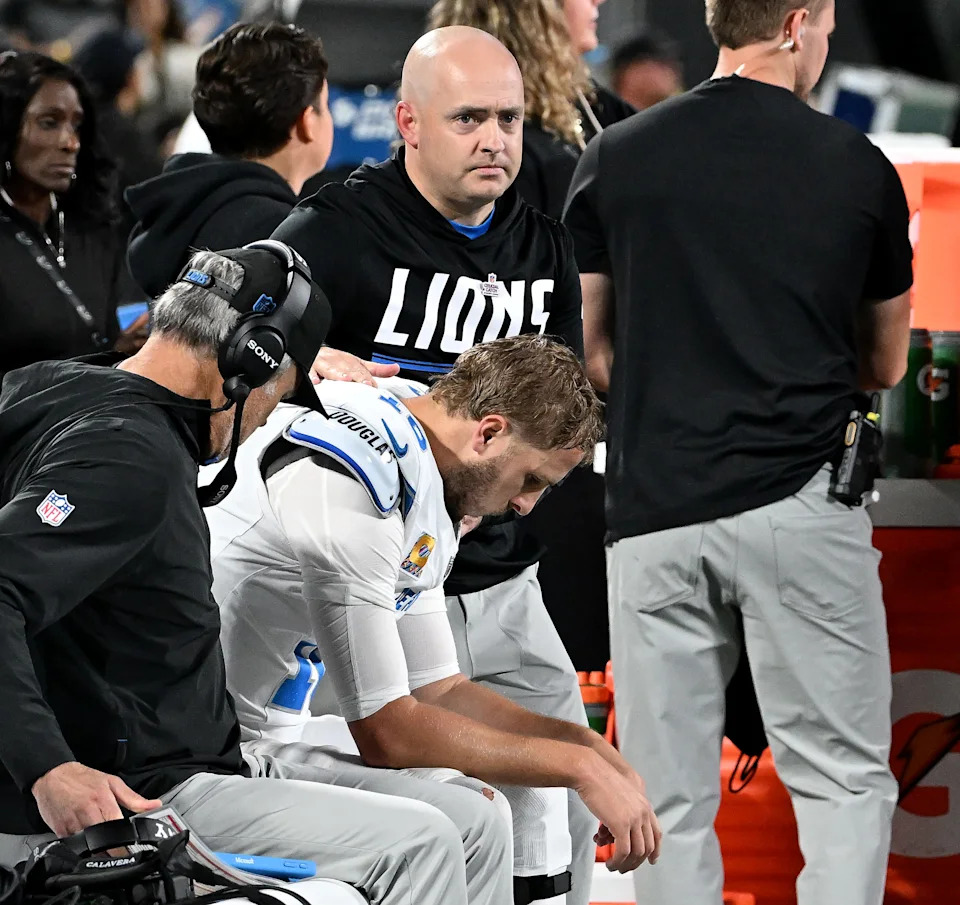
Lions offensive coordinator Drew Petzing, right, pats quarterback Jared Goff on the back late in the fourth quarter. Detroit Lions take on the Carolina Panthers at on Oct. 4, 2027 at Bank of America Stadium in Charlotte, North Carolina. Panthers win, 32-26.
In the play against New England, Petzing feels as though the linebacker lucked into being in the right spot “and just kind of ran with it, but that’s also a play that I would expect the quarterback and tight end to make at the end of the day.”
Petzing elaborated on the process of creating offshoots of the play, saying he largely watches how teams react to wacky alignments and figures out how to put those players in conflict the next time around, when they might be expecting to see the look.
Advertisement
“We’re never going to have like … here’s everything we could ever do, and it’s all up. But at the same point, we don’t want to just have one. You want to have a couple that you feel good about and maybe you’ve repped it, you kind of figure out, ‘All right, we like this, but we’ve got to tweak that,'” Petzing said.
“I think it’s an evolving process, but the iteration that you’re going to see on Sunday is not maybe … the first way that we rep that play.”
Believing in Roger McCreary
Cornerback Roger McCreary has been one of the faces of Detroit’s turnaround in the secondary, coming a long way from the player we saw in training camp to be at the forefront of a unit that’s now held opponents to 21 points or less in five consecutive games, all Lions victories.
Advertisement
Sheppard has repeatedly expressed an appreciation for McCreary, whose resilience has come to define the secondary’s rebound, and elaborated on that love on Thursday.
“I think players that don’t feel like they’ve had many people believe in them, I attach to those guys really fast because I know that feeling,” defensive coordinator Kelvin Sheppard said.
McCreary was a second-round pick out of Auburn (35th overall) by the Tennessee Titans in the 2022 NFL Draft. His role was diminished throughout his 3½-season stint, which culminated in him getting traded to the Los Angeles Rams at the 2025 trade deadline. He didn’t start a game for the Rams and signed a one-year, $1.4 million deal with Detroit this past offseason.
“We had talks in the offseason when we were trying to acquire him as a free agent … some of those talks were centered around — you know, he was a second-round pick,” Sheppard said. “When you’re a second-round pick in this league, you’re expected to come to the league and start and definitely contribute and play. Whereas in his case, he’s on his third team in … four or five years.”
Advertisement
McCreary’s tenure with the Lions got off to a shaky start in camp, but he improved as the summer went on and eventually became an important player for Detroit to start the season, which was marked by poor defensive performances and frustrating secondary play.
Over his last four games, McCreary has been targeted in coverage 18 times, allowing 11 catches for a total of just 93 yards, splitting time at both outside corner and in the slot. Sheppard said McCreary asked not to be pigeonholed to one position or the other, which is now paying dividends.
“He’s worked his tail off schematically, physically, to do the things that we want done here the way that we do them. And he’s doing it at a high level,” Sheppard said. “This past month, he’s been one of our best secondary players. He’s been one of our best corners, honestly. And I lean on him now.
“The same way he leaned on me with that trust factor of, ‘Where should I sign?’ I’m leaning on him now, now that things are hitting the road and that’s a player that I count on come Sunday and he’s earned that trust.”
Advertisement
Home-run seekers
Only one punt in the NFL this season has been returned for a touchdown, which Lions special teams coordinator Dave Fipp said is the result of a number of things, but most notably, teams and players being less willing to return punts.
“One part of that is I always say to returners, I mean, if you want to hit a home run, then swing the bat a lot of times. And the more times you swing the bat, the better your odds of getting a home run,” Fipp said. “Now you might strike out more too, but people don’t worry about that. They talk about the one. So returns are down.”
Fipp said the number of punts in general are also down, not only because teams are going for it on fourth down more often, but also because teams are finding themselves near midfield on fourth down more often, which is resulting in more fair catches.
Advertisement
“There’s less space to get started. Punt doesn’t go as far down the field. The gunners are in their face quicker. The coverage is up on the returner more. So, there’s probably a lot of variables to that,” Fipp said.
Pass-protection splits
The contrast between the Lions’ pass protection in the first and second halves of games has been staggering. Detroit has given up a league-high 13 sacks in first quarters this season — second-most is Cleveland (nine) — with five allowed in the second quarter, a league-best zero in the third quarter and just three in the fourth quarter.
Petzing said “a lot of” the dichotomy is because Detroit has been able to run the ball for “probably 70 to 75%” of the game over their last five or six games, particularly in second halves, but noted that “settling in is a part of that.”
Advertisement
Since the start of the season, the Lions have often gotten off to slow starts offensively because defenses are finding ways to pressure quarterback Jared Goff and get timely sacks to kill drives. Detroit has scored just three first-quarter touchdowns all season, compared to eight in the second quarter, 10 in the third quarter and eight in the fourth.
“I’d like to think that we wear on people and bring fatigue in the way that we play and the way that we go through a game, so some of those things could certainly play into it, and then some of it’s probably just chance, a little bit of both,” Petzing said.
Tyleik Williams evolving in Year 2
Second-year defensive tackle Tyleik Williams will be one of the players tasked with making up for the absence of star pass rusher Aidan Hutchinson, but it’s worth pointing out that the team is already thrilled with his output this season.
Advertisement
Williams’ development has flown under the radar just because of the position he plays, but Sheppard said he currently views Williams as “one of the best nose tackles in the NFL.” Williams has evolved as a pass rusher, recording 11 pressures through his first nine games.
“Things may not show up on the stat sheet, but just turn on the tape and show me where an offensive lineman blocks him one-on-one and has success. Rarely to never,” Sheppard said. “And credit to him because he does have a lot more in his toolbox, a lot more in his arsenal, where he could be saying, ‘Oh, I need more pass rush (opportunities).’ He’s never done that. He’s taking advantage of his opens.
“He knows where we need him for us to play collectively at a high level, and he’s doing it.”
Sheppard said the Lions will “absolutely” seek more opportunities for Williams to flex his pass-rushing chops, “not just with him, (but) with everybody.”
Advertisement
“If you show and prove that you can help us, we try to expand the role,” Sheppard said. “Just like if you do the opposite, your role’s going to shrink. But I’m glad you mentioned Tyleik because I do view him as a high-level player, not only for us, but in the league right now.”
nbianchi@detroitnews.com
@nolanbianchi
This article originally appeared on The Detroit News: Coordinator notes: How Lions evolve wacky looks to strain defenses
Disclaimer : This story is auto aggregated by a computer programme and has not been created or edited by DOWNTHENEWS. Publisher: Sports.yahoo.com