Council leaders wary of radical plan to redraw Scotland’s local government map
-
Published
Council leaders have been voicing their concerns about proposals for the biggest shake up of local government in 30 years.
Some have warned Scottish government plans to potentially streamline the number of authorities from 32 to six will not save money.
Others have questioned the potential impact on rural parts and the “absurd” timeline.
Under proposals for a new two-tier system, external, the regional bodies would focus on major issues such as education and economic growth.
Between 120 and 160 community authorities would also be created, contributing to local issues such as licensing and town centre improvements.
-
Scotland’s 32 councils could be cut to six under government plan
-
Published1 day ago
-
The changes, which would fundamentally reshape a system that has existed since 1996, have now been shared with Holyrood’s committees and council umbrella body Cosla ahead of a public consultation.
What’s the thinking behind the plan?
The Scottish government argues that some of these councils are too large to be truly local but too small to be strategic.
For almost 20 years there has been talk of councils working together more closely to share overheads and cut duplication – for instance sharing responsibility for road maintenance or back office functions.
But less has happened than had originally been expected and the talk now is of a fundamental overhaul.
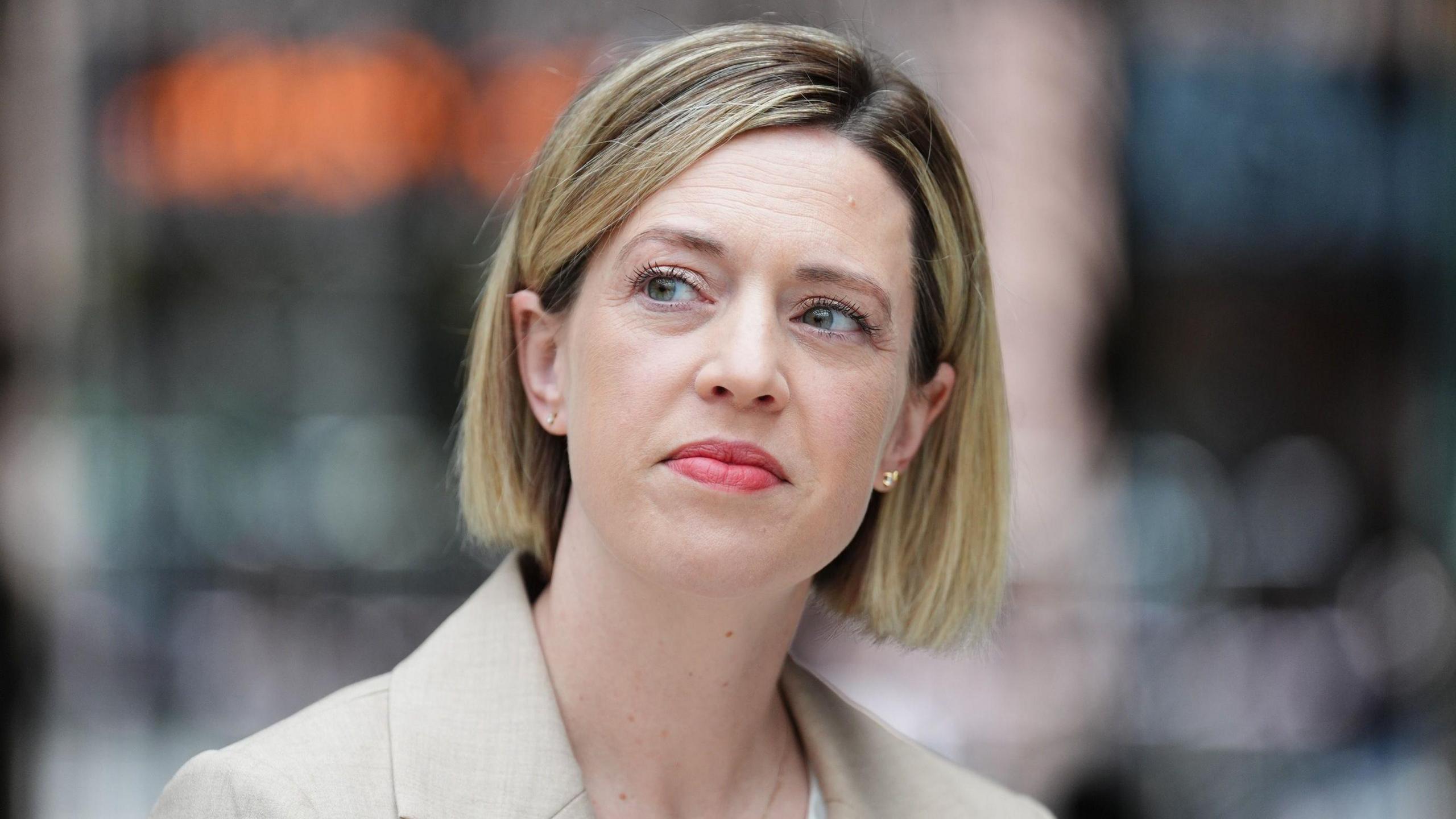 Image source, PA Media
Deputy First Minister Jenny Gilruth has described the proposals as a “starting point” for reform.
She said: “We need to ensure investment is focused on frontline delivery, with the right staff in the right roles to empower communities and deliver real improvements in public services.”
“Existing local government responsibilities could also be extended, including enhanced roles in economic development and business support so that individual areas can reflect local strengths and ambitions.”
The broad signals from the Scottish government at present seem to draw some inspiration from aspects of the two previous systems of local government in Scotland:
-
Large regional councils – which existed from 1975 to 1996 – which had responsibility for major services like education.
-
The old town councils – abolished in 1975 – which provided local services for distinct communities, sometimes of only a few thousand people.
They worked together with county councils.
There are no indications at present of the likely geographical boundaries of the new authorities.
Nor is there any indication of just how they would be funded.
Would the community bodies have tax raising powers of their own?
Or would the existing funding system be amended?
Inevitably this discussion may become intertwined with the question of replacing the council tax. So what do the current council leaders make of it?
 Image source, SNS
Perth and Kinross Council will be one of the first to fully debate the proposals on Wednesday.
Council leader Eric Drysdale, told BBC Scotland News he wanted them to be “a starting point for discussion rather than any final decision”.
“That’s why I believe it is vital to ensure that Perth and Kinross has a strong voice in the national conversation which is taking place about public service reform.”
Drysdale said the local authority already fulfilled many of the ambitions associated with public service reform through its partnership working, housing investment, employability support and collaboration with neighbouring authorities.
He added: “We have valuable experience to contribute that other parts of Scotland could benefit from.”
 Image source, Getty Images
But David Ross, leader of Fife Council, has questioned the very need for such fundamental structural reform – and does not think it will save money.
He said it would be “much simpler and more effective” to maintain the status quo but allow local authorities to “merge if they wished” and to collaborate through city region and local growth deals.
Ross proposed that they should also be trusted to develop local arrangements for “community empowerment”.
The council leader added: “Most local government services cannot simply be broken down into ‘community areas’ or they lose the economies of scale and operational efficiencies.
“Anyone who went through the last local government reorganisation in 1995/96 knows the complexity and disruption of this process and if the first minister thinks there will be any financial savings from the process then he is sadly mistaken.”
 Image source, Getty Images
Once actual proposals for the boundaries of the new regions and community bodies emerge, they may well prove controversial too.
One senior figure within Scottish local government that he thought the idea of six regions was simply a starting point or negotiating position.
He thought around 10 would be more realistic.
Fundamental change costs money to begin with – any savings are achieved over the longer term.
Another council leader, Brian Connolly, who heads up South Ayrshire Council, wants the costs of reorganisation to be met by the Scottish government.
He said: “The merits or otherwise of a regional approach can be debated but it is essential that local views and decision-making are maintained, along with substantial transfer of powers.”
Connolly added the three Ayrshire councils already have a “strong history of working together”.
 Image source, Getty Images
Given their proximity and links it is possible that Edinburgh, the three Lothian councils and the Scottish Borders could be within the same region.
But Euan Jardine, leader of Scottish Borders Council, said: “My biggest concern is rural Scotland.
“The Borders is a huge rural area made up of towns, villages and communities spread over a massive geography.”
He highlighted issues such as transport, access to services matters and local identity.
Jardine said: “The Scottish government has rightly recognised that island communities may need bespoke arrangements because geography matters.
“Well, rural mainland Scotland deserves the same thinking.
“You cannot take a model that might work in one part of Scotland and assume it will work everywhere else.”
The council leader said there were still “huge unanswered questions” in relation to local authority workers.
He added: “Who employs people? Where are they based? Who are they accountable to? What happens to existing council teams and local jobs? None of that is clear yet.”

The leader of City of Edinburgh Council, Jane Meagher, also has questions and is worried the plan could be rushed through.
She said it was unclear how community authorities would work and how they would be funded.
Meagher told BBC Scotland News: “What this might mean for Edinburgh Council remains to be seen.
“The timescale for such consequential and far-reaching reforms doesn’t lend itself to serious and considered discussion with the Scottish government.”
“Eleven weeks to decide the future of public services in the country is absurd.”

East Lothian Council leader Norman Hampshire said his administration supported the current structure of 32 local authorities bolstered by regional partnerships in priorities such as economic development and transport.
On the other side of Scotland, Argyll and Bute is a geographically vast, rural council – stretching from the Glasgow commuter zone to tiny islands like Tiree and Iona.
It was already looking at options for reform.
The so-called Single Authority Model would see the council and other local public services, such as the NHS, come together formally and work much more closely than at present. It is still keen on this approach.
Jim Lynch, is the leader of Argyll and Bute Council, which has the highest number of inhabited islands in Scotland.
He welcomed the Sottish government’s indication that it wanted to “identify a shared direction for public service reform”.
But Lynch added: “There is also the question of whether larger local government regions would still be able to reflect local needs and identities.

One of the most surprising results of local government reoganisation in the 1990s was the creation of Clackannanshire Council.
The smallest mainland council centred around Alloa serves around 52,000 people.
Council leader Ellen Forson says the council cannot ignore challenges and is always keen to work with neighbouring councils and other public bodies.
But she believes the council area itself works.
She said: “We are large enough to deliver effectively, but small enough to understand our communities, respond quickly and maintain a close connection between local people and those making decisions on their behalf.”
The reaction so far gives a foretaste of the intensity of the debate which is likely once solid proposals are published.
Blair McDougall, Labour MP for East Renfrewshire, has warned of the risk of the area – which includes some of Glasgow’s affluent suburbs – being absorbed into what he fears could be a larger city authority.
In the 1990s Labour fought to save Strathclyde Region and opposed the redrawing of Glasgow’s boundaries.
The reorganisation was opposed by most Scottish MPs and many within Scottish local government.
That level of controversy is unlikely this time.
The proposals will come from Holyrood and the SNP has more councillors than any other party.
But the powers of the new authorities, the practicalities of change and the simple geography of some council areas are still likely to provoke a huge discussion.
-
-
Published11 June
-
-
-
Published2 September

-
-
-
Published1 September

-
Disclaimer : This story is auto aggregated by a computer programme and has not been created or edited by DOWNTHENEWS. Publisher: BBC