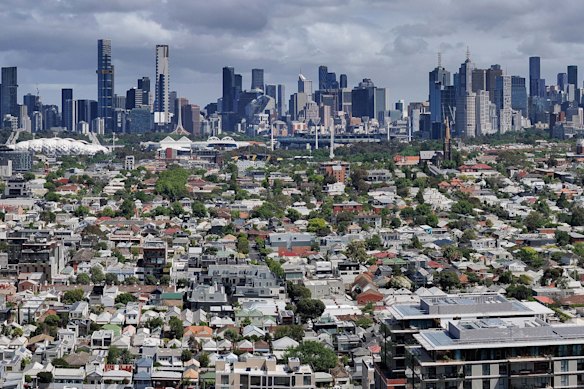

Melbourne councils are firing back at the premier’s claims they are the bottleneck in the housing crisis, instead blaming market conditions, land banking, and state government delays for tens of thousands of stalled homes.
As the state government positions the November election as a NIMBY versus YIMBY contest and amps up the pressure on local government to meet targets, new data from the Municipal Association of Victoria reveals a disconnect between what is approved and what is actually being built.
In the City of Maribyrnong, only nine out of 1178 dwellings approved over an 18-month period in 2023 and 2024 have been completed. Nearly 1000 of those approved homes – 84 per cent – have not even started construction.
In the outer-eastern suburb of Ringwood, 50 per cent of all dwellings approved since 2016 (1159 out of 2032) remain unconstructed. In the leafy inner-east, 669 of the 2522 homes approved within the Camberwell Junction catchment since 2011 never materialised.
Premier Jacinta Allan and Planning Minister Sonya Kilkenny have intensified efforts to frame the housing crisis as a direct contest between “blockers” – the “Not In My Back Yard” (NIMBY) contingent – and “builders” championing the “Yes In My Back Yard” (YIMBY) movement.
“We’re scrapping old NIMBY planning laws and saying yes to building more homes, faster,” Allan said in October last year.
The government has targeted affluent inner-city councils, accusing them of locking out Millennials, while ridiculing opposition MPs, such as Brighton’s James Newbury, as NIMBYs.
However, Port Phillip Mayor Alex Makin said the state government needed to “take a mirror to itself” before “punching down” and blaming local government for housing delays.
Makin pointed to ongoing delays at Fishermans Bend, the nation’s largest urban renewal project that could be home to 80,000 people, as evidence of the state government being a roadblock to new inner-city homes.
He said the council had been waiting more than a year for the government to finalise developer contribution plans, which in turn delayed the delivery of essential infrastructure, while the Montague precinct implementation plan was years overdue.
“It’s easy for the state government to blame local councils. It actually needs to realise it’s the reason for a lot of these delays,” Makin said.
In Whitehorse, once the epicentre of Melbourne’s suburban high-rise boom, Mayor Kirsten Langford reported a significant drop in activity. Residential planning applications fell from a consistent 1500 a year to 1000 in 2025.
“This is a reflection of the increasing cost and complexity of doing business,” Langford said. “Today, there are no cranes in Box Hill.”
Municipal Association of Victoria president Jennifer Anderson said the evidence proved councils were constructive partners in housing delivery.
“The local government sector in Victoria has pursued housing strategies to deliver more affordable homes for Victorians for decades, including using local schedules and policies to drive better designed homes in well-serviced areas.”
Merri-bek Mayor Nat Abboud said that 94 per cent of planning applications in 2025 had been approved within statutory timeframes.
A council spokesperson said many permits were failing to progress to the building stage due to the “increased cost of construction, financing, interest rates, taxation, and in some cases, land banking”.
The centrepiece of the government’s planning overhaul was the creation of “activity centres” in 60 zones near public transport, where local laws will be overridden by state-mandated height limits that encourage density.
The government has also introduced codes to fast-track low and mid-rise developments while stripping residents and councils of the right to challenge applications at VCAT.
The policies have been fiercely opposed by the Coalition, but backed by key industry groups.
Opposition planning spokesman David Southwick said rising costs and state taxes were the real reasons permits remained “on the shelf”.
Southwick said he had been told by councils that in the City of Melbourne alone, there were 17,000 inactive permits. In Kingston, 3000 approved dwellings remain stalled, and seven Box Hill towers were dormant, he said.
Inner-city councils including Glen Eira, Stonnington, Bayside and Boroondara have told the opposition their own structure plans are capable of delivering 400,000 homes – nearly double what the state’s activity centres estimate for the same areas by 2051 through activity centres.
“The government’s argument for scrapping council precinct structure plans simply does not stack up,” Southwick said.
Jonathan O’Brien, lead organiser for lobby group YIMBY Melbourne and backer of the government’s planning reforms, said councils had deliberately maintained a restrictive landscape, which limited the viability of planning applications.
“If you have made it so apartments can only be built on 5 per cent of your land, then you have created a constrained regulatory environment,” O’Brien said. “The answer is to increase the number of opportunities where it is legal to build.”
O’Brien said even in a challenging economy, it was vital to maximise approvals. “Even if not everything is getting built … the reality is we have some levers, and one of those is the ability to approve things through the regulatory process.”
Research conducted by the lobby group in 2024 found that metropolitan councils approved an average of 70 per cent of new home permits. Brimbank recorded the highest approval rate at 90 per cent, while Banyule recorded the lowest at 39 per cent.
A spokesman for Kilkenny said outer-suburban councils had carried the load for too long on housing, while well-connected inner areas such as Boroondara and Bayside had experienced slow growth.
“That’s not fair,” the spokesman said. “We’re fixing it by overhauling the planning system, cutting red tape and slashing upfront costs so more homes can be built close to the public transport, jobs and services Victorians rely on.”
Start the day with a summary of the day’s most important and interesting stories, analysis and insights. Sign up for our Morning Edition newsletter.
 Daniella White is a state political reporter for The Age. Contact her at da.white@nine.com.auConnect via X or email.
From our partners
Disclaimer : This story is auto aggregated by a computer programme and has not been created or edited by DOWNTHENEWS. Publisher: www.smh.com.au