

Updated ,first published
London: Leadership failures are being blamed for slow decisions and funding shortfalls that threaten the mammoth AUKUS submarine program, with a British inquiry revealing a series of problems that put Australia’s security at risk.
The parliamentary inquiry warns that the problems could snowball into a severe test for the AUKUS allies because investment has faltered, political leadership has dwindled and there are now serious doubts about whether the submarine project can be delivered.
The conclusions are a wake-up call to political leaders and military chiefs in the three signatories to the pact – Australia, the UK and the US – when submarine construction is behind schedule.
“We have deep concerns cracks are already beginning to show when it comes to funding,” said Tan Dhesi, the chair of the House of Commons defence committee, which undertook the first major review of the project for the British parliament.
“The investment pipeline has already faltered. This cannot be allowed to happen again.
“Even seemingly minor shortfalls and delays snowball over time, with potentially severe consequences for the UK and wider Euro-Atlantic security, and our standing with our trilateral partners.”
The committee, with members from all major political parties, called for faster decisions and greater action to finish the facilities needed to build and maintain nuclear-powered submarines in the UK and Australia.
While the pact sets out plans for Australia to buy at least three Virginia-class submarines from the US over the next decade, these vessels are meant to be an interim step before the UK and Australia build the new AUKUS-class fleet in both countries to a shared design.
The British government is planning to have up to 12 of the new submarines to defend its waters when it is seeing increasing incursions by Russian vessels. Australia hopes to have five vessels from the early 2040s, built in South Australia.
Dhesi, the Labour MP for Slough, backed the fundamental case for AUKUS despite the changes in world politics over the year since the inquiry began.
“Any undertaking of this scale requires committed, consistent political will and leadership,” he said in a statement upon the release of the report.
“Unfortunately, we found that the UK’s political leadership on AUKUS has dwindled. AUKUS can’t be seen as just another defence programme; if it is to stay on track then leadership must come from the very top.”
Australian Prime Minister Anthony Albanese on Tuesday played down the concerns raised in the report.
“There is support overwhelmingly from the British government, from Prime Minister Keir Starmer down, as well as from the defence personnel in the United Kingdom,” he said. “AUKUS is – to quote [US] President [Donald] Trump – full steam ahead, and I’m very confident that it will be so.”
The inquiry concluded that British Prime Minister Keir Starmer had to play a “more visible role” in promoting AUKUS – and that more control needed to come from his office rather than the Ministry of Defence.
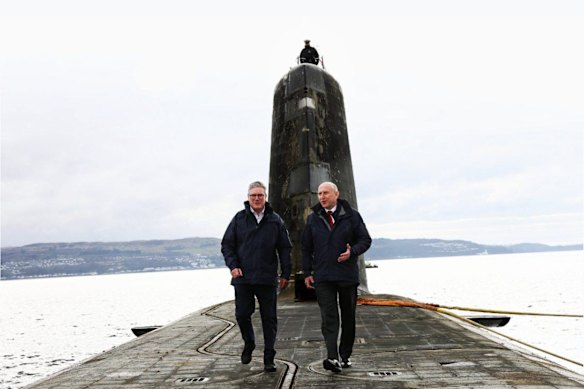
The report identified weaknesses in two major construction and maintenance bases in the UK at Devonport (near Plymouth) and Clyde (north of Glasgow) to ensure the Royal Navy could deploy submarines as promised.
“AUKUS has already started to hit bumps in the road. Submarine availability is critically low,” Dhesi said.
“Without urgent infrastructure improvements at HMNB Devonport and HMNB Clyde the government risks finding itself unable to meet its obligations under AUKUS.”
The key construction base for the AUKUS fleet in Britain is at Barrow-in-Furness, north of Liverpool, but the committee said the government was behind schedule in building the workforce and facilities needed to deliver the vessels.
The report was released at midnight on Monday in the UK (9am on Tuesday, AEST) after a year of review including testimony from ministers, defence officials and military experts.
Britain has committed £16 billion (about $30 billion) to AUKUS projects. This includes £4 billion for BAE Systems, Rolls-Royce and Babcock to design components for the SSN-AUKUS, another £3 billion for manufacturing at BAE and Rolls-Royce, and £9 billion for Rolls-Royce to produce nuclear reactors for the Royal Navy’s submarine fleet.
Australia has transferred $5 billion to upgrade the British industrial base, such as the design and construction of nuclear power plants from Rolls-Royce. Australia also spent $310 million in February on the first power components to be shipped to South Australia.
The construction of the new fleet depends on the speed with which the British can build the seventh and final Astute-class vessel and the new Dreadnought class nuclear-powered and nuclear-armed submarines, before it can shift to the new SSN-AUKUS design.
In one of its many warnings, the report noted that the Royal Navy had sent one of the Astute submarines, HMS Anson to Western Australia in early 2026 but had to hurriedly recall it when the US and Israel attacked Iran.
“It is clear that fulfilling this commitment has stretched the Astute fleet to – or even beyond – its limits,” the report said.
Observers are warning that Starmer and Defence Secretary John Healey have not put enough money towards rebuilding defence.
“Right now, the Royal Navy fleet looks like a construction site,” wrote James Fennell for the Centre for European Policy Analysis last month.
“All of the major classes of warships and support ships, without exception, are in various states of retirement, repair, construction, training, or crew regeneration.
“Some relatively new ships are tied up alongside but uncrewed as they await sufficient trained manpower and funding to be used operationally. It’s thought that of the force of just 13 destroyers and frigates, only around four are at sea.
“It’s the same story with attack submarines, where only one of the five vessels is known to be operational.”
The new report warns of a severe workforce challenge when the UK government expects to need 21,000 people working on the AUKUS vessels in UK shipyards and across the supply chain. The need for nuclear reactors means the civil and defence nuclear workforce will need to increase by 40,000 by 2030.
At Barrow-in-Furness, for instance, the government has promised £200 million in funding to build new facilities to support workers and their families around the crucial dockyard.
Lord Simon Case, a former cabinet secretary who now leads the Team Barrow agency to build these facilities, estimates the investment needs to be £1 billion.
The report called for more transparency about government decisions and the appointment of leading officials in each country, including Australia, to take responsibility for progress.
Opposition Leader Angus Taylor accused the Albanese government of underfunding defence.
“There is no commitment to make sure that AUKUS is properly funded,” he said. “We’ve been very supportive of making sure that the countries behind AUKUS … are able to trade defence technologies freely … but we do have to make sure that the transfer of technology and people to make AUKUS a success is easier between our three countries.”
Starmer named former national security adviser Stephen Lovegrove as AUKUS adviser in late 2024, leading to an internal review of the AUKUS project that was meant to be released but remains confidential.
“It is deeply disappointing that more than a year after Sir Stephen Lovegrove completed his review of AUKUS, the government’s commitment to issue a public version of his findings has not been fulfilled,” the parliamentary committee said.
“This reflects poorly on the government and is damaging to stakeholder and public confidence.
“It is also symptomatic of wider issues around the lack of public engagement with AUKUS.”
The committee called for the government to issue a public version of the Lovegrove report as soon as possible.
Get a note directly from our foreign correspondents on what’s making headlines around the world. Sign up for our weekly What in the World newsletter.
 David Crowe is Europe correspondent for The Sydney Morning Herald and The Age.Connect via X or email.
From our partners
Disclaimer : This story is auto aggregated by a computer programme and has not been created or edited by DOWNTHENEWS. Publisher: www.smh.com.au



