
TEHRAN – Joining Iranian political officials, several senior cultural figures, including the tourism minister, the head of the Iranology Foundation and the director-general of the National Museum of Iran, have criticized US Secretary of State Marco Rubio’s remarks on ancient Persian history, saying historical civilizations should not be used to justify political hostility or threats of war.
The reactions followed a speech Rubio delivered in Athens on October 7, in which he referred to the Greco-Persian Wars and the Persian army’s campaign against Athens in 480 BC. Speaking against the backdrop of the Acropolis, he said the forces of Persian king Xerxes had burned sanctuaries and destroyed parts of the ancient city.
In separate statements, the three Iranian officials challenged Rubio’s interpretation of history and emphasized Iran’s longstanding cultural and civilizational contributions.
Tourism Minister Seyyed Reza Salehi-Amiri said Iran should be addressed with respect as a living civilization and a great nation with an enduring place in world history.
In a statement issued late Friday, Salehi-Amiri said a nation’s identity could not be reduced to a single war, king or government, describing Iran as one of the world’s oldest continuous civilizations and a major contributor to the development of culture, knowledge, social order and coexistence.
“Iran cannot be defined by one war, one king or one government,” he said.
The minister also rejected the notion that Greek civilization belonged exclusively to the United States, pointing to the philosophical legacy of Socrates and Plato and their emphasis on justice, ethics and restraint.
“Greek civilization is not the exclusive property of the United States either,” Salehi-Amiri said.
He argued that political power was temporary compared with the historical memory and cultural identity of nations, adding that Iran had drawn strength from its civilizational heritage and the spirit of its people through periods of war, sanctions and what he described as historical distortion.
“Those who have considered themselves superior, unrivaled and entrusted with a historic mission have always overlooked one truth: powers come and go, but nations that stand firm on their memory, culture and identity endure,” he said.
Ali Akbar Salehi, head of the Iranology Foundation and a former Iranian foreign minister, also responded to Rubio’s remarks, drawing attention to repeated threats by US President Donald Trump to destroy a civilization.
“Secretary Rubio, the land of Cyrus the Great, who freed captives and respected the followers of other faiths, is not an enemy of civilization,” Salehi wrote.
“Now that you spoke of civilization, what is your opinion on Trump’s threats, who repeatedly threatened to destroy a civilization and return it to the Stone Age?” he asked.
Salehi’s remarks invoked Cyrus the Great, the founder of the Achaemenid Empire, whose rule is widely associated with the history of ancient Persia and its imperial policies toward conquered peoples.
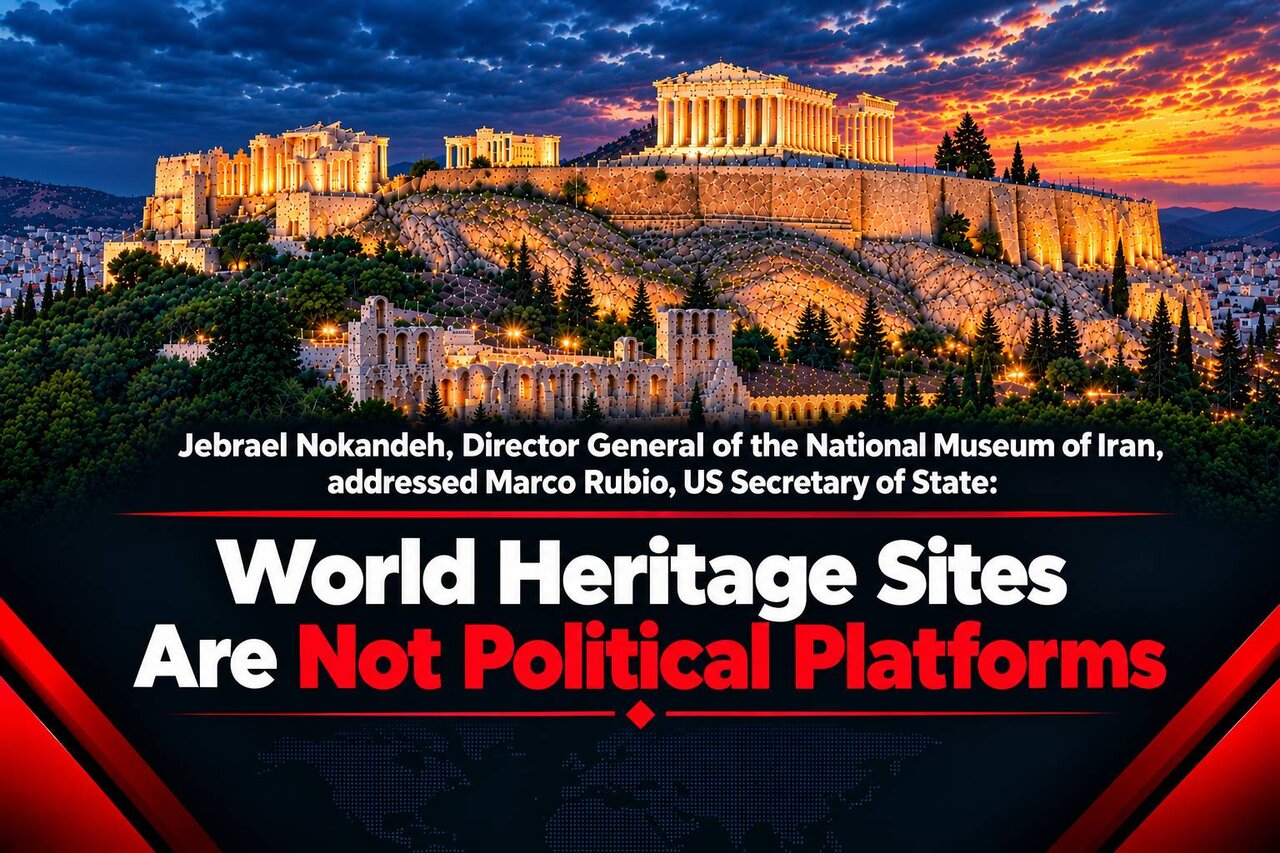
Jebrael Nokandeh, director general of the National Museum of Iran, focused on the use of heritage sites in political discourse, saying the Acropolis and other properties inscribed on UNESCO’s World Heritage List should serve as places of peace and coexistence rather than platforms for hostility.
“The Acropolis of Athens and all sites inscribed on the World Heritage List are realms of peace and peaceful coexistence for all the people of the world; they are not platforms for hate speech or the justification of warmongering,” Nokandeh said.
Addressing Rubio directly, he urged the US official to respect the significance of World Heritage sites and refrain from using them to justify confrontational policies or issue threats against Iran.
Nokandeh also criticized what he described as politically motivated interpretations of history, arguing that historical accounts should be grounded in scholarship and expertise rather than political objectives.
“History cannot be manipulated to suit political whims through personal and non-expert interpretations,” he said, adding that the study and narration of history required knowledge, expertise and integrity.
He further said Iran’s Persian civilization had made contributions to human history that could not be diminished by political rhetoric, noting that its significance was well established among scholars and experts worldwide.
Rubio’s speech drew parallels between the ancient Greco-Persian Wars and contemporary challenges facing the West, presenting the United States as the successor to the ancient Western civilization associated with Greece.
His remarks have prompted criticism in Iranian political and cultural circles, where officials have challenged the use of ancient conflicts to frame present-day relations and have called for greater respect for Iran’s historical identity and cultural heritage.
AM
Disclaimer : This story is auto aggregated by a computer programme and has not been created or edited by DOWNTHENEWS. Publisher: tehrantimes.com




