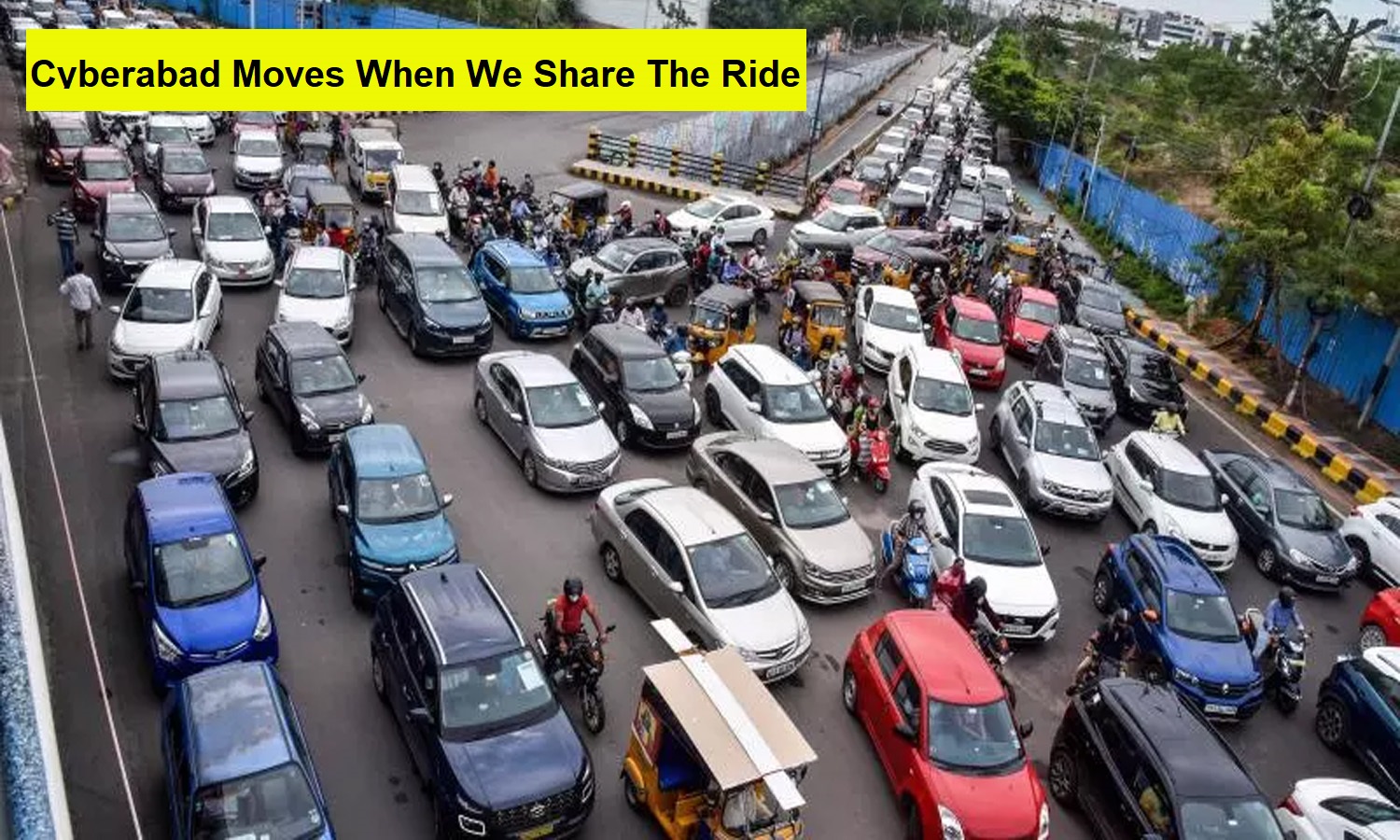
The data tells the same story. In Cyberabad’s main IT hubs, public transport currently handles barely 2 per cent of commuter movement, while four-wheelers and two-wheelers account for 82 per cent, according to the data from Cyberabad Police and the Society for Cyberabad Security Council (SCSC). Across 15 major IT-sector locations, daily traffic load exceeds 2.5 million vehicles that cross different stretches connecting the IT corridor.
This imbalance cannot be solved simply by creating more space for cars. For two decades, this part of Hyderabad has widened roads and built flyovers and underpasses. Yet congestion has continued to intensify as employment, residential development and private-vehicle use have grown. As more companies and workers come to Cyberabad, it will become increasingly difficult to build road capacity fast enough to keep pace, especially when urban land is already scarce.
The problem is well understood, and so is the broad direction of the solution. A shift from private vehicles to public transport and shared mobility like carpooling can unlock the true economic potential of one of India’s fastest-growing urban regions.
Public transport must carry Cyberabad’s future
In the long run, buses, the Metro and MMTS must carry the bulk of Cyberabad’s commuters. These modes can move far more people while using considerably less road space than private cars.
There is growing acknowledgement of this need, and investments are underway. But expanding public transport capacity takes time. New buses require procurement, depots, charging facilities and trained staff. Additional Metro coaches must be manufactured, tested and commissioned. MMTS services need improved frequency, punctuality and first- and last-mile connectivity. Thousands of electric buses are planned for Hyderabad, but their deployment timeline will determine how quickly commuters see their full impact. A tender has also been floated for 60 additional Metro coaches, but their procurement and commissioning will also need time.
Cyberabad cannot wait for every long-term investment to be completed before acting.
Every morning, thousands of cars enter Cyberabad, carrying only one person. The vacant seats represent transport capacity that already exists and can be used immediately. Even a modest increase in vehicle occupancy could reduce the number of cars entering Cyberabad during its busiest hours.
Anyone who has driven to work during Sankranti week knows how differently the roads perform when just a small share of traffic disappears. On a saturated road, removing even a small number of vehicles can noticeably improve our travel time.
Fewer cars would mean more than shorter journeys. They would mean less fuel use, lower emissions, cleaner air and quieter streets. Employers could benefit from staff arriving more punctually and less exhausted. Workers could reclaim time otherwise lost in traffic, giving them more time to spend with their loved ones, or simply to rest.
Turning scattered carpools into a daily habit
Carpooling is already happening across Cyberabad, although it is sporadic and nowhere near the scale we need.
Many companies like TCS, Cognizant, Infosys, Tech Mahindra, Wipro and Capgemini, to name just a few, actively encourage their employees to share rides. At Tech Mahindra’s HITEC City campus, employees who consistently carpooled were publicly recognised last November. Similar carpooling groups have grown at Raheja Mindspace and at firms like Envoy Global. Outside the office, residents of gated communities from Kondapur to Kokapet and Pragati Nagar run WhatsApp groups where neighbours heading to the same tech parks find each other every morning.
These efforts demonstrate that there is an appetite for shared travel. But they often depend on a small number of motivated individuals. When an enthusiastic employee leaves or a neighbourhood group becomes inactive, participation can quickly decline.
For carpooling to become a dependable part of the mobility system, it needs sustained institutional support. Employers can provide priority parking and clearly marked pick-up and drop-off points for pooled vehicles. They can recognise regular participants, establish measurable shared-commute targets and periodically report progress.
Safety and trust must be central, particularly for women and people travelling outside conventional office hours. Visible backing from employers, SCSC, Cyberabad Police and the Cyberabad Municipal Corporation, can help carpooling move from an informal arrangement to a credible everyday travel choice.
This solution is not a substitute for better public transport infrastructure in the city. But it can certainly bring relief while the expanded public transport capacity takes shape.
Give buses the priority they deserve
Telangana Road Transport Corporation, TGSRTC, will be central to transforming mobility in Cyberabad. The IT corridor of the city needs more buses, particularly during peak hours, but fleet expansion alone will not be enough. Buses need supporting infrastructure, accessible stops, real-time passenger information and convenient ticketing options. They should also have dedicated lanes to move quickly and reliably through congested corridors. A bus carrying dozens of passengers but trapped in the same traffic as private cars will struggle to become the attractive alternative commuters need.
Make better use of metro and rail capacity
Metro capacity must expand. Hyderabad Metro currently operates three-coach trains, and services through the IT corridor experience heavy peak-hour demand. The proposed addition of 60 coaches is welcome, but the procurement process should proceed as quickly as possible so that additional capacity becomes available to commuters sooner.
The most overlooked opportunity is the MMTS. Hyderabad already has a suburban rail network of about 140 km and 40 stations, including a newly redeveloped HITEC City station. Yet, daily ridership has fallen below 50,000 because of uncertain timings and frequent cancellations. The state government has already directed officials to improve peak-hour frequency, punctuality, passenger amenities and last-mile access to MMTS stations. More frequent and predictable services, supported by feeder connections between stations and employment centres, could help MMTS regain a significant role in Cyberabad’s daily travel.
If MMTS trains ran every ten to fifteen minutes at peak hours, with feeder buses from stations to office campuses, MMTS could once again become one of the main modes of travel for residents. The tracks and stations are already there. Many cities would welcome a suburban rail system of this scale. Hyderabad already has one; the task is to make better use of it.
Come, make your move!
In a little over two decades, Cyberabad has become one of India’s most important economic engines. The way people travel to work, however, has not kept pace with that transformation. Fixing that will require government agencies, companies and citizens to pull in the same direction, together.
That is the idea behind Cyberabad Moves, a three-day immersive mobility experience and convening organised by the Cyberabad Municipal Corporation, Cyberabad Police, the Society for Cyberabad Security Council (SCSC), along with WRI India’s SHIFT Transport Initiative. From 26 to 28 November at T-Hub, the experience will bring together mobility data, institutional knowledge and commuter perspectives. It will invite participants to reimagine a better-connected Cyberabad, with public transport as the backbone of its continued growth and prosperity.
It is also an invitation to everyone who lives, works, or studies in Cyberabad to consider a simple question: what would make you leave your car at home?
Srinivas Alavilli, Naved Alam Khan | Images by Arrangement
About the Authors | Srinivas Alavilli is a Fellow at WRI India. Naved Alam Khan is CEO of the Society for Cyberabad Security Council (SCSC).