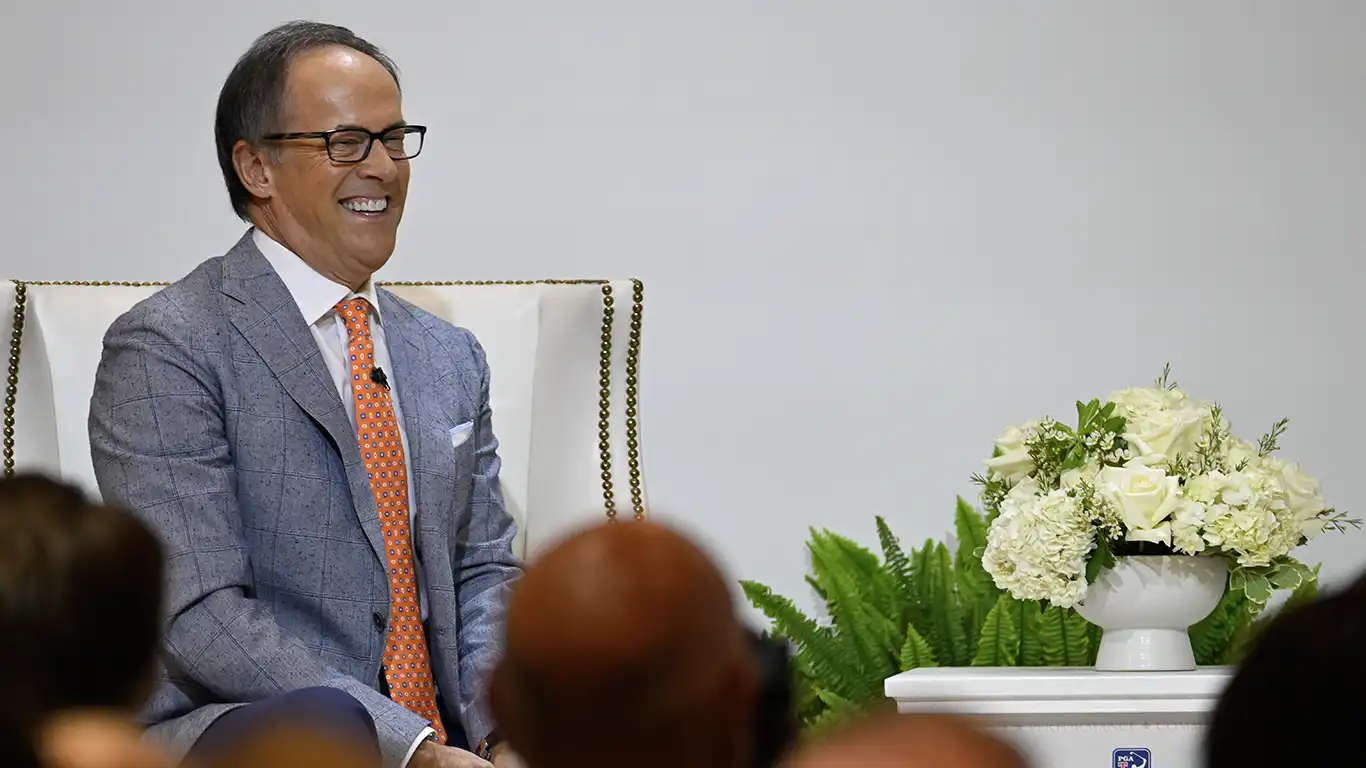
The last time I saw Dan Hicks — at Merion, at the U.S. Amateur in August — was like every time I saw Dan Hicks. A joy. He was sitting in a cart and hanging with two of his buddy-colleagues from NBC Sports, just off 16, Merion’s famous Quarry Hole, a rugged par-4 with a second shot over a rocky outcropping to an impossible sledding-hill green. Merion’s most famous hole, or one of them. It was a warm summer afternoon, the day’s play was done, Dan’s dinner reservation someplace good was likely in place, and time had stopped, or at least slowed down.
Dan Hicks knew Merion intimately, as he knew a lot of USGA courses intimately, Winged Foot most especially, where he was a longtime member. Dan was of golf. Not as an obsessive, but as a true lover of the game. He was one of its best broadcasters and his network has had the USGA contract for many years. Dan covered Justin Rose’s win at Merion, live and in person, in 2013. He should have been making return trips to Merion for years to come. After all, he was only 64 and at the top of his game when—
I’m slowing things down here as a sort of tribute to Dan, who was forever kind, funny, smart — and unhurried. You may know that unhurried is impossible in his line of work. That’s why he was a broadcasting legend, in golf, in football, in basketball, at the Olympics, on various highlight-reel news desks. He was always calm amid the constant chaos that accompanies the red light of live TV. He was ever-gracious in his public life. And he was a real person in his private one, loaded with stories and insights. Wherever he was, he always seemed to have time, even with all the juggling you have to do when you are managing the demands, and the joys, of career and family and friendships.
Dan Hicks died on Wednesday, Nov. 11, at age 64, from an acute illness that was not named. Golf lost one of its greatest ambassadors, and other sports will say the same. He was a star guard in winter and third baseman in spring at his public high school team in Tucson, Ariz., in the late 1970s, and he knew his way around all manner of leagues and a full deck of Olympic sports. But golf was home for him. In a tournament week, wherever you saw Dan — at a restaurant, in a hotel lobby, in the NBC Sports compound, on the course — he was never in a rush. He always seemed to be where he needed to be and where he wanted to be. He always seemed to be with people he liked. What a wonderful way to live.
I stumbled into a familiar scene, on that Saturday night at Merion in August. We spoke about the ridiculous sums LIV Golf had squandered and a fish house on the Shinnecock Canal where we had both eaten during the U.S. Open. We talked about how much unnecessary talking there is now on golf broadcasts. “Don’t get me started,” Dan said, but he was off and running.
Now and again, though not on this occasion, we’d talk about his wife, the ESPN broadcaster Hannah Storm. Hannah’s mother was a Hannah, too, and Dan and Hannah have three daughters, one of whom is yet another Hannah. Hannah’s father was a legendary basketball executive, Mike Storen, a founder of the Indiana Pacers. Hannah Storm went to Notre Dame in South Bend, Ind. Dan covered Notre Dame football. They met later, but they shared Notre Dame, and Dan was scheduled to cover Saturday’s Notre Dame-Boston College game. From the day they met, Hannah and Dan could share South Bend. When you have lived life as Dan lived life, finding common ground is second nature.
It makes the world smaller and more inviting, all this connectivity. Dan, in a broadcast booth, was inviting. You’d say the same of Jim Nantz, of Mike Tirico, of Jim McKay, back in the day. They all had a gift for bringing you in. Dan liked people. Makes all the difference in the world.
He was terrific in those bizarre pay-the-bills Sunday interviews he had to do with various corporate chieftains that represented, often with comical stiffness, the tournament sponsor. These interviews will typically eat up four good minutes in the name of promoting a charity along with the Acme Corp.’s devotion to it. Dan did these interviews with a wink and a smile and a certain lightness that nobody could match. They were fun to watch, in their own weird way, because of what Dan brought to them, a kind of appropriate impishness.
He wore suits at U.S. Opens and British Opens and jeans while eating out with his mates on Saturday nights on the road. He was a handsome man with a strong sense of style and had a definite presence without ever being a showboater. My goodness, did he class-up the annual Golf Writers dinner in Augusta whenever he was there.
Dan and I shared a lot of things. Time and place and age, to name three quick ones. I knew him, casually and a little more, for 30 years. “The best times were those early Tiger years,” Dan said that day at Merion. “He was so good. It was exciting just to be a witness to it.” Not his exact words but close to that. Dan knew he was preaching to the choir, that I would have said the same thing.
Dan knew, as we all knew, what a complicated and difficult person Tiger could be, so loaded with contradictions. But he wasn’t looking for or expecting perfection from him, and neither was he looking away. He was covering greatness. On that Saturday night at Merion, Dan was just enjoying the memory of it, the intense pleasure of seeing a difficult thing done well. Tiger winning the 1995 U.S. Amateur at the Newport Country Club. (Dan was there.) Tiger winning the 2008 U.S. Open at Torrey Pines. (Dan was there.) Tiger winning the 2018 Tour Championship at East Lake. (Dan was there.) Dan got to call the action, for millions of TV viewers. You were there because Dan Hicks was there. You’ll have that forever. Dan did a difficult thing well, too.
He worked side-by-side with Johnny Miller for two decades. On several occasions, I was able to hang with them before and during their broadcasts. NBC’s golf group, its on-air people and the directors and the camera operators and the spotters, are a special group, starting at the top, with Tommy Roy, the longtime producer. Hicks was especially close to Roger Maltbie and Jimmy Roberts, along with Bob Costas and Jim “Bones” Mackay and Mike Tirico and others. My guess is that Dan came up with “The Course Whisperer” for Maltbie, because Dan was so at ease with pop culture and he would know “The Horse Whisperer,” the book and the movie. Dan watched a lot of movies and read a lot of books. He read a lot of wine lists, too. He could imitate anybody, expertly. The wine helped.
Some years ago, I asked Dan how often he had had dinner with Johnny. “Never,” Dan said. “Nobody knows what Johnny does after the show. We don’t even see him leave.” Hicks was a perfect sideman for Miller. The path he cleared allowed John to be John. Neither was a corporate smoothie. Neither was ever on auto-pilot. They didn’t hype boring Sundays. They just let things happen and took us to the shots that mattered and the people who took them. Dan opened the doors for Johnny, tournament after tournament, and that made all the difference.
Dan could shoot 81 on a good day, and he played fast, companionable golf. He loved to play and played everywhere. I once was in a foursome with Dan and Jim Herman, the Tour player, at Pine Valley. Jim was on fire from the first hole on. Dan, while walking up a fairway and loud enough for all to hear, said, “How does this guy not top-10 every week?”
By the turn, Dan had a call whenever Jim rolled in a birdie putt: “The Hermanator!” He shot 64 that day. By the time the round was over, Jim Herman felt like the second coming of Ben Hogan. Hogan at Merion at the ’50 Open — like that good. Somebody will win the 2030 U.S. Open at Merion, but no one person will be able to fill Dan’s shoes there.
Dan Hicks had an unusual capacity to make people feel good. Golf will be in mourning for a long while here.
Michael Bamberger welcomes your comments at Michael.Bamberger@Golf.com.
Disclaimer : This story is auto aggregated by a computer programme and has not been created or edited by DOWNTHENEWS. Publisher: golf.com