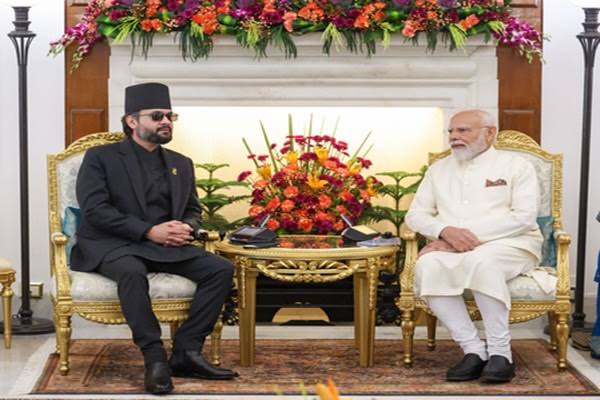
A Himalayan reset in India-Nepal ties comes after momentous times in the mountainous nation had led to a student movement evolving into a youth revolution that saw the old dispensation lose power and the representative of younger generations ascending the Prime Minister’s chair.
Nepalese Prime Minister Balendra Shah set the record straight in announcing that the relationship bound by historical, cultural and civilisational ties was “as strong as the Himalayas”. That he did so after choosing India as his first destination for a state visit, after addressing the UN as one of the youngest PMs to go up before the lectern in New York, reinforces the sharp diplomatic and strategic turn taken that makes contemporary history.
Gone are the days when K.P. Sharma Oli, as Prime Minister, unabashedly played the China card by visiting Beijing first after taking office, thus breaking a Nepali tradition of choosing its western neighbour for the closest ties not only in trade but in much else too. And another former Prime Minister in Prachanda too had, along with other Nepali leaders, aligned with China’s agenda, more for their own benefit, as per India’s assessment.
That was the time in recent days when India had been losing the perception battle mostly in the land of its nearest neighbours as they all wooed China as the alternative to strengthening old geographical ties to India. Chinese influence in Nepal had intensified so much with economic projects and cultural exchanges thanks to the political manoeuvring of leaders that India had reason to be miffed enough to place warm ties in cold storage.
The winds of change that blew through the subcontinent, beginning with Sri Lanka, Bangladesh and then Nepal brought about a sea change in relationships too after younger leaders took over the reins. India’s steadfast presence as a helpful neighbour made an impact first in Sri Lanka and then in Nepal where, after the recent disaster of a glacier breaking and falling off the mountain leading to the Bhote Koshi flash floods last August, India was the first responder in rescue operations.
Today, Mr Shah acknowledged that as he spoke in earnest in recounting the help given even as India has offered Nepal the equivalent of Rs 15,000 crore as development funds. In further recognition of the youthful changes that have come about, India also offered to set up an IIT in Nepal while also stepping up aid to Nepali students with scholarships to study law and technology. A startup incubator and an innovation hub will possibly be linked to the IIT to further help the youth of Nepal to get competitive in emerging businesses driven by technology.
Expanding on connectivity is also a key indicator of how much has changed with the reset. The flagging off of the Saryu-Kamala Express cross-border train service connecting places of significance in the two countries will be a boon for religious tourism even as Nepal came up with a request for easing certain restrictions in air connectivity. Along with eight MoUs to promote five major connectivity and energy projects, India has also offered to cooperate in a variety of fields, including in satellite technology.
The restoration of ties to a higher level of trust means Nepal will benefit a lot from India’s expertise in advanced technology while India gains in terms of security strategy with a neighbour sharing not only a long land border but connections from ancient times.
Disclaimer : This story is auto aggregated by a computer programme and has not been created or edited by DOWNTHENEWS. Publisher: deccanchronicle.com