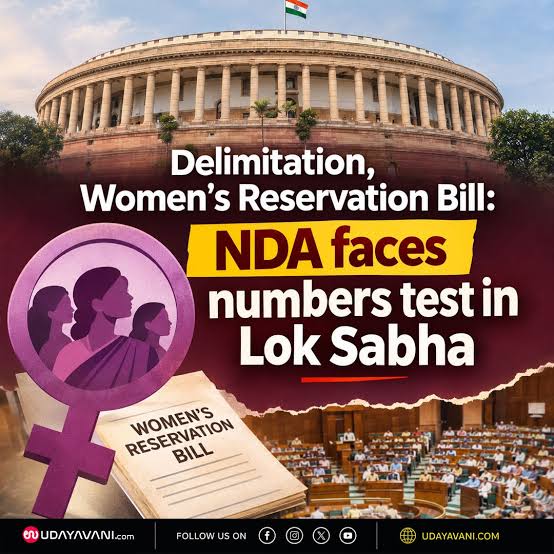
With the government calling for a special session of Parliament from Monday to consider a constitutional amendment for the delimitation bill, with which the women’s reservation bill runs again as twin legislation, the battle lines are drawn. It is hard to imagine that the ruling NDA would bring the bills back to Parliament after having failed to pass them on April 17 in a 298-230 Lok Sabha vote.
Armed with the promised support of the DMK, NCP (SP) as well as breakaway factions of TMC and the Shiv Sena and the YSRCP among others, the ruling alliance is hoping to muster the magic two-thirds majority number in a Lok Sabha of 540 (of 543) if all MPs are present and voting. It is a different matter whether taking up the bill in a heavily polarised political environment to expand the Lok Sabha by 50 per cent to around 850 seats is wise at this juncture and make it applicable for the 2029 general elections.
While delimitation has its own merits considering the burgeoning population which is now 140-crore plus and a voting population near enough to 100 crores, the proposal must be based on a proportional increase of MPs for all states rather than based on population because the more populous north Indian states would claim a numerical superiority. It is, however, clear that the BJP-led NDA is willing to sacrifice the known north Indian bias to have the bills passed and let the work of delimitation of constituencies begin in time for 2029.
There is no doubt over the proposal of one-third of the seats in an expanded Parliament reserved for women receiving all-party support. In fact, such a bill was already passed in Parliament with only reluctance from a male-dominated political landscape holding back on its implementation. It was in combining the women’s reservation with the delimitation that the ruling dispensation came a cropper in April.
A second defeat would be unthinkable for the rule of Prime Minister Narendra Modi who may have lost some of the perception battle after the exam paper leaks and the uproar over the denial of the rights of a considerable number of genuine voters. The matter of having the bills ratified by the states is another challenge but which will see an easing out if the delimitation proposal goes through.
The gerrymandering exercise, which usually hands the advantage to the ones doing the delimitation, cannot be done without a fair representation of Opposition members who are also stakeholders in the nation. Of course, that would be subject to the delimitation bill passing the constitutional test of a two-thirds vote. Several Opposition parties, barring the Congress, the SP and AAP, are inclined to support delimitation which might see them gain seats and MPs, have laid conditions like a 25-year freeze on seats to try and ensure they get places on the committee.
It cannot be said that in proportional increase for all states and UTs there will be an advantage for the ruling combine in the new Parliament. In that sense, the proposal may just about pass the fairness test, plus a positive in women getting to play a significant role in legislative business. It cannot be assumed that by retaining the same proportion of seat allocations, the numerical strengths of the more populous states will continue to tilt the scales in favour of the ruling alliance. Political circumstances change and delimitation is a necessity to ensure that people get more representatives in the legislature in a large country.
Disclaimer : This story is auto aggregated by a computer programme and has not been created or edited by DOWNTHENEWS. Publisher: deccanchronicle.com