
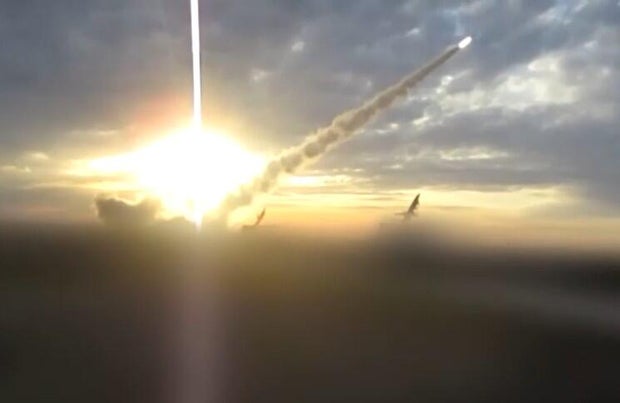
Amman, Jordan — When an Iranian missile hits its intended target, it’s because U.S. air defenses either failed to intercept it, or failed to even see it coming in the first place.
“One leaked through,” is how Secretary of State Marco Rubio described the Iranian attack on an air base in Jordan that killed two U.S. soldiers and left one missing in action on Friday. “A missile got through. We shot down almost all the missiles. One leaked through … it’s heartbreaking.”
When that happens more than once, which it has over the past week in Jordan, that’s not a “leaker.” That’s a problem for the U.S.
The same base, the Muwaffaq Salti Air Base, had been hit twice in a 48-hour period prior to the deadly strike on Friday. Direct hits. As CBS News reported Monday, dozens of U.S. military personnel were wounded.
Iranian, precision-guided munitions somehow managed to evade Jordanian and US missile defense systems to reach their targets. Twice. And the attacks continue — more Iranian missiles and drones were intercepted by Jordanian forces on Tuesday.
Iranian state TV
Asked how Iran had managed to strike the base with missiles on Friday, U.S. Central Command spokesman Captain Tim Hawkins told CBS News it would be inappropriate to comment as the incident remained under review. He said U.S. and partner forces had “defeated dozens of missiles and drones launched by Iran toward neighboring Gulf countries on July 17, but unfortunately a few got through and made impact.”
President Trump, speaking Tuesday at the White House, indicated that there were “other operators” at the base in Jordan that “let something through.”
“They [Iran] did slip something through in Jordan, and we had other operators,” Mr. Trump said.
“We have the best equipment in the world, you know, we’ve stopped almost everything,” the president said. “But, when you let other people do your job with the United States, we let other people do the job, and sometimes it doesn’t work out so well.”
Mr. Trump did not provide any further information about what “other operators” he was referring to or what role they had in protecting U.S. forces in Jordan.
The Pentagon acknowledged Monday, after CBS News obtained the figures, that nearly 100 American service members have been injured in multiple Iranian strikes on bases across the Middle East this month alone. That doesn’t include the recent round of attacks that killed at least two U.S. soldiers and wounded dozens in Jordan.
One veteran regional military analyst told CBS News that part of the reason for the rising American toll is that Tehran has upped its game.
“The Iranians have advanced missile technology,” said Jordanian Lt. Gen. Qasid Mahmoud, who served as Deputy Chief of Staff for his country’s armed forces before he retired. “They’re developing techniques and capacities to extend their reach, combining with drones to overwhelm radar defenses.”
“The Iranians use simple missiles to distract the radar,” Mahmoud, who has studied Iran’s military capabilities for years, told CBS News. “They then fire better quality missiles, which change their final target in the last 30 or 40 kilometers.”
That change in trajectory, he said, makes it harder to intercept the missiles.
Iranian state media 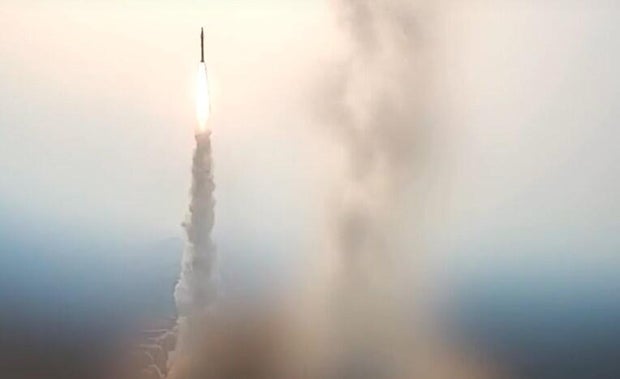
Despite hosting U.S. forces, Jordan had largely avoided Iranian attacks, with the Islamic Regime instead focusing its ire for months on America’s Persian Gulf allies, countries including Kuwait and Bahrain that have been targeted with repeated salvos since the war began.
But the U.S. bases in those countries are heavily fortified, heavily defended compounds.
Bahrain, for instance, is home to the U.S. Navy’s Fifth Fleet, while Kuwait hosts roughly 13,000 U.S. personnel on more than half of a dozen bases. Even in Bahrain, however, Iranian weapons have gotten through, including strikes earlier in the year that destroyed a radar installation.
The Jordanian government, on the other hand, is sensitive about even acknowledging the presence of U.S. forces.
Jordanian Foreign Minister Ayman Safadi has stressed that U.S. forces do not maintain any permanent bases in the country, saying repeatedly that they operate instead under joint agreements. That might suggest that outposts where American forces do operate in Jordan lack the kind of robust defenses used at permanent bases in Kuwait and Bahrain.
The two U.S. soldiers who were killed in the strike on the Jordanian air base, Private Isabella Gonzales of Carrollton, Texas, and First Lieutenant Tyler James Feehan from Hawaii, were both serving with Army Air Missile Defense Command — the kind of units responsible for air defense systems.
CBS News’ Omar Abdulkader and Ayman Qadi contributed to this report.
Disclaimer : This story is auto aggregated by a computer programme and has not been created or edited by DOWNTHENEWS. Publisher: cbsnews.com







