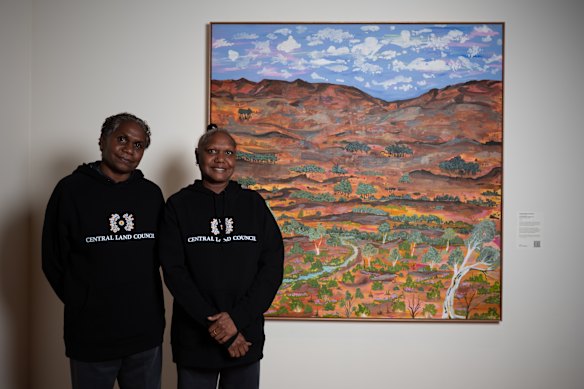

Elizabeth Ngwarraye Bonney’s painting stretches before me in great swathes of red and ochre – low ranges beneath a cloud-scattered sky, ghost gums, wildflowers and a winding creek bed. This is Titjambera, her grandmother’s Country.
“My mother has been fighting for this land for 40 years, one of the longest standing land claims in the Northern Territory,” reads Bonney’s description of her work. “We paint this Country to show our children, so they can keep painting the Country.”
I’m in Alice Springs (Mparntwe) for the opening night of the Desert Mob art festival where hundreds of works by Aboriginal artists from across Central Australia will be displayed. Bonney’s work seems to capture the essence of Desert Mob – art as a means of carrying culture forward, but also of fighting for Country.
It is one of the longest running First Nations art events in Australia, still going strong after 35 years. Presented by Desart, the peak body for Central Australian Aboriginal art centres, it brings artists from remote communities to Alice Springs each September for an exhibition, talks and a feverishly popular art market.
This year, 183 artists from 32 art centres are represented and their works reveal relationships with Country that run far deeper than landscape.
Sign up for the Traveller Deals newsletter
Get exclusive travel deals delivered straight to your inbox. Sign up now.
“Country isn’t just property, it’s family,” Desert Mob’s head curator Hetti Perkins says on opening night, as artists and visitors swirl around us.
“The ancestors created it, they still reside in it. And from that continuity comes culture.”
Aboriginal-owned art centres help sustain that continuity, adds Perkins, supporting artists with everything from bush trips and ceremonies to funeral services.
Outside, the desert heat has drained from the day and a crisp breeze moves through the eucalypts as we gather for the Vincent Lingiari Art Award, honouring the Gurindji leader whose Wave Hill walk-off in 1966 helped galvanise Australia’s land rights movement. This year’s prize goes to Bonney who is, fittingly, out on Country saving bilbies and doesn’t yet know she has won.
Later, my travel companions and I pile into the car and drive through the desert night with Kev Carmody and Paul Kelly’s song about Lingiari’s fight for land rights From Little Things Big Things Grow, pumping through the speakers.
Land rights remain front and centre the next morning, during a panel discussion marking the movement’s 50th anniversary.
“You have to keep fighting,” says scholar of Indigenous Australian affairs, Professor Marcia Langton. “Because they’ll [those who oppose Aboriginal land rights] never stop attacking the basic premise that Aboriginal people have rights.”
The day’s talks range across mining and water rights, art as protest, Indigenous fashion and cultural knowledge.
Another panel tackles buffel grass, an invasive species smothering vast stretches of Central Australia, crowding out bush foods and medicines and fuelling intense fires. As a response, artists from Iltja Ntjarra (Many Hands) Art Centre make the grass into paper and then paint images of the plants and foods it displaces onto it.
“This is a justice question,” says Alex Vaughan of the Arid Lands Environment Centre, noting Indigenous ranger groups are often tasked with tackling a problem they didn’t create. Yet he finds hope in the response. “Artists are the best storytellers. They get us thinking in unique ways around what’s at risk.”
Under a pavilion at Olive Pink Botanic Garden the next afternoon, a piece of rough buffel grass paper in my hand, I paint native plants in watercolours while artist Vanessa Inkamala yarns about the Country she remembers from childhood.
“We used to eat lots of bush tomato and mustard grass, it was growing everywhere,” she says. “Now, buffel grass chokes it and we don’t see it.”
Next morning, the queue for the Desert Mob Art Market snakes around the block. We surge towards tents filled with paintings, ceramics, weaving and hand-painted textiles. Back home, I desperately need a new fridge, but I blow the entire budget on art. The feeling of guilt lasts approximately 30 seconds, before I remember that buying through Aboriginal art centres means money flows back to artists and communities.
Later, walking through Angkerle Atwatye (Standley Chasm) on a cultural tour with Alywarre/Arrernte guide David McCormack, I think again of Bonney’s painting as we pass ghost gums and rust-stained rocks that tower above a winding creek bed.
At the end of the narrow gorge, we stop at a waterhole and I ask McCormack how I should introduce myself to his ancestors here. He thinks for a moment, then picks up a rock, rubs it against his skin and tosses it into the water.
“You can do that,” he says. “Now they know I’m here, I mean no harm, then they’ll know you’re with me, and you mean no harm.”
I do as he says, and watch the ripples spread slowly outwards.
DETAILS The annual Desert Mob festival includes ticketed talks and workshops. Opening night, exhibition and art market are free. See desertmob.com, northernterritory.com; DoubleTree by Hilton is about two kilometres from the centre of Alice Springs, rooms from $188 a night. See hilton.com
The writer travelled courtesy of Tourism and Events Northern Territory
 Nina Karnikowski is a travel writer focused on sustainability, and the author of two books including Go Lightly: How to Travel Without Hurting the Planet.Connect via X.
From our partners
Disclaimer : This story is auto aggregated by a computer programme and has not been created or edited by DOWNTHENEWS. Publisher: www.smh.com.au