
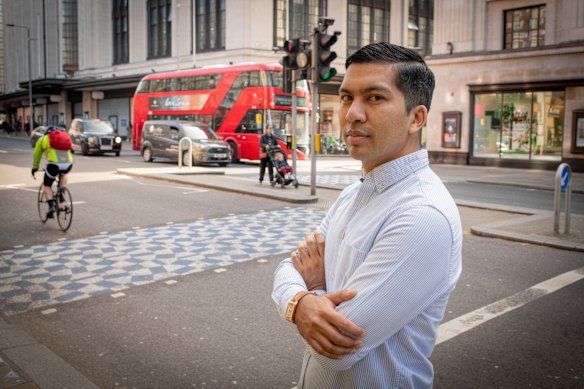

The Australian founder of this month’s controversial Enhanced Games says his new venture, a billionaire-backed “AI Tribunal” to challenge claims made about the uber-rich in the media, will restore trust in journalism rather than have a chilling effect on free speech.
Aron D’Souza, the London-based entrepreneur behind an alternative Olympics where athletes are allowed to take performance-enhancing drugs, last month unveiled Objection, described as an AI judge for adjudicating media claims, with significant support from billionaire PayPal co-founder Peter Thiel.
“Ultimately, the core problem we are solving is that there is no accountability mechanism for the news media. The court system is too slow, and it’s too expensive, and AI adjudication makes it all faster, cheaper and more accessible,” he said.
“AI is not perfect. AI hallucinates. However, human beings are more fallible.”
For a fee, starting from US$2000 ($2804), the subject of a story can file an objection. The company’s internal investigators – D’Souza says these are former FBI and CIA agents – then get to work scrutinising every line in the story.
The journalist then has the opportunity to submit their own rebuttal, before Objection’s AI comes up with a determination. Unlike a court, its decisions are not binding. But D’Souza insists that if journalists refuse to participate, it’s a sign that they don’t believe in transparency.
“If a journalist refuses to participate in an open, transparent truth-seeking process, that’s highly destructive to their reputation,” he said.
Objection is not the first time D’Souza and Thiel have challenged the media. D’Souza acted as a key go-between when Thiel secretly backed a lawsuit brought by wrestler Hulk Hogan against American gossip site Gawker after it posted a sex tape of him and the wife of radio personality Bubba the Love Sponge.
Hogan eventually won a $US140 million payout over claims that the site had invaded his privacy, leaving Gawker ruined.
As well as that case, Melbourne-born D’Souza cited this masthead’s CBD Column as an example of the kind of “unsourced gossip” that Objection aims to tackle.
“I feel like I can’t even walk down the street in Australia without CBD writing about me.”
On a deeper level, D’Souza said that Objection would help solve what he believes are some of the biggest problems in society today – a declining trust in the news media, and the lack of a shared truth.
“The example I always give is that for a lot of Australians, they think the COVID pandemic was worse than the Holocaust, and in Florida, they think it didn’t happen at all,” he said.
By allowing AI to determine the veracity of media articles, D’Souza believes Objection will restore that sense of collective truth.
For that to work, the venture will need to attract significant public buy-in. So far, most people interested in using the platform are billionaires, who D’Souza says he has been on the phone with for days.
“If you think about like, there’s only 3000 billionaires in the world, right? There are many already attached to this project in one way or another,” he said.
“We’re signing more up as we speak. You know, I’d say we have basically, low single-digit market penetration among the wealthiest people in the world.”
One of the first people to use the platform is Michael Sackler, scion of the family responsible for creating the highly addictive prescription drug OxyContin, which has faced multiple lawsuits over its role in the American opioid epidemic.
But D’Souza said that the goal of Objection is not to have fewer articles written about the world’s richest people.
“I think the goal of this is that every article that is written must stand up to the highest standards of peer review and external scrutiny,” he said.
“It’s not good enough that your overworked and underpaid editors get to make the decision about what is published because the power that journalists wield, in many ways, is more powerful than the biggest corporations or the richest individuals,” he said.
D’Souza cited a Molotov cocktail attack on the home of his friend, OpenAI chief executive Sam Altman, which came days after an unrelated New Yorker feature by journalist Ronan Farrow on the tech mogul, as evidence of the power of reporting.
Would submitting that article to Objection have stopped the attack on Altman’s home?
“It absolutely does because that content is going to help understand and give context to the overall narrative that Ronan [Farrow] created,” D’Souza said.
“Exposing the raw source data will give the opportunity to find actually what is true and distinguish that from opinion,” he said.
Despite the premise of Objection, D’Souza says his problem is not with journalists, but with media oligarchs.
“My axe to grind isn’t with journalists, I think journalists do a great job. It’s the media proprietors, it’s the billionaires like Rupert Murdoch and his lieutenants who are saying, you know, publish clickbait.”
The Market Recap newsletter is a wrap of the day’s trading. Get it each weekday afternoon.
 Kishor Napier-Raman is a senior business writer for The Sydney Morning Herald and The Age. Previously he worked as a CBD columnist and reporter in the federal parliamentary press gallery.Connect via X or email.
From our partners
Disclaimer : This story is auto aggregated by a computer programme and has not been created or edited by DOWNTHENEWS. Publisher: www.smh.com.au




