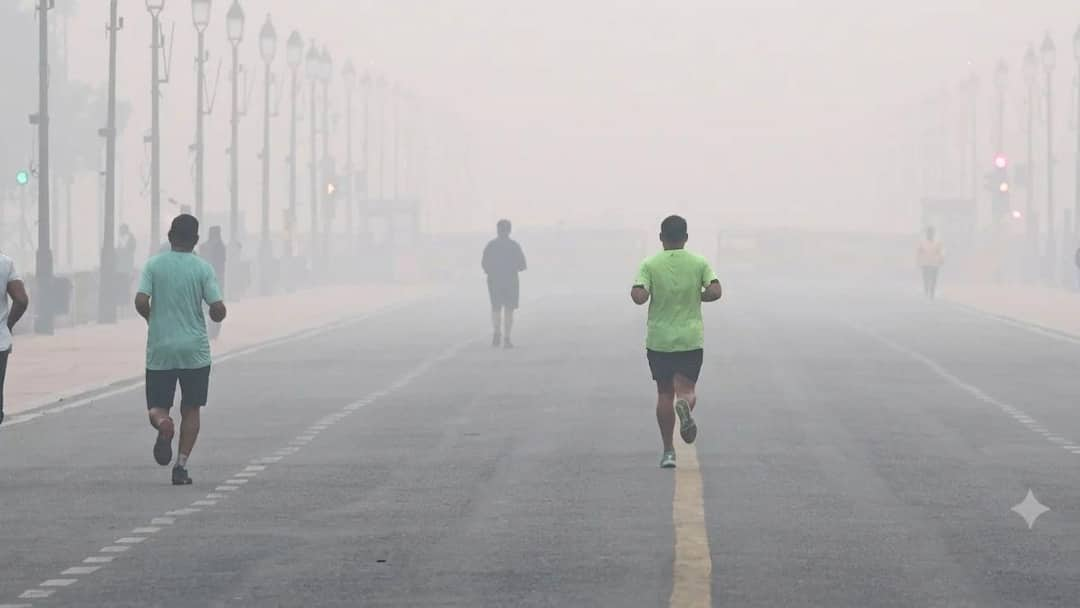
- Delhi’s air quality deteriorated to ‘very poor’ category.
- Air quality near India Gate hit 399 AQI.
- Winter approaching, stubble burning worsen the air quality.
- CAQM issued notices to Punjab officials over stubble burning.
Delhi’s air quality continued to deteriorate on Thursday, November 5, with a thick blanket of smog covering parts of the national capital ahead of Diwali. The worsening pollution has raised fresh public health concerns as winter approaches and temperatures begin to fall.
According to the Central Pollution Control Board (CPCB), the Air Quality Index (AQI) near India Gate stood at 399, placing it in the ‘very poor’ category. Visuals from the area showed a dense layer of haze obscuring the iconic monument, even as people continued with their morning walks and cycling.
The situation was relatively better in parts of east Delhi, with the AQI around Anand Vihar recorded at 296, falling in the ‘poor’ category, according to CPCB data.
Temperature To Drop As Winter Approaches
Delhi is expected to record a maximum temperature of around 31 degrees Celsius and a minimum of 18 degrees Celsius on Thursday. The weather department has forecast sunny to hazy conditions throughout the day.
With winter approaching, temperatures are expected to decline gradually, raising concerns over another spell of severe air pollution across Delhi and the adjoining National Capital Region (NCR).
Every year, falling temperatures, unfavourable weather conditions and emissions from multiple sources contribute to the deterioration of air quality in the region, prompting authorities to roll out measures to contain pollution.
Stubble Burning Adds To Delhi’s Pollution Woes
Stubble burning in neighbouring states, particularly Punjab and Haryana, continues to contribute to Delhi’s deteriorating air quality. The practice of burning paddy residue after harvesting releases pollutants that can travel towards the national capital.
On Wednesday, November 4, the Commission for Air Quality Management in National Capital Region and Adjoining Areas (CAQM) issued show-cause notices to the deputy commissioners (DCs) and senior superintendents of police (SSPs) of five Punjab districts over their failure to curb incidents of paddy stubble burning.
The notices were issued to officials in Jalandhar, Faridkot, Bathinda, Barnala and Fazilka, seeking accountability for the continuing incidents in their respective districts.
Delhi Records Worst Air Quality In 288 Days
The latest deterioration follows an alarming reading on Wednesday, when Delhi recorded its worst air quality in 288 days. According to the CPCB, the national capital’s 24-hour average AQI reached 377 at 4 pm, placing it in the ‘very poor’ category.
The reading highlights the worsening pollution situation as the city heads towards the winter season, when air quality typically comes under additional pressure.
Under the CPCB’s classification, an AQI between 301 and 400 falls in the ‘very poor’ category, while readings above 400 are classified as ‘severe’.
Disclaimer : This story is auto aggregated by a computer programme and has not been created or edited by DOWNTHENEWS. Publisher: abplive.com