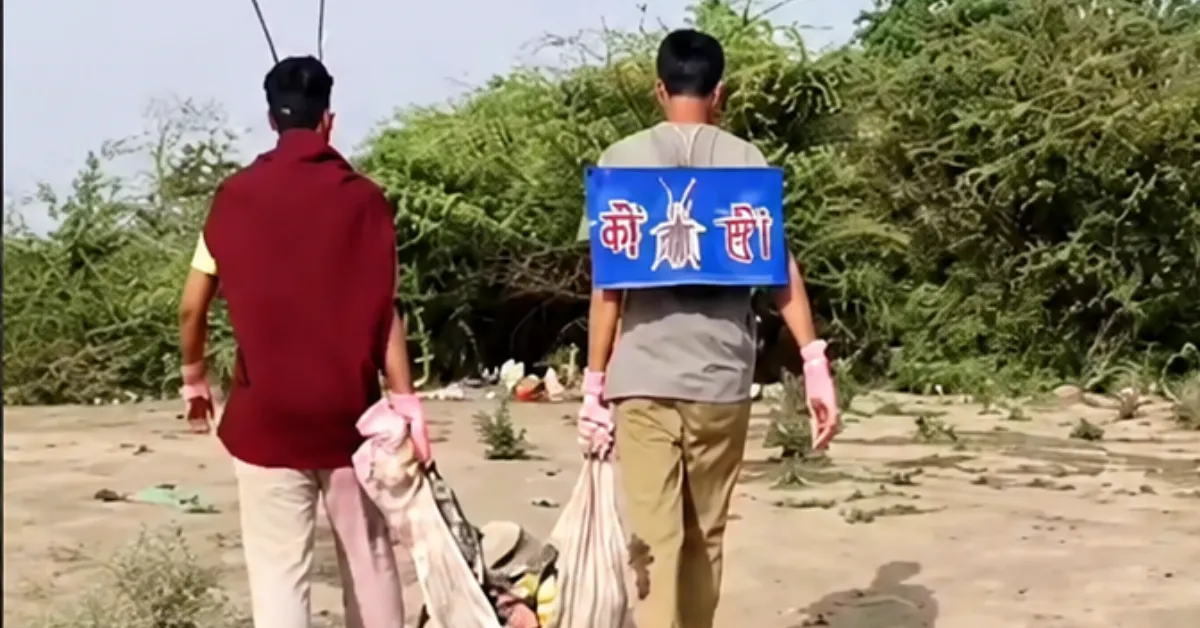
A giant cockroach bends down to pick up a discarded plastic bottle from the banks of the Yamuna.
Around it, more cockroaches, armed with gloves, garbage bags and rakes, gather piles of waste under the Delhi sun. Passersby stop to stare and pull out their phones, and within hours, the videos are everywhere on social media.
In a country where memes often disappear as quickly as they trend, the so-called ‘Cockroach Janta Party’ has managed to do something unusual: turn a viral joke into a conversation about civic action, public criticism and one of Delhi’s most pressing environmental challenges.
The young volunteers behind the campaign chose their costumes carefully. Their act came after remarks reportedly made by Chief Justice of India Surya Kant during a recent Supreme Court hearing sparked debate online. Instead of responding only through statements or hashtags, the group took the conversation to the banks of the Yamuna.
What followed was a mix of satire, environmental activism and internet-age storytelling that has caught the attention of thousands across the country.
What sparked the controversy?
The controversy began during a Supreme Court hearing, where the CJI reportedly used the word “cockroaches” while referring to certain unemployed individuals involved in social media activism, filing Right to Information (RTI) applications and publicly criticising institutions.
The remarks quickly spread across social media platforms, drawing reactions from journalists, activists and members of civil society.
For some, the comments raised questions about how citizen engagement and public criticism are perceived. Others viewed the episode as part of a larger debate around accountability, participation and the role of young people in public discourse.
As conversations intensified online, a group of youngsters decided to respond in a way that would be difficult to ignore.
/filters:format(webp)/english-betterindia/media/media_files/2026/05/20/cockroach-janta-party-2026-05-20-13-09-09.png)
Photograph: (instagram/@kayakuchitales)
Why did they choose the Yamuna?
Dressed in oversized cockroach costumes, the volunteers gathered near the Yamuna and began cleaning litter from the riverbank.
Videos show them collecting plastic waste, sorting garbage and interacting with curious onlookers. The symbolism was clear. If they had been compared to cockroaches, they would own the label, while drawing attention to a problem that Delhi has lived with for decades.
The choice of Yamuna also gave the campaign a larger purpose.
Delhi’s stretch of the river has long struggled under the weight of sewage, industrial waste and untreated discharge. According to a July 2025 statement by the Ministry of Jal Shakti, Delhi generates an estimated 3,596 million litres of sewage every day. Of this, about 641 million litres remains untreated and enters the river or drainage network.
The Centre for Science and Environment has also noted that the 22-km stretch of the Yamuna in Delhi, though barely 2% of the river basin’s total length, contributes over 80% of the pollution load in the river.
Against this backdrop, the costumes may have made people stop and watch, but the garbage bags pointed to something far more serious.
Turning a viral remark into environmental action
The campaign quickly gained traction online. Social media users described it as creative, humorous and peaceful, while others praised the volunteers for combining environmental action with a message about civic participation.
At the centre of the videos, however, remained the Yamuna itself.
For years, the river has appeared in public conversations during festivals, floods, court hearings, government campaigns and pollution reports. Yet, for many citizens, it often remains a problem to be discussed from a distance.
By showing up in costume and cleaning the riverbank, the group found a way to turn a moment of outrage into something physical and visible.
Their act did not claim to solve the Yamuna’s pollution crisis. But it did ask a simple question: if citizens can show up with gloves and garbage bags, what else can be done when civic anger is turned into action?
The clarification that followed
As the debate continued, Chief Justice Surya Kant later clarified his remarks.
According to reports, he stated that the comments were not directed at India’s youth in general. Instead, they referred to individuals allegedly using fake degrees and misusing professional platforms.
The clarification sought to separate legitimate civic engagement from conduct that undermines professional standards.
By then, however, the images of giant cockroaches cleaning a riverbank had already taken on a life of their own.
A question beyond the costumes
The story of the ‘Cockroach Janta Party’ is, in many ways, a story about modern activism. It reflects how a generation raised on social media often responds to controversy, not just through debate, but through symbolism, humour and public action.
/filters:format(webp)/english-betterindia/media/media_files/2026/05/20/cockroach-janta-party-2026-05-20-13-12-19.png)
(Instagram/@kayakuchitales & @earthwarriorofficial)
The costumes made people stop and watch. The cleanup shifted attention to the Yamuna, a river Delhi continues to struggle to protect.
For the volunteers, the message was simple: instead of letting a viral remark remain an online argument, they chose to turn it into an act of civic participation.
And in doing so, they left people with a more grounded question: what would happen if more public anger found its way into public action?
Source:
‘Cockroach Janta Party’ Goes Viral After Youth Clean Yamuna In Insect Costumes’ by Gaurav Sharma for OneIndia, Published on 19 May 2026.
Disclaimer : This story is auto aggregated by a computer programme and has not been created or edited by DOWNTHENEWS. Publisher: thebetterindia.com