
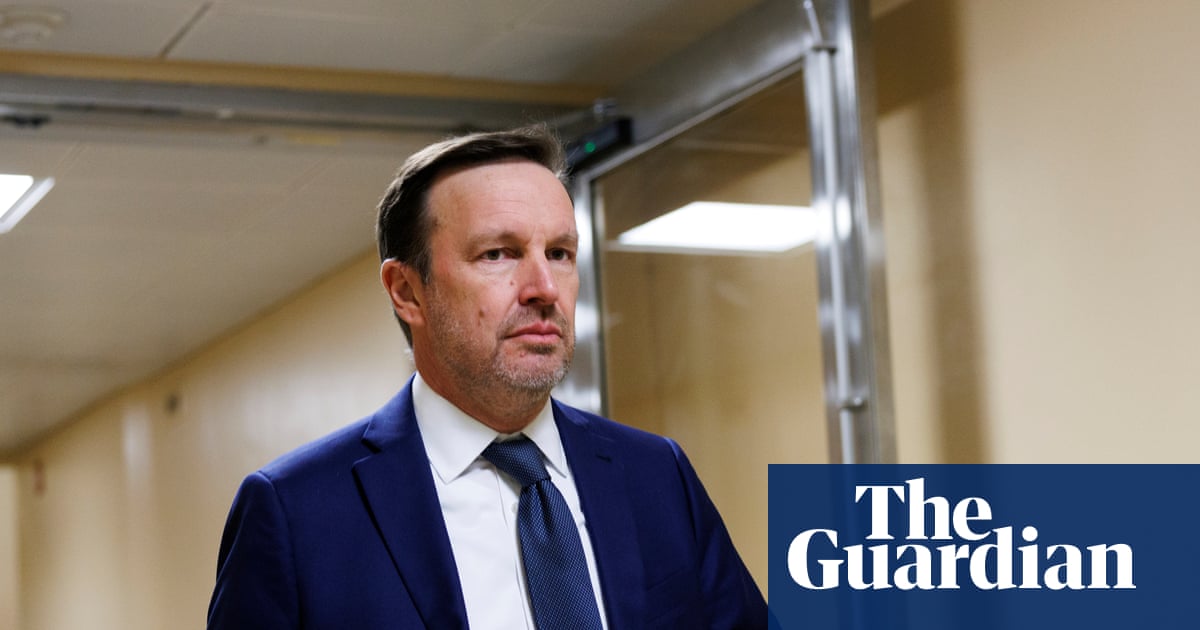
The US senator Chris Murphy said the Pentagon blocked him from a major US base in Qatar, yet saw enough damage on the US embassy in Saudi Arabia to conclude that an Iranian strike would have been deadly had it happened during the day.
The Connecticut Democrat, who sits on the Senate foreign relations and appropriations committees, described the destruction he witnessed in Riyadh as “extraordinary” and much more damaging than the public has been led to believe.
“Had that attack happened during the daytime, there’s no doubt that there would have been many, many Americans killed,” he told reporters on a call after returning from Qatar and Saudi Arabia. He also accused the Pentagon of trying to prevent Congress from seeing the costs of the war first-hand, saying the Pentagon secretary, Pete Hegseth, was “determined to hide the cost and the consequences of this war from the American public”.
Two drones hit the compound in the early hours of 3 March, days after the US and Israel launched the war on 28 February, setting off a fire and sending black smoke over the district. The building was reportedly empty at the time and no injuries were reported. Saudi Arabia’s defense ministry initially described the damage as minor.
But, according to Murphy, the drones caused extensive damage across several floors. The strike, he explained, hit “an area of the embassy in which there are a lot of people” and said that “part of that space is uninhabitable and will likely remain uninhabitable”. Murphy said some of it would not be repaired because the embassy is moving soon.
In Qatar, the senator visited Ras Laffan, the gas complex where Iranian drone strikes halted LNG (liquefied natural gas) production early in the war. Murphy said 17% of Qatar’s exports had been eliminated, probably for at least three years of repairs. He also said he saw just one LNG tanker in port, compared with the usual six, and about one a day leaving rather than 10.
Murphy said the Pentagon blocked him from seeing more. He said he gave notice of his visit weeks in advance and submitted a written request for access to Al Udeid air base, the largest US military installation in the region. He also said he raised it with Admiral Brad Cooper, the commander of the US Central Command, who appeared surprised that military leaders had also been barred from speaking to him. On arrival, Murphy said, he was told he would not have access to the base and no contact with military leadership.
In response, a senior Pentagon official told the Guardian that Murphy’s office “was informed before his trip” that he would not receive department support to access Ul Udeid air base, as per Hegseth’s 3 March directive on travel restrictions in the region.
“That decision was communicated in advance by the office of the secretary of war for legislative affairs,” the official said in a statement. “The department applies the secretary’s guidance evenly.”
Murphy said he would draft language in the coming days requiring the Pentagon to give members of Congress access to overseas bases, which he would seek to include in next year’s appropriations and defense authorization bills. If the war is still going by early next year, he said Congress should withhold defense funding unless it includes a provision to end the conflict, and vowed accountability and investigations if Democrats win one or both chambers in next month’s midterm elections.
The administration, he said, was “giving its middle finger to the Congress, pretending as if we are totally irrelevant”.
“We will potentially have power of both the House and the Senate,” Murphy said of Democrats, “and we should make the end of the war a priority.”
Disclaimer : This story is auto aggregated by a computer programme and has not been created or edited by DOWNTHENEWS. Publisher: theguardian.com




