
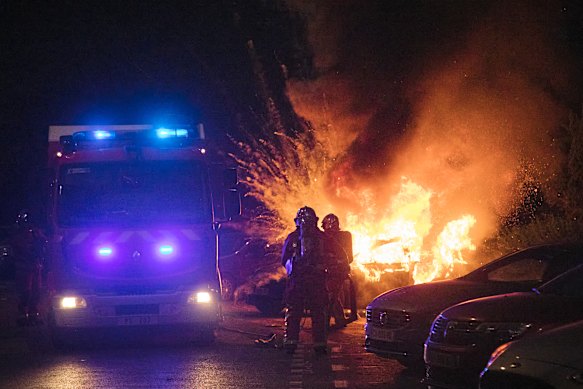

London: The protesters hurling rocks at police have become vivid proof of the fury in Europe at leaders who cannot meet the demands of a despairing public.
But the activists are not merely confronting police and political leaders. They are also at odds with economic reality: unfortunately, every government facing these protests has run out of money to give unhappy voters everything they want.
And that is especially true in France, where thousands of protesters took to the streets again on Saturday (Paris time) for another rally over education and the cost of living. It is also the case in Italy, where protesters marched on Friday, and in Spain, where protesters gathered in Barcelona and other cities.
Many countries across Europe are suffering from low growth, stagnant wages, high debt and rising costs. While every country has its own trigger for unrest, economic hardship is a common theme. Migration is also a factor in marches that heighten the pressure on social cohesion.
While protesters complain about austerity, most governments are practising the opposite. They are spending more than they can collect in taxes.
France is the leading example of this pressure. Its budget deficit is 5.4 per cent of gross domestic product (GDP) this year and will improve only if the National Assembly can agree on budget reforms, an unlikely prospect when all parties are preparing for elections next year.
Things are hardly any better in Belgium, where the deficit is 5.2 per cent of GDP and protesters are calling for more spending on schools. The deficit is 3.1 per cent in Italy and 2.4 per cent in Spain.
Political leaders have no easy answer to the angry crowds when their governments have no spare cash. The French government debt is now 119 per cent of GDP, while in Belgium it is 110 per cent, in Spain, 101 per cent and in Portugal, 92.5 per cent.
These facts will not stop the protesters. They do, however, highlight the sense of delusion about endless government spending and debt. The fires on the streets of French cities do not light up a path towards a solution, and the challenges will continue regardless of who wins the presidential election next year.
Another fact is that investors are growing wary of their exposure to European borrowing. In the week that France made headlines for riots and looting, the yields on its 10-year bonds rose to almost 5.1 per cent – proof that it must pay a bigger interest bill if it wants to keep borrowing. Germany pays 3.4 per cent on its bonds. Credit rating agency Fitch downgraded France’s outlook from “stable” to “negative” on Friday.
The predictable demand from the rallies is to hike taxes and hit the rich – starting with a 2 per cent tax on wealth over €100 million ($160 million) as proposed by economist Gabriel Zucman. In France, that might raise €20 billion a year from about 1800 households (assuming they do not move their money to Switzerland).
This idea was rejected in the National Assembly last year, but even if passed, it would not be enough to fix the woes in France. The contenders for the presidency, such as National Rally leader Marine Le Pen on the right and France Unbowed leader Jean-Luc Mélenchon on the left, are yet to set out any comprehensive solutions.
One key question: How much money can be raised without stifling growth? Many European countries already have relatively high tax burdens: tax is 43.5 per cent of GDP in France, 42.6 per cent in Belgium, 42.8 per cent in Italy and 36.7 per cent in Spain. (It is about 30 per cent in Australia).
While all this revenue has funded generous welfare systems for decades, it is still not enough to meet the demands from voters. The pressure on the social safety net is increasing when growth is lacklustre and family incomes are flat or falling.
In Spain, where people have taken to the streets over the high cost of housing, household income has at least grown in recent years. An index published by the European Union shows a slight gain from 2014 to 2024. But the country is now reeling from Wednesday’s train disaster.
In France, household income per capita has fallen over the decade: the index measure at the European Union is down from 116.6 to 109.1. The same slump has been under way in Italy, where the index is down from 101.2 to 96.5. Families are not wrong to feel their living standards are shrinking.
Growth is lacklustre among advanced economies worldwide, but it is especially weak in parts of Europe. The French economy contracted slightly in the first quarter of this year, grew by just 0.2 per cent in the second quarter and then shrank by 0.1 per cent in the third. Italy grew by 0.3 per cent in the first quarter and 0.2 per cent in the second.
Parts of the continent are forging ahead – such as Poland, where living standards have soared since the fall of Communism. The decline is greatest among the major powers of Western Europe. And Britain, by the way, is not spared: its national budget last Wednesday confirmed a future of annual deficits, deeper debt, higher welfare spending and lower household incomes.
But the violent protests in Europe are not just about the economy. The rioters are seeking to clash with police on other issues. In central Paris, for instance, they unfurled Palestinian and Algerian flags, as reported in this masthead two weeks ago. The graffiti in the Place de la Republique included anti-Israel slogans.
In Spain, police accuse a group known as “Blocus” of using social media apps to plan protests that they escalate into violence and looting.
This is a common dynamic in mass protests. Hard-left activists often put themselves at the vanguard of a march, as if they were its leaders. They can hijack an otherwise peaceful rally. The aggressive tactics in Paris over the past few weeks were typical of the “black bloc” agitators who have torched vehicles and buildings at public protests in the past.
Young men from migrant backgrounds were also part of the confrontations with police in Paris. Some were part of the looting seen by this masthead. Arguments about the protests are now linked to arguments about migration.
Fears about migration are shaping the presidential election due next year, and polling suggests it will help Le Pen, the anti-migration candidate.
Nobody should feel smug about the European crisis. Australia faces some of the same challenges as Europe, with annual budget deficits and pressure on living standards. Government debt is lower in Australia than in France and other countries, but it is increasing each year by billions of dollars.
Behind the broken glass is a broken social contract. Young people in some European countries see a future where their living standards decline compared to the generation that came before. Migrant families see a future where they do not prosper in their new countries.
Confidence slides in hard times. Support for migration falls and community cohesion fractures. Without growth, the social project stalls.
And, no matter what the protesters demand, governments cannot spend their way to a solution.
Get a note directly from our foreign correspondents on what’s making headlines around the world. Sign up for our weekly What in the World newsletter.
 David Crowe is Europe correspondent for The Sydney Morning Herald and The Age.Connect via X or email.
From our partners
Disclaimer : This story is auto aggregated by a computer programme and has not been created or edited by DOWNTHENEWS. Publisher: www.smh.com.au







