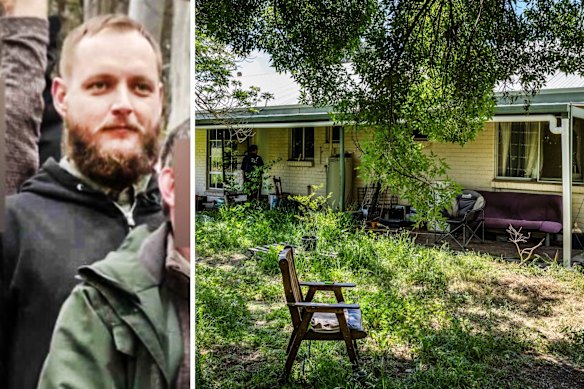
Last New Year’s Eve, Brendan Nugent barged into his father’s home, ranting. It was the first time Rodney had seen his son in years.
Nugent, once known in Wangaratta as a passionate environmentalist and talented high school footballer, was again in the grip of the mental health struggles that had caused him to grow increasingly isolated and erratic.
No one visited his overgrown house outside town any more. His family hired a mediator to handle his needs, but by October this year, Nugent had fired them.
While Wangaratta is the gateway to the lush, green hills of Victoria’s north-eastern Alpine country, to some experts it’s known as a desert. Health and extremism researchers have been warning of a dangerous vacuum of mental health services out here – where people often live in makeshift shelters and bungalows, off-grid, and unaccounted for, and locals say so-called “sovereign citizen” anti-government ideas are brewing.
There are few answers after this week’s alleged attack on popular local MP Helen Haines – the second major case of violence against public officials in the area in just over a year. Haines has had both her legs amputated and remains in critical condition at Melbourne’s Alfred hospital after a car rammed into her on Monday.
In August 2025, further into those hills, a conspiracy theorist named Dezi Freeman shot dead two police officers and injured another when they arrived at his remote home to serve a warrant in a child sex abuse investigation.
Freeman had an appointment with a psychologist booked that day. Instead, he opened fire on police and fled into the wilds of Porepunkah, sparking Australia’s biggest manhunt, before he was shot dead seven months later and more than 100 kilometres away, near the NSW border.
Haines, a former nurse and health researcher, had long been calling for an urgent injection of healthcare resources for the area, and her voice grew louder after the Freeman shootings and a devastating sweep of bushfires. None came.
Nugent is the man accused of deliberately hitting Haines with his four-wheel drive, twice, outside her electorate office in Wangaratta. He had been in and out of local psychiatric facilities. Like Freeman, he’d railed online against the system as he struggled to find support, speaking of unemployment, chronic pain and stints of homelessness. And like Freeman, he’d been drawn into a web of conspiracy theories on social media.
It is unclear how deep the similarities go between the two cases, and experts stress that having a mental illness does not mean someone will become violent. It also “should not be treated as an explanation for extremism”, says Dr Zena Burgess, noting that “alienation and exposure to extremist networks” often plays a role.
Josh Roose, an extremism expert who has assessed high-profile cases of sovereign citizens for police, has warned that support services in Victoria’s north-east are stretched to breaking point. It’s a statewide problem of under-resourcing, but the lack of healthcare and housing options carries particularly “dangerous implications” in country as remote and known for sovereign citizen ideology as the Alpine region, he says.
This masthead spoke to about a dozen experts, some of whom said the region’s mental health services were in a similar state to Victoria’s dilapidated roads. Local GPs say patients often wait six to nine months to see a psychologist once they get a referral – even after the Freeman case, the pandemic and a royal commission into the state’s mental health system which, in 2021, called for major investment in rural communities.
Those close to Nugent say he started smoking marijuana in his teens, and his mental health began to unravel in his 20s, but they hadn’t noticed any signs of extremism.
Others, including neighbours, have described years of aggression and violence from Nugent, particularly targeted at women. When the Haines attack happened, Wangaratta police were already investigating a report that he had menaced a woman with a claw hammer last month following an alleged road rage incident near the town.
But some who knew him spoke of a quiet and intelligent ecology researcher who was well-liked. All say he changed dramatically in recent years from his days protesting logging in the local forest nearly a decade ago.
Nugent’s lawyer told a local court on Thursday that his client was not on any medication at the time of his arrest but suffered from a rare spinal condition, and also had a concussion. He has been charged with dangerous driving causing serious injury, intentionally causing serious injury, and causing harm to a Commonwealth public official. Nugent was sent for an urgent mental health assessment as he was remanded in custody and did not apply for bail.
Roose says the evidence that has emerged so far paints a picture of an unwell man living increasingly alone and off-grid, being drawn deeper into far-left ideology and conspiracies. This week, the yard at the home that Nugent’s father had bought for him seven years ago was overgrown and littered with beer bottles and plastic plant pots.
Police are now investigating connections between Nugent and Haines, who was close friends with his father and stepmother, and whether the alleged attack was “opportunistic” or the result of a particular fixation or monitoring of Haines. They are also probing any potential connection between Nugent and the local sovereign citizen movement to which Freeman belonged.
In 2019, Nugent was briefly part of the same local anti-logging group as Freeman’s landlord, Rebecca Swift, though neither appeared to hold conspiratorial, anti-government views at the time.
Roose says both personal and ideological motives could well be at play, as well as substance abuse issues and illness. “Irrespective of whether or not it was planned, someone like Haines may have just symbolised government, and the system he viewed as corrupt [that he felt had let him down],” Roose says.
Online, Nugent followed and engaged with a number of doomsday, far-left and anarchist accounts. In 2022, he began spouting false pro-Kremlin conspiracy theories, claiming Russia’s invasion of Ukraine was a secret American operation to hike sanctions on Russia and tip the world closer to “world war III”. “Ukraine exposed as CIA-MI6 beachhead,” Nugent wrote in February 2024, as the war entered its second year. He commented on posts by Australian government ministers accusing them of helping Israel commit genocide in Gaza, though he had earlier praised Haines herself.
While his family had long cut contact with Nugent by the time of the alleged attack, they had continued to pay his bills and petrol, and planned to leave him the house where he lived.
Many locals say they barely knew their reclusive neighbour; some were afraid of him after altercations which began in late 2019, but others thought he seemed nice enough.
Days before the alleged attack, Nugent had his knives sharpened at the local butcher, who remembered him as a “normal guy”.
Nugent had multiple stays in psychiatric units, including the Kerferd ward operated by Albury and Wodonga Health. A former mental health nurse at the ward says they felt there were many opportunities to “catch” Nugent as he moved through the system, but services are overwhelmed across the state.
A senior Melbourne-based psychiatrist, who was also not permitted to speak publicly, told this masthead of significant issues in attracting staff to the north-east region, leaving the Kerferd and other surrounding units covered by a string of locum doctors juggling large areas without long-term knowledge of individual patients. The overreliance of fill-in staff was also raised by union members working at Kerferd last year in a survey, alongside concerns about rising workloads and leadership failures.
According to the most recent health data, only 55 per cent of patients presenting to hospital emergency departments for a mental health issue were moved to a specialist bed within eight hours – well below the state government’s 80 per cent target.
Dr Pramudie Gunaratne, who heads the Australian Society of Psychiatrists, says it’s too early to say how big a factor mental health played in the Haines incident, but the case and others “show what happens when we’re flying blind”.
Two years ago, the Westfield Bondi Junction attacks revealed major failings in psychiatric care when Joel Cauchi, a man living with schizophrenia who had fallen into homelessness, went on a fatal stabbing spree through the popular Sydney shopping centre.
The psychiatrists’ society will write to federal Health Minister Mark Butler next week with an urgent proposal to fund a national “observatory” project, tracking mental health service demand and outcomes across the country.
“We know that people fall through the cracks in the system all the time, but it’s a revolving door,” says Gunaratne. “We’ll have a tragedy and then outrage, and we might even have an inquiry to tell us what we already know, but nothing ever changes. The system is too overwhelmed to even keep waitlists.”
In Wangaratta, director of the Phillipson Street Medical Clinic, Dr Patrick O’Connor, says there are only a few beds for those suffering from serious psychiatric illnesses in the area.
“There is one mental health service based out of Albury Wodonga, and you can be on the phone for ages, and you just have to keep calling back to get someone on the line. You really have to push your case.”
The horrific police shootings by Freeman in August 2025 have added further strain to services in the region, locals say, with police and their families still recovering.
Australia’s mental health system is designed for crisis, explains Gunaratne. Patients are often told they must be fully detoxed to get a longer-term bed beyond a brief emergency stay in a psychiatric ward, for example, but there are few spots at drug and alcohol treatment centres to detox. Funding tends to flow to the most visible choke points – to reducing hospital waiting times – but without longer-term treatment and preventative programs, more people are forced into emergency rooms anyway, Gunaratne says.
“And then when someone is then discharged, you have to follow up,” O’Connor says, describing years of inadequate investment in the sector.
“Often we have to seek out private psychiatrists or use telehealth, which is not ideal, and sometimes people are falling through the cracks. I can’t talk about what happened [with independent MP Helen Haines], but the situation [in general] is not good,” he says.
There are just two inpatient detox beds in the region for planned alcohol and drug withdrawals: one at Northeast Health Wangaratta and one at Albury Wodonga Health. Two healthcare sources, speaking on condition of anonymity, say waiting lists for the beds now stretch well into 2027.
Dr Paul Molina Chavez, director of the Wangaratta Medical Centre, says patients often have to make do with telehealth consultations because of the demand, while others are forced to make the three-hour drive to Melbourne to seek private treatment.
“And there are not enough private clinics, which often have waiting times of several weeks, or even months, themselves,” says Molina Chavez. A lack of specialist training across regional Victoria forces medical students to gain the expertise in Melbourne or Sydney, he says, and few return to the country.
“The saddest thing is knowing that we have effective treatments, but so often people can’t access them,” says Gunaratne. “It’s so hard to get someone into care.”
Sometimes, she adds, “people turned away are even labelled treatment resistant, when they’re not, making it even harder for them to get support”.
Across the state, waiting times for alcohol and drug treatment have more than doubled since the pandemic, according to Victorian Alcohol and Drug Association CEO Scott Drummond, with regional communities facing “acute gaps” in care.
“Out of desperation, people may end up in emergency departments,” he says. “Regional communities cannot continue to be left behind.”
Meanwhile, for someone already perilously close to anti-government ideology, being cut loose from the system after brief stints of emergency care can become a deep betrayal, making them even harder to reach.
Research by Griffith University published just days before the Freeman attack last year found that those who hold conspiratorial, anti-government views were more likely to engage in violence themselves or support violence directed at governments and officials.
“Of course, that doesn’t mean all sovereign citizens are violent or people who are mentally unwell will become sovereign citizens,” says Kristina Murphy, a criminologist who helped lead the research. “But [sovereign citizens] are less likely to believe in the authority of governments, they report more anger at institutions, and that makes them more willing to back insurrection or violence against officials.”
More from our Helen Haines coverage
Disclaimer : This story is auto aggregated by a computer programme and has not been created or edited by DOWNTHENEWS. Publisher: www.smh.com.au