Without Kareem Abdul-Jabbar, L.A. punk rock history might not have been documented. On the surface, this may seem preposterous. Yet for Dina Douglass, if not for the Lakers great and his hobby, she couldn’t have bought a Canon AE-1 camera at 14.
“My dad was a doctor who collected Persian carpets,” she says. “Fellow rug collector Kareem Abdul-Jabbar heard about my dad’s collection and would occasionally come by our home to see what he had. Over time, my dad gave me a few small rugs, and at some point, Kareem decided he liked one. My dad arranged for him to buy it, and I used the money to buy my very first Canon AE-1 camera.”
Growing up in Agoura Hills when most of her classmates played sports, worked at fast-food restaurants or hung around watching movies, Douglass had a different idea of what a good time was. Transfixed by her father’s Instamatic camera, which she initially used around the neighborhood, Douglass preferred listening to records and going to shows (with homework sprinkled in).
Douglass went to her first show at 14 (Gary Numan at the Forum). Once she could drive and had a car, she went to three to four shows a week, camera in hand. It set her on a path that’s shown in her new photo book, the aptly titled “Shot as a Teen” (through Trust Records and Kill Your Idols Books).
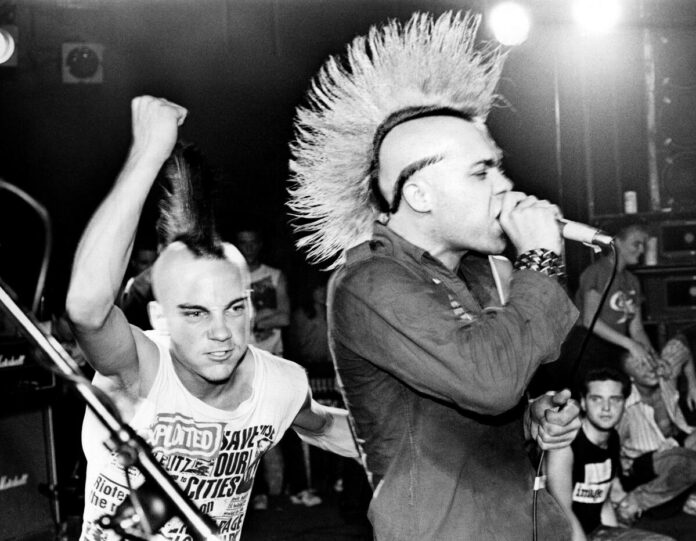
Wattie Buchan of the Exploited on stage with a young punk.
(Dina Douglass)
Oftentimes, when Douglass went to shows, she made the journey down to L.A. on her own.
“No one out there [in the Valley] was interested in punk,” she says. “Back then, your parents would just be like, ‘Bye!’ and you didn’t have a cellphone, and you were driving to the bowels of downtown Los Angeles, and the seediest areas possible that were really dangerous, and none of us had any fear.”
At the time, the punk scene still ran on word of mouth, with zines and DIY promoters like Goldenvoice providing what, generously, you could call infrastructure. Long-defunct, and now mythical Southern California venues like the Hong Kong Cafe, Masque, Cathay de Grande, the Country Club, RollerWorks, the Olympic Auditorium and the Starwood hosted all-ages shows. Douglass believes she shot her first show in 1981 at Al’s Bar, featuring Social Distortion and the Super Heroines.
For the next three years, instead of partaking in traditional high school activities (her sister was a cheerleader), Douglass was out on the town capturing punk’s deviants and miscreants.
Douglass, along with fellow photographers Edward Colver, Marla Watson and Alison Braun, documented the scene. Late nights out were the norm, and encounters with punks were common (even if she was scared to talk to some of them because she was so young); some even enjoyed being photographed.

Mike Ness of Social Distortion.
(Dina Douglass)
“[Late Social Distortion guitarist] Dennis [Danell] was a huge, huge clown in front of the camera,” she says. “He loved being photographed, as did [Social Distortion frontman/guitarist] Mike [Ness].”
Douglass stopped shooting punk in 1985, finishing college (she skipped 11th and 12th grade to pursue photography and access her school’s darkroom) and spent years in the corporate world, leaving Southern California and punk behind.
Then, in 2014, Douglass unearthed and digitized her archives. She had thousands of scans but never had time to do anything with them. Douglass was pleasantly surprised by the quality of her archive.

Dina Douglass
(Dario Leventini)
“I’ve been a pro photographer for about 25 years, and so going back and looking through stuff with a professional’s eye, I was kind of very surprised actually at my sense of composition and what I was capturing at that time,” she says. “Because I was a teenager, I thought there might be a bunch of junk, and there was some junk, but most of it stands up.”
A decade later, she created an Instagram account to share her punk photos. Photos from that era are rare, and thus, the account instantly found an audience. Shots of Circle Jerks (“One of the best music photography books I’ve seen,” singer Keith Morris says), the Adicts, Redd Kross, (“Nobody could put on a show like Stevo, and you never knew what he was going to do”), and Legal Weapon (“Kat Arthur looked great and there were so few females fronting punk bands”) take center stage.

Jack Grisham, singer of T.S.O.L., at the Ukranian Cultural Center, Oct. 15, 1982.
(Dina Douglass)
Orange County bands like T.S.O.L. and the Vandals also take center stage, and were among her favorites to shoot.
“That photo of [T.S.O.L. singer] Jack (Grisham) sitting on the stage is just incredible,” she says. “I feel like that captures his sinister vibe. He’s up to no good, but you don’t know what he’s doing.”
For Douglass, taking a trip down memory lane and reliving those anarchic years through her archives made putting together her first book fun. As was uncovering her collection of Ektachrome slides, lost since college, that contained her earliest punk work. Finding those lost color photos of the Misfits (including the day Vampira joined the Misfits at the Vinyl Fetish on Melrose Avenue), the Flesh Eaters, Wasted Youth and Christian Death was like finding buried treasure, she says. The book brings to life images that were nearly lost to time and could have been misplaced. Its subjects endorse it.

Circle Jerks perform for a crowd of wild punks.
(Dina Douglass)
“One of the best music photography books I’ve seen,” Circle Jerks frontman Keith Morris says.
Even with the scene’s endorsement, Douglass knows that without her parents’ trust and support, her life would have been very different, and the punk world wouldn’t have had one of its foremost chroniclers.
“I took care of myself. I didn’t get into trouble, and I was able to create and capture a piece of history,” she says. “I’m so amazed at the freedom that we had. When you give kids freedom and let them run free, look at what they can create.”
More to Read
Disclaimer : This story is auto aggregated by a computer programme and has not been created or edited by DOWNTHENEWS. Publisher: latimes.com