When you think of Star Wars, you think of lightsabers. Right? What could be better, from a movie-making standpoint, than a futuristic sword that lets you create awesome fencing duels like in old-time Errol Flynn swashbucklers. (So much better than watching Stormtroopers fire their blasters into walls and ceilings and anything else except their targets.)
Lightsabers come in a cosmic rainbow of hues (color-coded blue or green for good guys, red for bad) and a variety of shapes. There’s even a double-bladed version in Phantom Menace. (I don’t want to start a nerd fight—yet—but the best lightsaber battle in the canon has to be the “Duel of the Fates” in that movie, thanks to the skills and scariness of Darth Maul actor Ray Park.)
So … exactly what are lightsabers? Of course, they aren’t real, so nobody really knows how they work. Even the characters in the movies seem a little confused about it. In Phantom Menace, Anakin calls it a “laser sword.” Yeah, he was a kid, but both Din Djarin (the Mandalorian) and Luke Skywalker also refer to it as a laser sword—though I suspect Luke was being sarcastic.
Anyway, that’s just wrong: It can’t be a laser. For starters, lasers beams are invisible from the side, so you wouldn’t see a thing unless you staged the duels in a disco with fog machines to scatter the beams. Second, the beams go on forever; they don’t have an end. Third, laser beams can’t clank together like swords—they’d just pass through each other when you try to parry.
But what is it then? We can greatly narrow the possibilities by asking if the blade has mass. If it’s some kind of light (as you’d think from the name “lightsaber”), then the answer is no—light, or electromagnetic radiation, has no mass. If we can determine that it has mass, then it’s not light.
This is a question we can answer, by analyzing how lightsabers move when you wave them around. In other words, it’s time for some physics!
Mass and Motion
Don’t confuse mass and weight. Mass is a measure of how much “stuff” like protons, neutrons, and electrons are in an object, and weight is the amount of gravitational force acting on an object. Here we want to see what impact the mass of a lightsaber would have on its motion. But let’s start with something simpler.
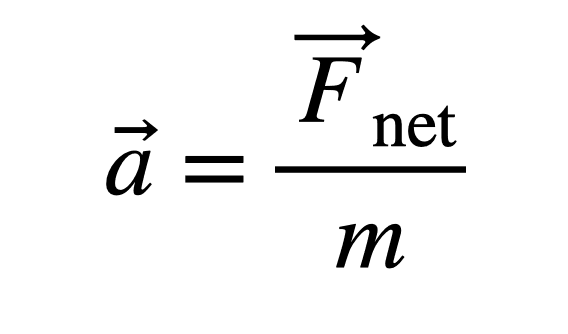
Instead of a lightsaber, say we have a “lightball” made of the same buzzy substance. Since it’s symmetrical, we can describe its motion without worrying about rotation. If we want to move this ball back and forth, we call on Newton’s second law of motion. This says the acceleration (a) of an object depends on its mass (m) and the amount of force (F) applied to it.
If the ball’s at rest and you kick it, it’ll accelerate—its speed will increase from 0 to some positive number. As you can see from the equation, the more massive the ball, the harder you have to kick it to achieve a certain acceleration. This is the simple case of linear motion. But what we want is …
Angular Motion
Newton’s second law is cool and everything, and it’s useful if you want to move a lightsaber back and forth. But if you’re up against a Sith lord, you’re going to want to swing that thing. Now you have rotational motion, also called angular motion. Think of it like the sweeping motion of a windshield wiper around a pivot point. And that requires a slightly different model.
Again, we’ll start simple: Imagine you’re holding a lightsaber horizontally and you want to turn it to a vertical orientation. In order to rotate the weapon, you need to give it an angular acceleration (α). Yes, that’s just like regular acceleration (a), except that it deals with rotational motion.
Well, there should be something like Newton’s second law for rotations, right? Yup, there is. We have a “rotational force” that we call torque (τ), and a “rotational mass” called the moment of inertia (I):

This moment of inertia (I) is the part we really need to understand. It’s the property of an object that “resists” changes in rotational motion, and it depends not just on the mass of the object but also where that mass is located.
Here’s a simple demo to get a feel for this. All you need is a plain stick. First, hold the stick at one end (yes, like a lightsaber) and use your wrist to rotate it back and forth as fast as you can. Now hold the stick in the center and again rotate it back and forth. I’m using a PVC pipe below:

It’s the same stick, so the length and the mass are unchanged. The only difference is the point of rotation. Holding it in the center makes it much easier to rotate. When you hold it at the end, some of the mass of the stick is much farther from the point of rotation. So, even though the mass didn’t change, the moment of inertia did change.
What’s this got to do with lightsabers? Well, if the blade part of the lightsaber has a mass, it will also increase the moment of inertia. It would be like holding the stick on the end (or swinging an actual sword). It will swing slower and require more effort to wave it around.
Now let’s think about lightsaber battles in Star Wars. Yes, sometimes things move fast—but it does indeed look like they are hacking with swords. You can see that they’re putting some oomph into it. That alone tells us these lightsaber blades have mass. Otherwise they’d move differently.
Center of Mass
But wait! There’s more evidence. Remember the climactic battle between Luke and Darth Vader in Return of the Jedi? At one point (2:37 in this excerpt), Vader takes his lightsaber and throws it at Luke. Now, once the lightsaber leaves Darth Vader’s hand, it will rotate about its center of mass.
If the blade has no mass, the lightsaber will rotate about the center of the hilt. If the blade has some mass, the rotation point will move upwards into the blade part, as shown on the right below. The dot shows the center of mass in each case.

This will cause it to spin very differently. Look at that scene again: It’s quite clear that the center of mass is more like the case on the right, which means the blade has mass. QED, debate over. The lightsaber does not use light for it’s business end.
Yeah, I know, it moves like that because it’s a movie prop with an actual stick for a blade, onto which they superimposed the glowing special effects later. I’m not crazy. But it all fits together, don’t you see? If the lightsaber blade didn’t have mass, a duel would look like two people waving laser pointers. The blades would move so fast, it wouldn’t even be entertaining.
So what exactly does create the light-blade part? Maybe there’s an internal mechanism that extends from the hilt and emits some kind of plasma field. I’m not really sure. But not knowing all the answers is what makes science fiction such a blast.
Disclaimer : This story is auto aggregated by a computer programme and has not been created or edited by DOWNTHENEWS. Publisher: wired.com