Summer is right around the corner. We’re headed out on adventures and bringing our stuff with us. Here are all the tech and tips that WIRED Reviews recommends for your travels.
Unless you’re in the top 5 percent club, modern air travel is a grind. The halcyon days of chinking champagne flutes, spacious seating, and sense of adventure has long been replaced by the budget sardine-can approach to air travel. Despite security rigmaroles and overcrowded gates, sashaying through an airport lounge still holds considerable cool cachet, especially if you’re pushing the finest carry-on luggage. That’s where the superstar DJ and international business traveler Venn diagram collides. When it comes to carry-on luggage, only aluminum will do.
When you think about metal luggage, you’re thinking about Rimowa. Synonymous with luxury and durability, the brand was founded in Germany in 1898 and is now the benchmark for high-end travel gear. As a rule, the more beaten up the case, the cooler the owner. But at $1,525 for a small carry-on, it’s a big investment for a small bag.
Nowadays, Rimowa isn’t alone. Many luggage brands, including Carl Friedrik ($845), Tumi ($1,295), Away ($625), and many mysteriously cheap Amazon/Ali Express/Temu brands, now offer aluminum options. But are they worth double, if not triple, the cost of your ordinary polycarbonate roll-aboard?
What’s So Great About Aluminum?
Premium pricing, celebrity endorsements, and catwalk appearances create a sense of exclusivity, while aesthetics bring must-have style. But for the regular traveler, buying aluminum luggage is, or at least should be, more a question of durability than desirability.
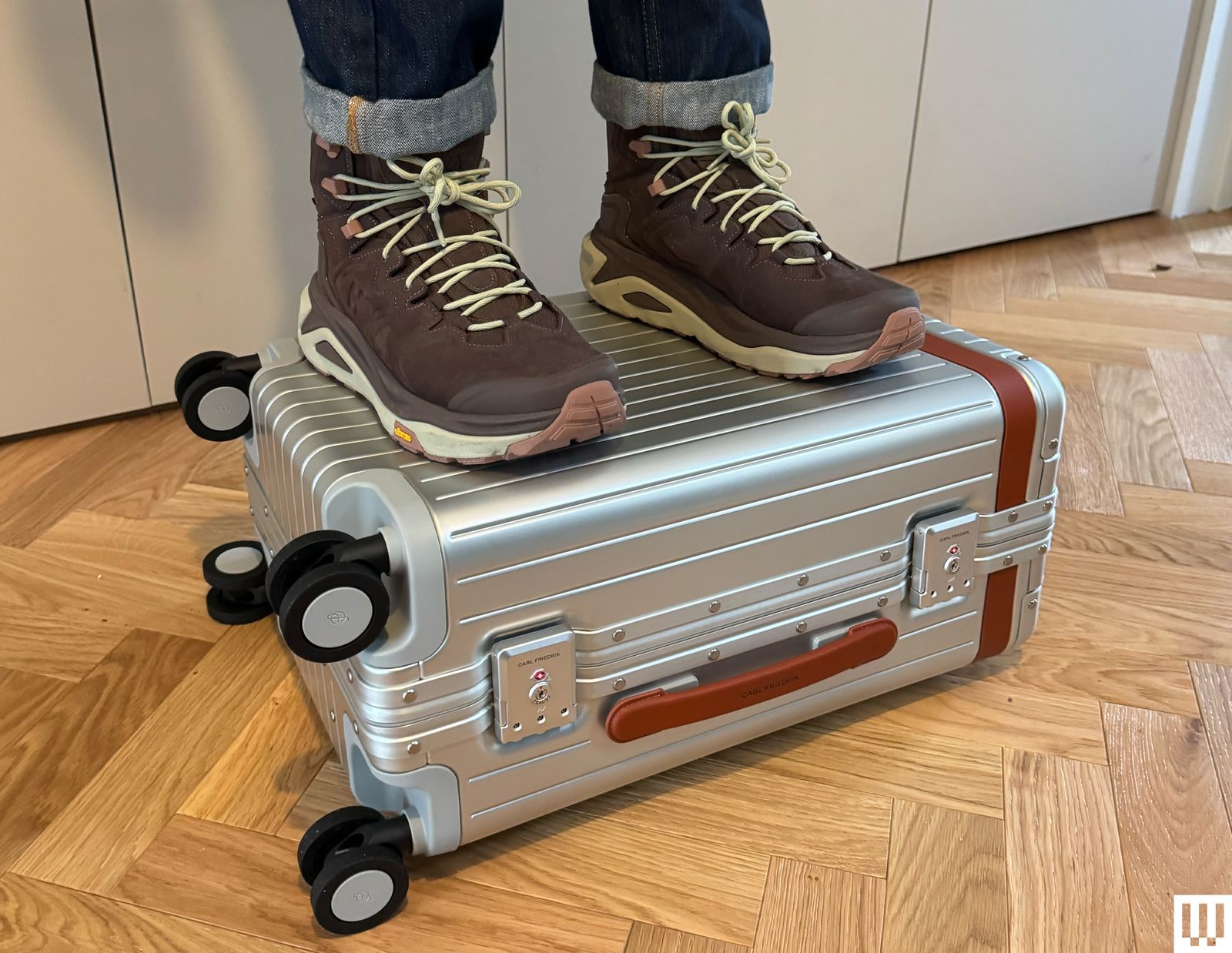
Aluminum won’t crack like a polycarbonate shell. You can stomp on these bags and stand on them. Don’t tell airport security, but my daughter and I have been known to race aluminum carry-on bags through airport terminals, like real-life Mario Kart. When frequent travelers buy luggage, they want this structural integrity and reliability. Rigid shells with metal frames and strong latch closures offer better protection for your belongings and should last a lifetime.
Metal rivets, high-quality wheels, robust handles, and better components also mean that all-metal luggage is easier to repair. Well-established brands typically offer generous warranties and repair services, especially on premium cases. Clamshell, zipperless closures are also harder to force open; there’s no zipper fabric that you can sneakily slash through with a pen knife. As with all good-quality luggage brands, the majority now use TSA-approved combination locks, which are not only far more elegant than a clunky old zipper, but add to the confidence these cases afford.
The irony of making a more sustainable purchase while also burning through aviation fuel is not lost on us, but there’s no denying the eco-friendly advantages of aluminum. Recycling aluminum uses up to 95 percent less energy than producing it from raw materials, and it can be easily recycled without any loss of quality.
The longevity of a well-made aluminum case will also mean fewer replacements over time, potentially keeping harder-to-recycle polycarbonate cases out of landfill. Even if you don’t end up buying it for life, aluminum cases also hold their value. Just check eBay.
They’re sexy, desirable, eco-friendly, and long lasting, but aluminum is significantly heavier than the latest polycarbonate equivalent. Most aluminum carry-on bags (standard 22 x 14 x 9 inches as a rule) weigh between 9 and 11 pounds. Of WIRED’s current favorite carry-on luggage, the Rimowa is the second heaviest, behind a 9.7-pound ballistic nylon option from Briggs & Riley.
In comparison, the Samsonite C-Lite Spinner ($500) weighs just 4.5 pounds, and the Travelpro Maxlite Air V2 ($195) weighs just 6.4 pounds. At 9.5 pounds, the Rimowa is the lightest aluminum carry-on we’ve found.
This is fine if your airline doesn’t have an official weight limit, but many do, especially budget ones. Flying short-haul in Europe, I’ve become accustomed to my overweight Sterling Pacific case being whisked away to the hold. Carry-on weight limits start from just 15 pounds (Etihad, Emirates, Air New Zealand). After taking into account the bag’s weight, that leaves you with 5 pounds of luggage to pack.
While aluminum provides strength, the rigidity also means you’ll never be able to overpack your carry-on. Expandable nylon designs give you the chance to squeeze in extra layers, or a souvenir or two, but there’s no chance with metal. This isn’t just a problem with aluminum designs. Polycarbonate hard shells have the same issue, although there are a few with external pockets.
Some suitcases have internal compression straps that let you squeeze in more gear. But the buckle fastenings means that, unlike a zipper, there is no give. As I did on a recent trip to Poland, you might have to resort to sitting on the case to get the clasps locked.
In contrast to virtually all other examples of premium product design, owners of aluminum luggage—well, historically Rimowa owners—actually look forward to their $1,500 investment getting battered. Dings, dents, and tatty old stickers are seen as badges of honor, battle scars from a hectic life as an international jet-setter.
It’s just as well, because aluminum is easily scratched and scuffed, and keeping metal luggage pristine for long is a thankless task. If you’re precious about these things, a metal case is not for you. As WIRED’s Martin Cizmar discovered on a recent trip around Europe using a Level8 Gibraltar Aluminum Carry, you will need an auto body technician to get the serious dents out. Polycarbonate designs often bounce back into shape; aluminum does not.
Is Aluminum the Only Option?
Possibly the most used case in my house is the 34-liter D_b_ Ramverk Pro ($749). It combines a rigid aluminum frame with a part-recycled polycarbonate shell and very useful internal laptop sleeve. At 9.9 pounds it isn’t light, but it is extremely tough, and even after five years of regular abuse, it still looks great and performs perfectly.
And if aluminum is too passé for you, Tumi now offers a range of titanium luggage. Starting from a whopping $3,800, it boasts fluid lines and striking looks, but interestingly it weighs more than most (11.6 pounds), despite titanium’s ultralight reputation.
Why They’re Expensive (and Why That’s OK)
Even ignoring the fashion/branding premium placed on them, aluminum carry-ons are expensive. The raw material costs more than molded plastics and is harder to work with. It requires stamping, machining, and finishing, rather than basic injection molding. Construction is also more complex compared to a basic zip bag, with rigid metal frames, latch systems, and reinforced corners. The more parts needed to build it, the more labor and greater manufacturing time required. Better construction also generally means better components and a greater ability to repair.
The up-front cost is high, but if you have a habit of breaking cheap luggage and buying new every few years, you could be better served by a metal carry-on case that lasts for decades. Previous WIRED UK managing editor Mike Dent had his Rimowa case for 16 years. Aluminum cases have become a visible signifier of travel status, with brands like Rimowa actively promoting the unattainably chic aesthetic. This always commands a premium, and it’s not often that highly durable, extremely practical products are also lusted after as luxury goods.
Prices are starting to fall, though. I found the Kangshilu aluminum 20-inch suitcase for just $125, and several options are now under $500. With more manufacturers entering the category, production has scaled, and factories are now more able to produce aluminum shells at volume. Competition is bringing costs down, even if the best-made examples still command a premium.
Are You Really an Aluminum Luggage Person?
If you fly often, value durability, and don’t mind lifting an extra few pounds every time you open the overhead bin, then yes, welcome to the club. Aluminum cases are built to last and capable of taking years of abuse without failing, even if they pick up dents along the way. For frequent travelers, that reliability—and widespread repairability—matters more than pristine looks or marginal weight savings.
There’s also the aesthetic to consider, with aluminum luggage a shorthand for a certain kind of traveler. It carries a fashion-forward high-earner appeal that few practical products manage, where wear and tear adds character and cache.
If you are chasing lightness, flexibility, or strict airline compliance, the appeal of aluminum fades quickly. Polycarbonate and soft-shell designs are easier to live with, cheaper, and often more practical. Polycarbonate cases with stiff aluminum fames are a great compromise, but they don’t look as cool. Whatever you do, check your preferred airline’s weight limits before you buy.
The One You Want
-Reviewer-Photo-(no-border)-SOURCE-Adrienne-So.jpg)
Like Sean Connery or a ’51 Chevy pickup, Rimowa luggage looks better with age. They come clean and new, but after you start seasoning your bag with a few dings and stickers, you may find yourself looking down from the jet bridge expectantly, hoping the baggage handlers give it a rough toss into the cart. After two years, the Rimowa that I’m testing is only starting to break in, and the durability is starting to shine as the roller wheels retain uncommon confidence and balance, and the seals remain tight. As the patina grows, the Rimowa only feels more indestructible. —Martin Cizmar
| Specs | |
|---|---|
| Dimensions | 21.7 × 15.7 × 9.1 inches (includes wheels and handles) |
| Volume | 35 L |
| Weight | 9.5 lb |
| Finishes | Silver, Emerald Green, Black, and Titanium |
A Superb Mid-Priced Option

I recently used this affordable aluminum bag on a 10-day trip to Ireland and Scotland, where it rolled over plenty of cobblestones and was used as a spinning toy by my grade-school-aged daughter. It did extraordinarily well, and I especially came to appreciate the flexible mesh interior dividers, which kept my clean, semi-clean, and dirty clothing separate without bulging out when I overstuffed the bag. The telescoping handle is as smooth and solid as any bag I’ve tested, and a lot better than I was expecting for the price. My daughter declared it the best piece of luggage we’ve ever tested, as she is not allowed to sit on the Rimowa and spin in circles. —Martin Cizmar
| Specs | |
|---|---|
| Dimensions | 22 × 15 × 8.4 inches |
| Volume | 36 L |
| Weight | 10 lb |
| Finishes | Silver, Gray |
A Rimowa Alternative
.jpg)


Founded in London in 2013 by Swedish brothers, Carl Friedrik produces elegant and modern bags and suitcases that scream quiet luxury. The suitcases are not prohibitively expensive, but premium enough to have been used in both Succession and White Lotus. It’s clear that the company is aiming for a slice of Rimowa’s pie, and its new aluminum case is more than cool enough.
It’s stylish without being too showy—as proof, I was stopped and complimented on it twice in the space of one trip—and ticks all the boxes, with leather trim, flawless aluminum paneling and classy fixtures throughout. 38 liters feels a little small compared to others on test, and a weight of 10.8 pounds won’t impress Rimowa users, but the internal layout is luxurious, the clasps and zippers are of excellent quality, and it’s easy to keep organized.
I’ve no doubt the rigid shell will last decades. The corners are reinforced and the TSA-approved combination locks have a loved clunk-click to them. I wish it was just a little lighter, but there’s no denying this is a well made, highly desirable piece of luggage.
| Specs | |
|---|---|
| Dimensions | 22 × 15 × 9 inches |
| Volume | 38 L |
| Weight | 10 lb |
| Finishes | Silver/Cognac, Silver/Chocolate, Silver/Black |
The Lifetime Investment

It’s difficult to justify the cost of this Sterling Pacific bag, but I’m positive that if American Pickers is still airing in 2100, you’ll find my case in a barn somewhere. It will be in almost perfect condition. The 0.9 mm 5000 grade aerospace aluminum shell is reinforced with deep ridges, and 1.5 mm thick corner caps are riveted in with stainless steel. There are over 100 rivets in the case. According to the brand, the case has a shear strength of 26,000 pounds of weight per square inch. It’s built more like a bygone-era steamship trunk than a modern carry-on.
The handles are full-grain Italian leather and unlike the vast majority of suitcases, the trolley handle retracts into a die-cast aluminum housing. It’s a superb piece of engineering and a pleasure to push. The locks are equally luxurious, and the super soft lining and strap systems deserves better than my meager wardrobe choices. To me, the only blemish are the small plastic bumpers, which look oddly cheap compared to the rest of it.
Sadly, the pay-off for all this metal work is weight. While it does feel, and look wonderful, if packed full it is a heavy item to lift into the overhead bins. Watch out in Europe, too. Even half-full, it will be too heavy for many airlines, and end up in the hold. It’s a big investment for a small bag, but with a lifetime warranty and repair service to back up the build quality, it is a bag for life.
| Specs | |
|---|---|
| Dimensions | 22 × 14 × 9 inches |
| Volume | 40 liters |
| Weight | 11 lb |
| Finishes | Silver aluminum |
Small But Mighty


Noticeably smaller than the rest on test, but just like Away’s hugely popular polycarbonate carry-on bag, it’s easy to love, although it is 3 pounds heavier and more than twice the price. It’s a gorgeous little bag though, built with great attention to detail both inside and out, and a significant upgrade in build quality. The aluminum corners are impressively robust, the handles comfortable and well balanced, and wheels smooth and quiet.
I couldn’t quite bring myself to like the Rose Gold colorway justice, although it is very pretty, but I did like the black finish, which was a little more understated than most shiny aluminum options. There’s no expandability, but the trade-off is a case that feels like it will outlast me. Excellent internal compression straps meant I was able to get a few extra layers in with ease. Extra kudos for the built-in laundry bag too.
The clamshell closure is secure, the TSA locks are high-quality, and the hinges offer no wobble or give at all. The Level8 Gibraltar is a marginally better value option, and has more capacity and weighs a little less. For me, I prefer Away just because it’s, well, a little bit cooler.
| Specs | |
|---|---|
| Dimensions | 21.5 x 13.5 x 9 inches (including wheels) |
| Volume | 32 liters |
| Weight | 10.5 lb |
| Finishes | Silver, black, rose gold |
Unbeatable Price


At just $125, you could buy 12 of these aluminum cases for the cost of one Rimowa. That’s a bag each for an entire soccer team, including the manager. Is the Rimowa 12 times better than this 40-liter carry-on? Absolutely not. The shell is full aluminum, the frame feels rigid, and it has a generous capacity. It’s quite heavy, and the plastic handles aren’t especially premium, with the telescopic option rattling a lot. There’s also a little more play in the hinges and body, but it still feels surprisingly solid.
The TSA-compatible locks seem good quality, and they’ve included a master key which is rare these days. In a side-by-side race with the Carl Friedrik, the wheels were noticeably quieter. They are also easily removable and come with a set of spares, which makes the retail price even more remarkable. You can also shrink the bag’s dimensions in an instant if you come across an airline with tighter carry-on restrictions.
It also comes with a full set of packing cubes, which is a generous touch, although the fabric and stitching isn’t the finest. There’s also a luggage tag and plastic cover to keep it looking pristine. Inside the case, you can see where corners have been cut to save costs. The stitching is basic, and the simple components are more in line with what you’d find in budget luggage. Did anyone point and laugh at my bargain aluminum luggage? On the contrary, in a blind test with a few friends, nobody guessed it was the cheapest. Time will tell when it comes to durability, but so far, it’s a bargain.
| Specs | |
|---|---|
| Dimensions | 22 x 14 x 9 inches |
| Volume | 40 liters |
| Weight | 11 lb |
| Finishes | Silver |
Disclaimer : This story is auto aggregated by a computer programme and has not been created or edited by DOWNTHENEWS. Publisher: wired.com