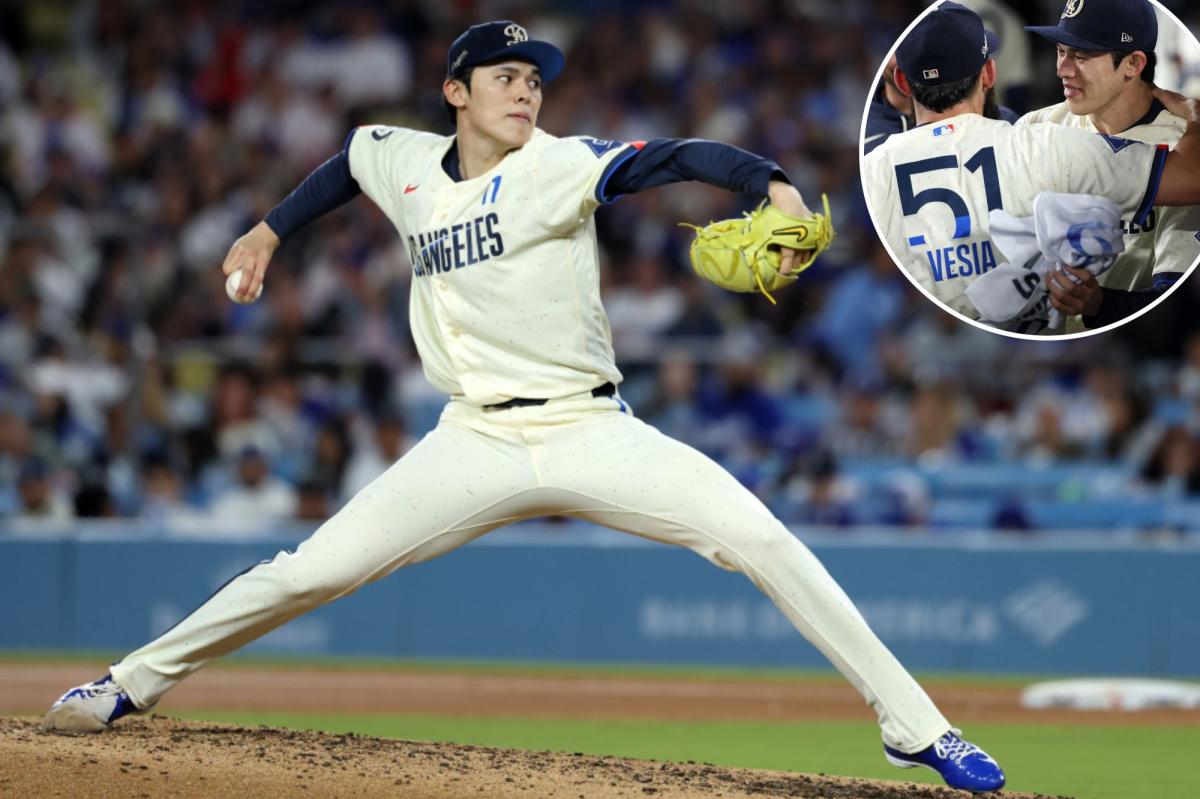
Never mind the final score.
Never mind how the Dodgers’ six-game winning streak ended or even how many innings Roki Sasaki pitched.
The details were trivial.
What mattered was that in the 10th start of his second major-league season, Sasaki rediscovered his fastball – and by doing so, might have rediscovered himself.
In a 4-3 defeat to the Phillies at Dodger Stadium on Saturday night, Sasaki touched 100 mph twice, including a second-inning fastball to J.T. Realmuto that was clocked at 100.4 mph.
The only other time Sasaki threw 100 mph as a starter in the major leagues was in his first game with the Dodgers, which was played in his home country of Japan last year.
“This was the game in which I was able to pitch most like me,” Sasaki said in Japanese.
By that, he meant that he was able to use his fastball as his primary weapon. His average fastball velocity was 98.5 mph, which was 1.5 mph faster than his season average. Of the 38 fastballs he threw, 14 were 99 mph or faster.
Sasaki pitched 5 ⅓ innings, the only run charged to him coming on a home run by Alec Bohm to start the second inning. Bohm’s homer was one of only three hits given up by Sasaki, who struck out seven batters.
The results weren’t as important as how he pitched.
The decline in fastball velocity and command was a long-standing problem for Sasaki that started in his final season in the Japanese league, in 2024.
He was able to reach triple digits when he moved into the bullpen late in his rookie season with the Dodgers, but he had trouble generating consistent velocity with the pitch again this year. Instead of overpowering hitters the way he did in Japan, he resorted to using smoke and mirrors to get through his starts.
Until Saturday.
“Fundamentally, what I did wasn’t particularly different from my last game,” Sasaki said. “I just think my body is moving better and better.”
While Sasaki made adjustments in the days leading up to his start that he thought would enhance his fastball, he said, “I didn’t think it would go up so much at once.”
Manager Dave Roberts credited Sasaki’s effort in the weight room.
“Travis Smith, one of our strength guys, has been working really hard with Roki and trying to build some mass and some strength,” Roberts said.
In the third inning, Sasaki found himself in a 3-1 count against Kyle Schwarber, who led the National League in home runs last year. Sasaki threw back-to-back 99-mph fastballs. Schwarber fouled off the first and whiffed on the second for strike three.
“Of course, it’s not good to attack an opponent’s strength too much,” Sasaki said. “Attacking an opponent’s weakness is fundamental, but my fastball was good today.”
In the sixth inning, he found himself in another three-ball count, this time against Justin Crawford. With the count full, Sasaki threw him three consecutive fastballs: 97.5 mph, 97.7, and 99.
Crawford struck out swinging.
Sasaki’s command wasn’t compromised significantly by the elevated velocity, which Sasaki said was to be expected.
“If I’m throwing hard, it tells me my delivery is good,” Sasaki said. “I feel that makes it easier to control the ball.”
Sasaki wasn’t ready to declare that his mission was accomplished, however.
“This,” he said, “isn’t the finish line.”
Following his strikeout of Crawford, Sasaki gave up consecutive singles to Schwarber and Trea Turner, which led to Roberts removing him from the game.
Alex Vesia walked Bryce Harper to load the bases but protected the 2-1 lead he inherited from Sasaki by retiring the next two batters.
When Vesia returned to the dugout, Sasaki embraced him. Sasaki was glowing. His last couple of starts offered him reasons to smile — he won both games — but not like this.
At very least, Sasaki established a new baseline on which he could build. And he might have done more than that.
After spending more than two years searching for what once made him the world’s greatest pitching prospect, he might have solved his identity crisis. If only for one night, Roki Sasaki felt like Roki Sasaki again.
“Regardless of whether it was good or bad, I was able to pitch my game,” he said.
Disclaimer : This story is auto aggregated by a computer programme and has not been created or edited by DOWNTHENEWS. Publisher: nypost.com