
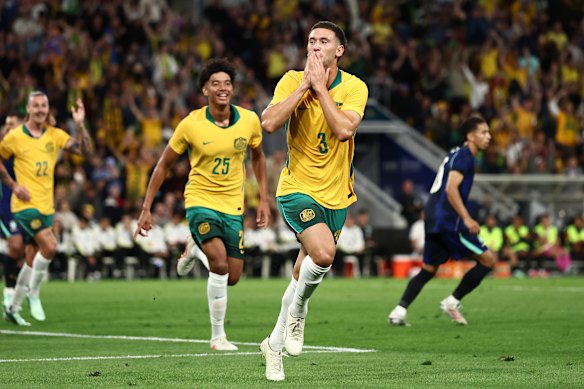

The head of Australian soccer’s players union has accused Football Australia of squandering a golden era for the code, firing back at allegations that players are motivated by greed in pursuing a legal dispute over their share of the federation’s commercial revenues.
Professional Footballers Australia chief executive Beau Busch says players are being unfairly blamed for the financial problems engulfing the code after the Socceroos and Matildas delivered unprecedented on-field success which administrators have failed to capitalise on.
The revelation that the PFA is pursuing legal action against FA over a long-running dispute regarding their revenue-sharing agreement triggered incendiary reactions from two prominent ex-players.
Former Socceroo Robbie Slater, in a scathing column for News Corp Australia, said it was “morally wrong” and a “disgrace” for the players to seek more money given the code’s ongoing financial problems, while former Matildas star Lisa De Vanna suggested players were being greedy and “knocking [the] game when it’s at its lowest” in a post on X.
But Busch said anyone criticising the players for FA’s financial woes was “missing the forest for the trees”, arguing that the national teams generated almost half of the federation’s income but players received only around 7 per cent of total revenues.
That is backed up by FA’s own financial results, which also show that the $9.1 million paid to national team players in 2025 accounted for only 6.2 per cent of FA’s $147.2 million in operating expenditure.
“What we have right now is a governance and performance problem, and that’s resulted in a dispute and the erosion of trust with the players,” Busch said.
“When we look at the national teams, we’ve had a golden period, and the players have been absolutely outstanding on the pitch … [but] that performance on the pitch hasn’t been matched off it.
“The players are really disappointed by that.”
The union and FA are at loggerheads over whether the governing body has properly honoured the revenue-sharing provisions of the national teams’ collective bargaining agreement (CBA). The dispute is before FA’s independent arbitration body.
The PFA has also initiated proceedings in the NSW Supreme Court to obtain information relevant to the dispute, which relates to a third party, through a subpoena process, but the court is not being asked to consider the underlying claim.
Busch said the PFA is only seeking to enforce what has already been agreed rather than renegotiate a larger slice for players, and that attempts to resolve the disagreement privately had failed.
“Legal action is certainly never the first option. It’s only resulted following extensive attempts to try and resolve these good-faith proposals put forward on behalf of the players in an attempt to resolve all these matters over the past 18 months to two years,” he said.
“Unfortunately, that hasn’t resulted in a satisfactory outcome … so we find ourselves where we are.”
Slater, in his column, also alleged that Socceroos players were paid $1 million each from the World Cup, and said “that is one of the reasons why FA is broke” – a characterisation Busch rejected.
Busch clarified that players were entitled to 50 per cent of Australia’s World Cup prizemoney. He did not provide a revised number, but the carve-up is easily calculable: FIFA paid Australia about $15.9 million ($US11 million) for reaching the round of 32, so an equal division of the players’ share of that amount between the 26-man squad equates to roughly $300,000 each, although the exact distribution arrangements have not been disclosed.
In any case, players are still yet to receive overdue match fees from the World Cup, which are separate from both the prizemoney and the ongoing CBA dispute – but FA says those payments cannot be processed without specialist tax advice regarding obligations in the United States and Canada, where Australia’s matches were played.
While Busch revealed a new CBA for the A-Leagues is close to being signed, which he said would enable players to help the Australian Professional Leagues to “turn around” the ailing domestic leagues after the previous deal lapsed in acrimonious circumstances, the stand-off with FA foreshadows a much bigger fight when the national teams CBA expires in September 2027.
The CBA was signed in 2023 – but since then, FA’s executive ranks have been cleaned out, Anter Isaac has replaced Chris Nikou as chair, and the federation has taken a starkly different position on a number of matters.
Meanwhile, FA’s finances have deteriorated sharply, forcing them into laying off 20 per cent of their workforce.
FA recorded a $15.3 million loss in 2025 – almost double the previous year’s deficit, with its accounts including $6 million in provisions for doubtful debts, and another $3 million associated with the settlement of legal proceedings and claims.
FA also reached confidential settlements with the APL over historical debts, and with Macarthur FC over allegations the club was misled about the financial terms of its entry into the A-League.
The current FA administration believes the national teams CBA is financially unsustainable, setting the scene for a bruising round of negotiations next year.
Busch said the PFA’s 30-year history of collective bargaining showed players were always mindful of Australian soccer’s economic realities, but warned they would be prepared to cede ground on payments only if they were given confidence about the direction of the sport.
“If the players, at any point in this negotiation or at any point in the future, are required to make any type of concessions, that needs to be coupled with important reforms that mean the game never finds itself in this position [again],” he said.
“We’re in a revenue share agreement – we’re meant to be business partners with Football Australia. We want to see them thriving. We want a great financial base for FA to be able to invest into the sport, so we take no satisfaction out of the current state of affairs.”
News, results and expert analysis on sport sent every Friday. Sign up for our Sport newsletter.
From our partners
Disclaimer : This story is auto aggregated by a computer programme and has not been created or edited by DOWNTHENEWS. Publisher: www.smh.com.au



