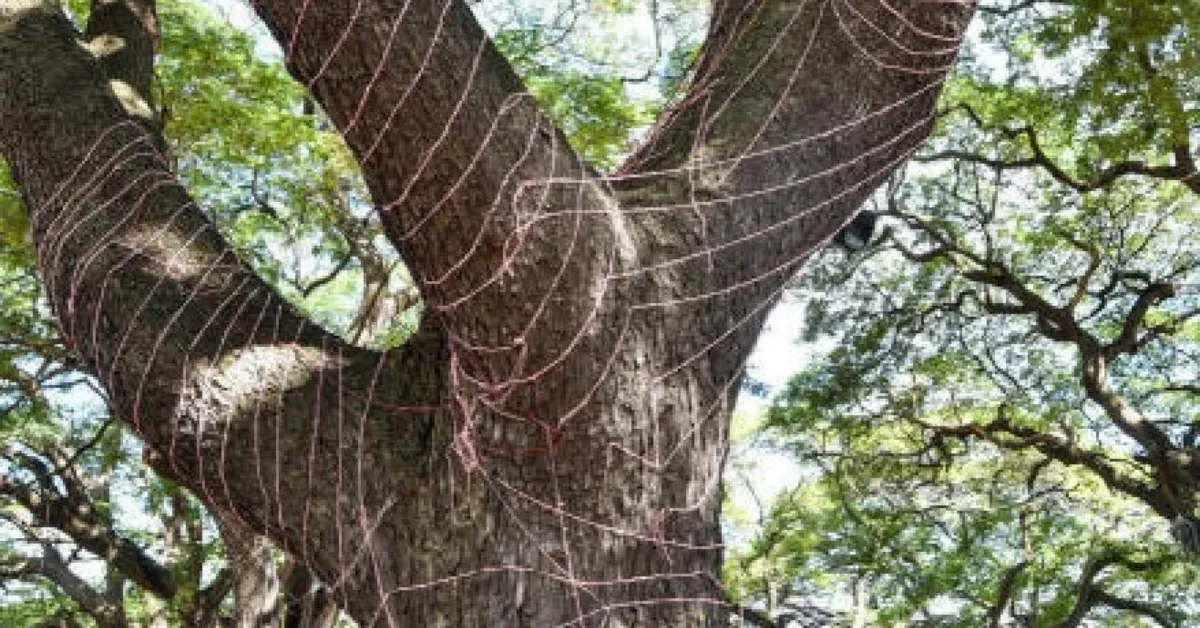
Every festive season, trees across Indian cities become supports for strings of decorative lights.
In Mysuru now, a sustained campaign by environmentalists and local residents has prompted the Forest Department to draw a line. Trees can no longer be used for illumination during Dasara or any other occasion.
The Forest Department has directed the Mysuru City Corporation (MCC) commissioner and the managing director of Chamundeshwari Electricity Supply Corporation (CESC) not to use trees for illumination during Dasara or any other occasion in the city.
Deputy Conservator of Forests K Paramesha issued the order on Thursday, following complaints from environmentalists and members of the Mysore Grahakara Parishat (MGP). Forest officials have warned CESC and its contractors that failure to remove wires could invite action under the Karnataka Preservation of Trees Act, 1976.
The decision follows weeks of objections to lighting installations on trees ahead of this year’s Dasara celebrations. It also brings a recurring question about festive decorations into sharper focus: how can cities celebrate without putting their urban trees at risk?
When the decorations become a concern
Mysuru’s experience is not an isolated one. Across India, campaigns against attaching decorative lights to trees have highlighted the tension between public celebrations and the care of urban green spaces.
In December 2024, The Indian Express reported on concerns in Pune over decorative lighting installations on trees, including wires and metal fasteners attached to trunks. In Mumbai, activist Rohit Manohar Joshi filed a public interest litigation challenging artificial lighting and electrical wiring on trees.
In April 2024, the Bombay High Court sought responses from the Maharashtra government and civic bodies on the matter.
Bengaluru, too, has seen residents take up the issue. In November 2019, teenagers from an Interact Club approached shops along Indiranagar’s 100 Feet Road, asking business owners to remove fairy lights from roadside trees.
These cases point to a problem that can recur whenever streets, commercial districts and public spaces are decorated for festivals. While the immediate objective is to illuminate a road or make a neighbourhood festive, the method of installation matters. Wires tied tightly around trunks, nails driven into bark and attachments that penetrate living tissue can create avoidable risks for trees.
How Mysuru’s campaign gathered momentum
The latest order followed a series of interventions in the city.
According to Deccan Herald, which pursued the issue through a series of reports last year and again this year, MGP members had written to the Forest Department, CESC and MCC the previous month, asking them to stop using trees for Dasara illumination. The newspaper also followed up with officials and coordinated with environmentalists to push for a change in practice.
The immediate sequence of events began in September. CESC began using trees for illumination on certain roads on 14 September. The following day, environmentalists, including Shylajesha and Banu Prashanth, worked with CESC contractors and Forest Department staff to get nails and wires removed from trees.
The practice resurfaced on Chamaraja Double Road on 2 October, when contractors reportedly used trees for illumination again.
On 3 October, environmentalists responded by hugging trees in an appeal reminiscent of the Appiko movement, Karnataka’s forest-protection campaign inspired by the idea of embracing trees to prevent their destruction. They urged CESC officials and contractors to stop the installations and submitted a complaint to the Forest Department.
A separate letter from MGP members and tree authority member Ravishankar Bale to the Forest Department and the state government also sought a prohibition on using trees for illumination during any occasion.
Rather than treating the removal of individual wires as a one-time intervention, the order establishes a broader restriction on using trees as supports for festive lighting in Mysuru.
What science says about lighting trees at night
The concerns extend beyond the physical damage caused by nails and wires. Artificial light at night can interfere with the biological processes that help plants respond to their environment.
A 2023 study by E Lo Piccolo and colleagues, published in Science of the Total Environment, examined how LED street lighting affected the nighttime physiology of plane and lime trees. The researchers found changes in nighttime carbon assimilation and photosynthetic performance, indicating that artificial illumination can influence processes that trees would otherwise regulate through their natural day-night cycles.
In another 2023 experiment conducted in Beijing, Yaxi Wei and colleagues investigated the physiological responses of Japanese spindle and hybrid roses to different LED light colours. Their findings showed that the plants’ responses varied with the colour of the illumination, including changes associated with physiological stress.
/filters:format(webp)/english-betterindia/media/media_files/2026/10/15/glowg-31-2026-10-15-12-24-33.png)
A 2025 review by Luisa Friulla and Laura Varone in Urban Science examined evidence linking artificial light at night to changes in plant metabolism, circadian rhythms and seasonal processes.
All these researches suggest that artificial lighting can affect plant physiology, although the effects depend on factors such as light intensity, spectrum, duration and the species being exposed.
Although these studies do not establish that festive lights alone kill trees, nor do they directly quantify the damage caused by nails, tightly secured wires or other installation methods.
The physical risks remain a separate concern. The extent of the damage depends on how the lights are installed, how long they remain in place, and the condition of the tree.
Can cities celebrate without using trees?
Mysuru’s order offers a practical starting point: festive lighting does not have to depend on living trees.
Temporary poles, freestanding frames and purpose-built lighting structures can provide illumination without attaching cables or fixtures to trunks.
Installations should avoid nails, drilling, constricting ties and other methods that injure bark or interfere with growth.
Where lights are used near trees, organisers should also consider their intensity, duration and potential effects on nocturnal wildlife.
For city authorities, this means planning illumination around existing green cover rather than treating trees as convenient fixtures. It also requires contractors to follow clear installation guidelines and officials to ensure that those guidelines are enforced.
The Karnataka Preservation of Trees Act, 1976, provides the legal framework cited by Mysuru forest officials in warning CESC and its contractors of possible action.
The effectiveness of the latest directive will depend on whether installations are removed where necessary and the prohibition is followed during future celebrations.
Mysuru’s decision moves the discussion beyond individual complaints and damaged trees towards a city-wide rule.
A festival’s lights may disappear after a few days. But the trees lining a city’s roads remain part of its landscape even after the decorations come down. Protecting them need not mean giving up the celebrations,but also to find ways to light the streets without making the trees bear the weight.
Sources:
‘Mysuru: Forest dept orders end to use of trees for illumination’: By Shilpa P, Published on 8 October 2026
‘Shedding light on the effects of LED streetlamps on trees in urban areas: Friends or foes?’: By Science of The Total Environment, Published on 27 December 2022
‘Artificial Light at Night (ALAN) as an Emerging Urban Stressor for Tree Phenology and Physiology: A Review’: By Luisa Friulla and Laura Varone, Published on 10 January 2025
‘The silent victims: How fancy lighting around trees in Pune is slowly killing them’: By Shubham Kurale, Published on 16 December 2024
Disclaimer : This story is auto aggregated by a computer programme and has not been created or edited by DOWNTHENEWS. Publisher: thebetterindia.com