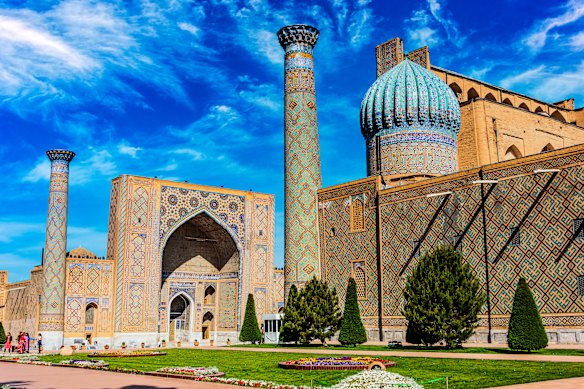

It’s one of the most intriguing emerging destinations – the vast, landlocked region between Europe and China colloquially known as the “Stans”. Comprising the five former Soviet republics of Uzbekistan, Kazakhstan, Kyrgyzstan, Tajikistan and Turkmenistan, Central Asia promises dramatic landscapes, ancient Silk Road cities and a fascinating cultural cauldron of Muslim, Mongol and Soviet influences.
Some tour operators try to cover all five ’Stans in a single trip, rushing around on a breathless itinerary that leaves little time to savour each destination. Intrepid Travel’s new 18-day Premium Central Asia tour takes a different approach, concentrating on Uzbekistan, Kazakhstan and Kyrgyzstan while using flights and high-speed trains to avoid 10-hour bus trips on bumpy roads.
Sounds good in theory, but is it possible to deliver a premium experience in an emerging destination?
Uzbekistan’s capital Tashkent provides a compelling introduction to the cultural contrasts that define the region. One minute you’re admiring one of the world’s oldest copies of the Koran in the Hazrati Imam complex of 16th-century mosques and madrassas; the next you’re in the manicured Tashkent City Park watching a choreographed fountain show.
In Chorsu Bazaar, the city’s 2000-year-old market, there’s a labyrinth of stalls selling fragrant spices, nuts and dried fruits; in the cavernous Tashkent City Mall, there are glitzy outlets of Armani, Boss and Swarovski. There’s no respite in the Soviet-era subway, where rickety trains trundle between ornate, chandeliered stations.
Sign up for the Traveller Deals newsletter
Get exclusive travel deals delivered straight to your inbox. Sign up now.
The cultural whiplash continues when we leave Tashkent, taking the Chinese-built high-speed train to the UNESCO World Heritage-listed cities of Samarkand and Bukhara – two ancient Silk Road trading stops with some of the region’s most impressive Islamic architecture.
Samarkand’s big-hitters include the extraordinary Registan Square, a yawning plaza flanked by three imposing madrassas that comes alive each evening with an immersive historical light show. Other highlights are the monumental Bibi-Khanym Mosque and the 11th-century Shah-i-Zinda necropolis, where legend claims that the prophet Muhammad’s cousin, Qutham ibn Abbas, is buried.
Bukhara is often touted as the region’s holiest city – a maze of stone alleyways that spills into grand squares flanked by soaring mosques and madrassas. For centuries, it was both a thriving Silk Road trading post and an important centre for Islamic scholarship and pilgrimage. Even during Soviet times, when religion was effectively banned, some of its mosques and madrassas continued operating.
Today, it’s an evocative tangle of artisan stores (the city is famous for its handmade carpets and intricate miniature paintings), atmospheric restaurants and notable historic sites, including the ancient Ark Fortress and the 46-metre-high Kalyan Minaret. It’s particularly beguiling at night when the monuments are illuminated and the alleyways echo with the rhythmic beat of doyras (handheld drums).
Despite the best efforts of our excellent guide Lochin Juraev, I find the region’s complex history difficult to grasp. Suffice to say that everyone from Genghis Khan and Stalin to Timur and Alexander the Great was involved. For history buffs, it’s a fascinating deep dive into some of humankind’s most influential empires. For the rest of us, the architectural splendour is self-evident, not to mention miraculous, given how much conflict the region has endured.
Few tours used to make it to Khiva, largely because of the seven-hour road trip from Bukhara, although a high-speed train service has started since our tour (cutting travel time to about four hours). The reward is an ancient walled city of storybook perfection. A warren of medieval mosques and madrassas, it’s especially magical at night, when you can wander through lantern-lit adobe alleyways, past open-air stalls and dramatically lit monuments.
In Khiva we stay in a boutique hotel within the UNESCO World Heritage-listed walled complex – a characterful property that’s indicative of the upgraded accommodation throughout the trip. In Samarkand, our base is the ornate, marble-lobbied Hotel Royal Samarkand, while in Bukhara it’s a delightful 12-room former Jewish residence with a tranquil inner courtyard decorated with Arabian artefacts.
Predictably, many of the most memorable moments come from the premium inclusions that elevate this tour. The cooking class and dinner with a local family in Samarkand; the sunset champagne on a rooftop in Khiva; the wine and brandy tasting in an atmospheric hotel cellar. It’s a chance to meet people who can still remember life under Soviet rule, understand how things have changed and learn about their concerns for the future.
“Most people are happy with independence,” says Juraev one evening over dinner. “We are a safe country and there is less corruption. Hopefully, tourism doesn’t spoil it.”
This 18-day Premium Central Asia trip is actually a combination of two shorter itineraries, so after a 90-minute flight from Tashkent to Almaty in Kazakhstan, we’ve acquired a new guide and some new guests.
“For those of you coming from Uzbekistan, please lower your expectations,” says our 29-year-old leader, Anastasia Kirichenko. “Not everything is perfect – especially in Kyrgyzstan.”
Despite this expectation reset, a half-day walking tour of Almaty reveals an attractive European-style city of leafy parks and alfresco cafes with a striking backdrop of snow-smothered peaks. It might not have Uzbekistan’s architectural wow factor, but it’s clearly more affluent and progressive.
With no high-speed train to whisk us into Kyrgyzstan, it’s a long drive through featureless plains to the border. Our destination, the capital Bishkek, frequently ranks as one of the world’s most polluted cities thanks to its notorious traffic.
During an entertaining city tour with local guide Elizabeth, we learn about the country’s coup-filled history and watch a theatrical guard-changing ceremony in Ala-Too Square. “If you need a revolution,” she says, “just call us.”
Unlike Uzbekistan, where the cities are the main attractions, Kyrgyzstan is known for its dramatic natural landscapes. More than 90 per cent of the country is mountainous, the highlight of which is the spectacular Tian Shan range, which includes the country’s loftiest peak, 7439-metre Jengish Chokusu, and its largest lake, 182-kilometre-long Lake Issyk-Kul, the second-largest alpine lake in the world.
While staying in a modern yurt camp near Lake Issyk-Kul’s shoreline, we wake to a magnificent vista of snow-dusted peaks erupting from the lake’s vast inky-blue depths. It’s a taste of the traditional lifestyle followed by the country’s 40 or so nomadic tribes until the Soviets forced them to settle down in the 1920s.
During our stay, we learn the laborious process of making felt, the wool-based material used to cover a yurt, and participate in a yurt-building workshop with a local couple who still make all the components from scratch.
Of course, not all cultural traditions should be preserved. Over lunch with a family in a small village near Bishkek (in a yurt, naturally), we hear about bride kidnapping, a shockingly common practice that continues today, even though it was outlawed in 1994. The father cheerfully recalls kidnapping his wife 23 years ago, miming throwing her over his shoulder.
“At least she knew him,” says Kirichenko, when we discuss it later. “When I was 12, everyone at my school had to watch a video about what to do if you were kidnapped.”
Despite Kirichenko’s caution in Almaty, the standard of accommodation in Kyrgyzstan is excellent and every hosted meal is an extravagant spread of local specialties, such as hand-pulled lagman noodles and beshbarmak, a hearty stew of noodles and boiled horse meat that’s rich and tender.
Fortunately, the tour offers multiple opportunities to burn off calories, with hikes in Kyrgyzstan’s Skazka Canyon, a Utah-like riot of multicoloured rock formations, and Kazakhstan’s Charyn Canyon, a spectacular winding gorge notable for its striking castle-like sandstone pillars.
Although Kyrgyzstan is endeavouring to preserve its nomadic heritage through events like the World Nomad Games, which will be held around Issyk-Kul in August, progress is inevitable. Our penultimate dinner is with a family in Karakol, whose daughter-in-law, Salima, is visiting from Dubai, where she works in property sales. When I ask her if she will choose her daughter’s husband when the time comes, she looks aghast. “No!” she replies. “Everything has changed, she will marry for love.”
It’s an indication of the modernity that’s sweeping through the region, changing attitudes and upending traditions. Fortunately, for the discerning traveller, this also means better facilities and upgraded infrastructure. Can you now explore the Stans in style? Absolutely.
THE DETAILS
TOUR
Starting in Tashkent and ending in Almaty, Intrepid Travel’s 18-day Premium Central Asia trip runs from March to October and includes upgraded accommodation, an arrival transfer and 24/7 on-ground support. From $9090 a person, twin share. See intrepidtravel.com
FLY
Emirates (emirates.com) flies to Tashkent and Almaty via Dubai. Other one-stop options include China Southern (csair.com) and China Eastern (ceair.com).
MORE
uzbekistan.travel
kazakhstan.travel
visitkyrgyz.com
The writer was a guest of Intrepid Travel.
 After abandoning a sensible career in IT, Rob McFarland now divides his time between Sydney, the US and Europe. He’s won seven writing awards, including Australian Travel Writer of the Year, and offers writing courses for tourism operators, PR professionals and aspiring travel writers. While not averse to a 5-star hotel, his most memorable travels include scaling the mountain behind Machu Picchu and rafting Patagonia’s Futaleufu River. Follow his travels on Instagram @mctraveller.Connect via email.
From our partners
Disclaimer : This story is auto aggregated by a computer programme and has not been created or edited by DOWNTHENEWS. Publisher: www.smh.com.au