
Updated ,first published
After gruelling negotiations that ran 40 hours overtime, global climate talks were on a knife edge last night, with the European Union and other small island states demanding any final agreement include a call to transition away from fossil fuels over the objections of oil-producing nations led by Saudi Arabia.
With the final meeting about to begin at the time of writing, the agreement text included the call to ramp up the share of electricity in the world’s energy system to 35 per cent globally by 2035, a target that the Saudi-led bloc has also objected to.
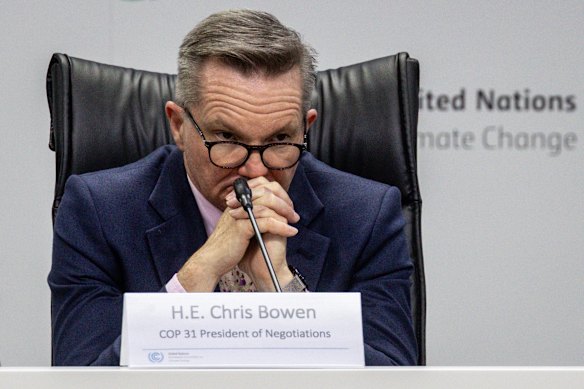
Climate Change and Energy Minister Chris Bowen, who has led the negotiations, has made the target a mark of the overall success of the COP31 talks, which were co-hosted with Turkey in the resort city of Antalya.
Bowen sought to defuse the standoff over fossil fuel transition by including language at the top of the test referring to the agreement signed at COP28 in Dubai, where all nations agreed to “transition away from fossil fuels”.
This sidestep prompted fury from nations demanding more urgent action, especially given that these come only weeks after the United Nations Environment Program admitted the world would miss its Paris target of stabilising the climate at 1.5 degrees.
On Friday, Panama’s Environment Minister Juan Carlos Navarro sent a formal letter to the summit hosts stating that Panama will “not join any consensus, and will formally object in the closing plenaries” to a final deal that fails to meet its environmental principles. UN climate deals can only be settled by consensus of the nearly 200 nations party to the talks.
Another sticking point has been over the inclusion of an agreement to increase the uptake of carbon capture, use and storage technology to “gigatonne scale globally by 2035”.
This is seen by the EU and many small island states as a “get out of jail free” card that could be used by some nations as an excuse to continue polluting on the understanding that they might capture and remove carbon from the atmosphere later.
Since the world has already failed to cut emissions fast enough to hold the climate under 1.5 degrees of warming, models used by the UN say that CCUS will have to be used by the end of the century to reverse a global temperature “overshoot” and bring it back down under 1.5°C
In briefings and media conferences during the negotiations Bowen and his team have described the electrification target as the crucial next step in the world’s efforts cut fossil fuel use and reduce greenhouse gas emissions. “Electrification is the key to transitioning away from fossil fuels,” said Bowen in a press conference on Friday.
“Electrification is the how. Electrification, we know, will deliver two-thirds of what we need to do to keep the world at 1.5 degrees of warming by 2035. That is worth doing. That is what this COP is about.”
Acknowledging that the negotiations had become fraught in their dying hours, Bowen said: “Things worth doing, in my experience, don’t come easy. And I’ll tell you what’s worth doing is electrification. Electrification is the key to transitioning away from fossil fuels.”
The push for electrification targets has also been pushed hard by the Turkish COP hosts, the International Energy Agency and a coalition of civil society groups.
Turkey won the support of 80 nations and the European Union for an electrification pledge in the so-called “action agenda”, which runs parallel to formal negotiations at the COP.
The push for electrification is designed to work in conjunction with previous COP agreements to triple renewable energy capacity and double energy efficiency by 2030. Electrification is seen as a bridge connecting clean power generation with daily energy consumption. Without a rapid expansion of electric technologies across transport, heating and industrial processes, adding renewable capacity alone cannot fully displace fossil fuel consumption across the global economy.
There is also disagreement over climate finance, and European Union Climate Commissioner Wopke Hoekstra called demands for increased pledges for finance from developing nations hit by climate disasters “dead in the water” before the talks even began.
Finance has long between a contentions issue at climate talks, with developed nations wanting to maintain focus on reducing emissions, and developing nations demanding financial assistance to help them insulate their economies from the impact of warming that they did not cause. The dispute is becoming more complex as the talks continue, with donor nations arguing that some countries that were considered poor when the first climate agreements were made have since become more wealthy and should no longer be receiving support.
If the standoff cannot be resolved, UN rules allow for the talks to be suspended until next year. That outcome would be a blow to Bowen, who created the role of president of negotiations at the talks when Australia failed to secure the hosting rights in a stand-off with Turkey.
Though it is not unusual for COP negotiations, which demand consensus agreement between the almost 200 signatories of the Paris Accord, to extend beyond deadline, they have only ever once been suspended without an outcome – when Kyoto Protocol talks collapsed in 2000.
By Friday evening in Antalya, frustrated activists had begun to blame Bowen and his Turkish counterpart, Environment Minister Murat Kurum, for the failure of the COP to command support for ambitious climate action.
“The COP presidents want to tell us this has been a great COP,” said Mohamed Adow, head of the climate group Power Shift Africa at a press conference convened by the Climate Action Network. “Well, I can tell you without any doubt that this has been the worst COP ever.”
Others have questioned Bowen’s strategy of allowing nations to insert many ambitious claims in an early draft of the cover decision, and of even insisting that the talks include such a decision in the first place.
Leading climate analyst Bill Hare, the director of Climate Analytics – a global non-profit climate science and policy institute – said Bowen made the right call, particularly given the UN’s scientific report published before the COP which said the world was set to miss its 1.5-degree target.
“The urgency of the crisis is visible to everyone, and if the COP didn’t do anything visible about the urgency in a political sense, there would be bigger questions about there was any point [in the process] at all,” Hare said.
“I think Bowen is right and correct and courageous to say we need to have a cover decision because it anchors things and provides a focal point for making some decent political signals.”
Get to the heart of what’s happening with climate change and the environment. Sign up for our fortnightly Environment newsletter.
 Nick O’Malley is National Environment and Climate Editor for The Sydney Morning Herald and The Age. He is also a senior writer and a former US correspondent.Connect via email.
From our partners
Disclaimer : This story is auto aggregated by a computer programme and has not been created or edited by DOWNTHENEWS. Publisher: www.smh.com.au