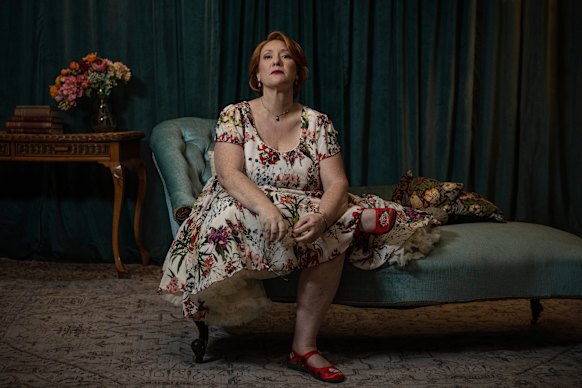

Dr Jeni Haynes has spent her life trying to make people believe what is, to many, unbelievable: that she has 2682 people inside her mind. Haynes was diagnosed with dissociative identity disorder (DID), formerly known as multiple personality disorder (MPD), a decade before she took the stand in a 2019 trial in a Sydney court that put her father, Richard Haynes, behind bars for 45 years. Setting a legal precedent, six of her alternate personalities, or “alters”, gave evidence, recalling in photographic detail the abuse, rape and torture she endured throughout her childhood.
“We’re perfectly sane people using an incredible survival strategy to survive what should be un-survivable,” says the Entity Currently Known as Jeni, as she introduces herself in the groundbreaking SBS documentary We Are Jeni. She uses the pronouns “we, us and our” to acknowledge that all her alters are always present. They include protective Erik; leather-clad Muscles; and four-year-old Symphony, the original alter who created the entire “constellation”.
“The only way I survived my dad was being able to switch into different alters,” says Haynes. “Because every time somebody got too exhausted from what he was doing, we switched them out and sent somebody else in, like shoving in a new battery.”
She gets that DID is difficult to grasp, even for those who have it. She spent 18 years in academia, studying psychology (“to find out what was wrong with me”); criminology (“to find out whether what he did was criminal”); and completing a PhD in male victimology (“to stop me being afraid of half the population”).
When approached by filmmakers Mariel Thomas and Akhim Dev, she seized the opportunity to tell her story in her own words. In We Are Jeni, she presents confronting truths and dispels myths. Classic movies such as The Three Faces of Eve and Sybil filter DID through the eyes of therapists, she says, hiding the experience “behind innuendo and euphemism”.
She turned off the 2009 Toni Collette series, United States of Tara, after five minutes, triggered by a “sexy” alter. However, her psychiatrist, Dr George Blair-West, who appears in the documentary and with whom Haynes co-authored her memoir, The Girl in the Green Dress, declined to watch the series because he found it too realistic, “like work”.
Also appearing in the documentary is the man Haynes calls “God on legs”, NSW Police detective Paul Stamoulis. “He listened, and then he went out and got evidence.”
Reliving her trauma for the documentary came at a cost. “There were days when we cried. There were days when we could only think in song lyrics. But [the filmmakers] handled it beautifully.”
Haynes was adamant no child actor would portray her. Instead, animation infers the abuse and illustrates her internal world. Now aged 56, she wears a colostomy bag, a legacy of the damage done by her father.
“I can see it as a permanent reminder of what my dad did,” she says. “Or I can see it as a permanent reminder that despite what my dad says, I am worthy of medical care. I choose, as often as possible, to frame it through that positive lens.”
History and archaeology are on her academic wish list, but for now, she is focusing on her hobbies: Dungeons & Dragons (“It’s an opportunity to let different alters role-play different ways of being”) and making jewellery.
She intends to keep speaking her truth in the hope people living with DID, and survivors of child abuse, will be silent no more.
“What I hope my story shows is that abuse is not about sex,” she says. “The sexual abuse of children is about power. And it’s weak, ineffectual humans getting their power from hurting somebody weaker than them, more vulnerable than them.”
We Are Jeni premieres at 7.30pm on Sunday, June 7, on SBS and SBS On Demand.
Help is available from the National Sexual Assault, Domestic Family Violence Counselling Service on 1800RESPECT (1800 737 732) and Lifeline on 13 11 14.
Want more TV? We’ve got you.
 Bridget McManus is a television writer and critic for Green Guide. She was deputy editor of Green Guide from 2006 to 2010 and now also writes features and interviews for Life & Style in The Saturday Age and M magazine in The Sunday Age.
From our partners
Disclaimer : This story is auto aggregated by a computer programme and has not been created or edited by DOWNTHENEWS. Publisher: www.smh.com.au