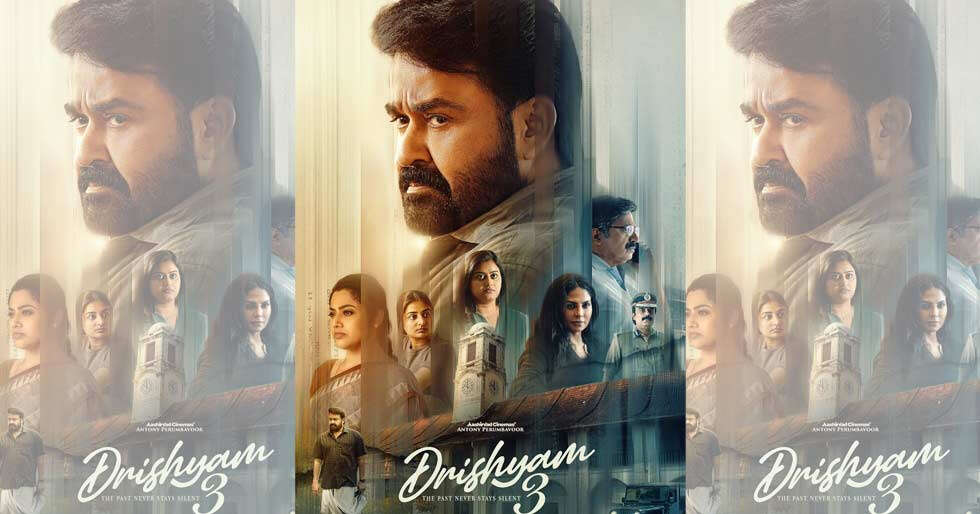
There is a peculiar burden attached to a franchise like Drishyam. The first film worked because it felt startlingly original within mainstream Indian cinema, a rooted family drama that transformed into a nerve-racking survival thriller powered entirely by intelligence and emotional stakes. The second film succeeded because it understood the aftermath of guilt and paranoia. With Drishyam 3, director Jeethu Joseph attempts something more ambitious. The film shifts away from pure cat-and-mouse suspense and becomes a story about consequence, guilt and the exhaustion of constantly protecting a lie.
The result is an engaging, often compelling thriller that benefits enormously from Mohanlal’s deeply internalised performance and the emotional history of its characters, even if the film occasionally struggles under the weight of its own mythology.
Set several years after the events of Drishyam 2, the story finds Georgekutty in a more fragile state than before. He is wealthier, more influential and publicly respected, but the confidence that once made him invincible has begun to crack. The ghosts of the Varun case continue to hover over his family. His daughters carry the trauma differently now, while Rani has learned to survive through silence rather than resilience.
The police machinery, meanwhile, has evolved. Instead of relying solely on brute-force investigation, the new officers approach Georgekutty with patience and psychological precision. The film’s central conflict is not merely about whether he can outsmart the system again. It is about whether a man can continue living inside a lie for this long without losing himself completely.
Jeethu Joseph deserves credit for refusing to turn the third installment into a loud, crowd-pleasing extension of the franchise. Drishyam 3 remains rooted in emotional tension rather than spectacle. The director understands that the greatest strength of these films has always been their atmosphere, the unbearable feeling that Georgekutty’s carefully constructed life could collapse at any moment.
Several stretches in the first half are especially effective because of how restrained they remain. Conversations feel loaded with subtext. Casual exchanges become psychological chess games. A dinner table scene midway through the film, where an apparently harmless discussion slowly transforms into a trap, is written and staged with impressive control.
Yet the film is not without problems. The biggest issue is pacing. Drishyam 3 takes too long to arrive at its central revelation. The screenplay repeatedly circles familiar emotional beats, particularly in scenes involving Georgekutty’s anxiety and his family’s fear of exposure. While these moments are important thematically, the repetition begins to dilute the tension.
The film also occasionally tries too hard to underline its moral dilemmas. Conversations about truth, justice and guilt sometimes become overly explanatory, especially when Mohanlal’s performance is already conveying those emotions far more effectively through silence and body language.
What ultimately elevates the film is Mohanlal. As Georgekutty, he once again demonstrates why the character became so iconic in the first place. This is no longer the quietly resourceful cable operator from the original film. Age, fear and guilt have reshaped him. Mohanlal plays these changes with remarkable subtlety. His eyes constantly seem alert, as if Georgekutty is mentally calculating every possible consequence before speaking. Even during quieter scenes, there is an exhaustion beneath the composure.
One particularly powerful sequence features Georgekutty sitting alone in his theatre late at night, replaying fragments of old memories while trying to convince himself that everything he did was necessary. Mohanlal performs the scene with minimal dialogue, allowing regret and self-preservation to coexist in the same expression. It is among the film’s finest moments.
Meena brings warmth and vulnerability to Rani, though the character occasionally feels underwritten compared to the emotional complexity she displayed in the earlier films. Ansiba Hassan and Esther Anil effectively portray daughters shaped by years of fear and secrecy, especially in scenes where their trauma quietly surfaces.
Murali Gopy’s character takes off from where the last film left him and works well because he avoids playing his character as a conventional antagonist. His investigator operates with restraint and intelligence, which creates more suspense than an aggressive cop ever could. Asha Sharath, meanwhile, lends emotional gravity to her scenes despite limited screen time.
Technically, the film maintains the grounded aesthetic associated with the franchise. Satheesh Kurup’s cinematography favours muted interiors and carefully composed frames that reinforce the emotional suffocation surrounding the family. The background score is effective without becoming manipulative, although there are moments where the music pushes tension too aggressively.
The screenplay’s biggest challenge lies in delivering a payoff worthy of two beloved films. To its credit, Drishyam 3 avoids easy twists designed purely for applause. The climax aims for emotional closure rather than shock value. Some viewers may appreciate the maturity of this approach, while others could find it less satisfying than the ingenious reveals of the earlier installments.
The final act is thoughtful and emotionally layered, but it lacks the devastating impact of the original Drishyam’s conclusion. Jeethu Joseph prioritises emotional closure over elaborate shock, which gives the film maturity but reduces edge-of-the-seat tension associated with the franchise.
What makes Drishyam 3 worth watching is not merely the mystery surrounding Georgekutty’s fate. It is the film’s understanding that survival has consequences. The earlier films explored how far a man would go to protect his family. This chapter asks what remains of a man after years spent defending the same lie.
Even with its uneven pacing and occasional narrative excesses, Drishyam 3 succeeds because it treats its characters seriously and resists reducing them into franchise caricatures. It may not reinvent the genre in the way the first film did, but it expands its emotional terrain in interesting ways.
Drishyam 3 may not deliver the same shocking high as the earlier films, but it understands these characters well enough to give them a fittingly emotional goodbye.
Also Read: A Candid Mohanlal Moment From Drishyam 3 Sets Has Fans Celebrating The Man Behind The Legend
Disclaimer : This story is auto aggregated by a computer programme and has not been created or edited by DOWNTHENEWS. Publisher: filmfare.com