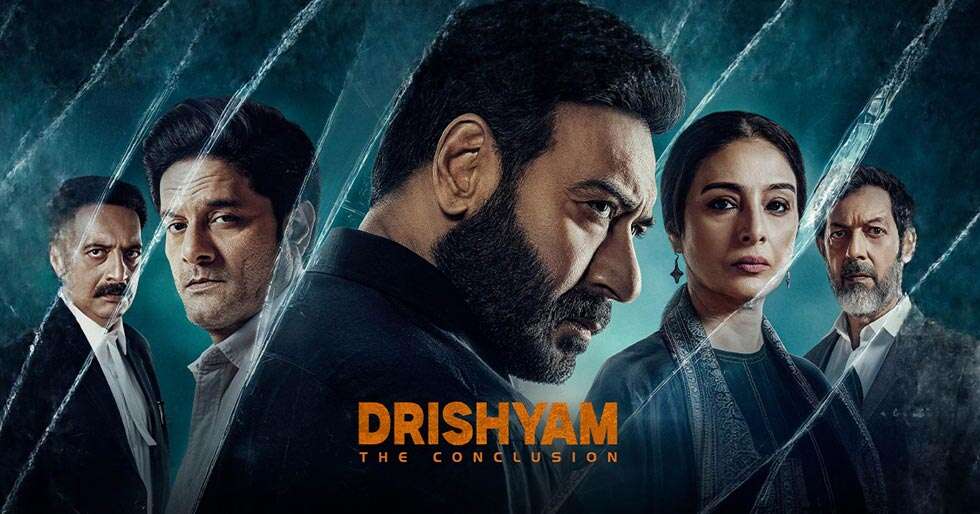
There is a temptation to compare Drishyam: The Conclusion with the Malayalam Drishyam 3, directed by Jeethu Joseph and starring Mohanlal. But the two films take very different routes. While Jeethu Joseph’s film explores new elements and pushes the story in another direction, director Abhishek Pathak chooses to stay closer to the world and storyline established by the first two Hindi films. He reinterprets it in his own way, giving us another chapter in Vijay Salgaonkar’s seemingly endless battle to protect his family.
And if you thought Vijay had finally run out of tricks, think again.
The film takes a little time to find its rhythm. The first half sets up the new predicament facing Vijay and his family without rushing towards the big reveals. It is in the second half that Drishyam: The Conclusion really comes alive. The tension steadily builds and, more importantly, the film keeps its cards close to its chest. You may think you know where Vijay is headed, but you probably won’t be able to guess the bag of tricks he has at his disposal this time.
That is the film’s biggest strength. The surprises are genuine. Just when you think you have figured out the next move, another piece of the puzzle falls into place. The final stretch, particularly the last 20 minutes or so, is the soul of the film.
The courtroom sequences are especially engaging. Prakash Raj, as Public Prosecutor Indrajith Shetty, and Samvedna Suwalka, as the Salgaonkar’s Advocate Gayathri Mohan, go head-to-head in a battle of wits that gives the climax a distinct flavour. Their exchanges bring a welcome spark to the proceedings, with both actors getting enough room to play the intellectual game at the heart of the story.
It is also here that Shriya Saran gets her moment of glory. As Nandini Salgaonkar, she has spent much of the film in the shadow of the crisis surrounding her family. The courtroom gives her character an opportunity to step forward, and Saran makes the most of it.
Ajay Devgn, meanwhile, does what he does best here: he says very little. Vijay remains reticent, watchful and constantly calculating. Devgn does not need long speeches to tell us what is going on in his head. His silence carries the weight of a man who knows that one wrong move could destroy everything he has done to protect his wife and daughters. He is every inch the concerned father and husband trying to get his family out of yet another impossible situation.
Jaideep Ahlawat plays SP Rajveer Singh Tomar IPS of the Crime Branch, a police officer who is sympathetic to Meera Deshmukh’s pain and determined to deliver justice to her. Ahlawat is capable of creating menace without raising his voice. He understands that a quiet threat can sometimes be more effective than a loud one. But, and this is not a criticism of Ahlawat’s acting, we did miss Akshaye Khanna. His presence in the previous film had a certain aura that was difficult to ignore. Ahlawat brings his own energy to the character, but Khanna’s particular brand of screen presence is hard to replicate. We’re not dissing Ahlawat. We’re simply saying Khanna’s aura farming is better.
Tabu returns as Meera Deshmukh, the former Inspector General of Police, with the emotional baggage of everything that has happened before. Her character remains driven by the need for justice, for revenge, while Rajat Kapoor brings restraint to Mahesh Deshmukh. In the original, Asha Sarath’s character is shown to be having neurological issues due to the emotional stress and the husband is shown to be actively plotting revenge. That’s not the case here. Ishita Dutta, playing the elder daughter Anju and Mrunal Jadhav playing the younger daughter Anu provide able support. Kamlesh Sawant returns as Inspector Laxmikant Gaitonde. Actually, the makers have shot a couple of skits where his character announces the beginning of the film and the interval and they’re decidedly funny. Saurabh Shukla adds his familiar gravitas as Murad Ali.
One of the interesting things about Drishyam: The Conclusion is that it does not try to outdo itself by becoming unnecessarily complicated. Jeethu Joseph’s Malayalam version is more dramatic, more intense and darker in its approach. Here, Pathak chooses a relatively cleaner and more contained route. Unlike Georgekutty, Vijay does not turn into a ronin-like figure, wandering far outside the moral and emotional universe established by the earlier Hindi films.
In that sense, this feels like a PG-13 version of the story. Yet, surprisingly, it also feels more logical and more in keeping with the first two Hindi films. There are no unnecessary outside elements brought into the narrative. The film remains centred on Vijay, his family, the police and the consequences of what happened before. Most importantly, the film eventually explains its twists rather than leaving us with convenient loose ends. By the time the final pieces fall into place, the various strands are tied together neatly.
Drishyam: The Conclusion may not have the same darkness or dramatic intensity as Jeethu Joseph’s Malayalam interpretation, but Abhishek Pathak has clearly chosen to play by his own rules. The result is a film that understands what audiences have come to expect from the Drishyam franchise while still finding new ways to keep us guessing.
The first half lays the foundation. The second half builds upon it nicely. And by the time the courtroom drama reaches its final act, Vijay has one more lesson to teach us: never underestimate a man who loves his family enough to plan several moves ahead.
Also Read: Drishyam 3 Advance Booking: Ajay Devgn’s Film Crosses Drishyam 2’s Final Sales
Disclaimer : This story is auto aggregated by a computer programme and has not been created or edited by DOWNTHENEWS. Publisher: filmfare.com