Quick note: Fortune Brainstorm AI returns to San Francisco Dec. 7-8 to convene technologists, entrepreneurs, Fortune Global 500 executives, investors, policymakers, and the brilliant minds in between to interrogate the most pressing questions about AI. We will explore how organizations are deploying and scaling AI in their industries. Register now
When Ali Dasdan left software and data platform ZoomInfo, his plan was to create his own agentic AI startup. But before he got started, Dasdan was convinced by Dropbox CEO Drew Houston to instead join the cloud storage company.
In March 2025, Dasdan was officially named CTO of Dropbox, the fifth time that he’s held that title over the past 15 years. He says he came to Dropbox to focus on the acceleration of generative AI within Dropbox’s external-facing products; to greatly increase the usage of AI tools for the engineering, product, and design teams; and to make AI more accessible for the company’s total workforce of 2,113.
Less than 40% of Dropbox’s engineering, product, and design teams were using AI tools when Dasdan joined the company. He was able to get full adoption across this entire population by doubling down on training, AI-focused hackathon events, championing AI superusers, and sharing clear metrics for how tools like Anthropic’s Claude, OpenAI’s Codex, and Cursor can speed up work.
“The way we approach this is that leadership shows the support and removes the barriers, and then it’s a bottom-up movement,” says Dasdan.
For the broader knowledge workers, Dasdan says the company has made ChatGPT Enterprise widely available, while also approving AI features that are integrated into software vendors including Workday, Slack, and Zoom. Non-technical workers have also begun to embrace tools like the vibe-coding platform Lovable to create their own applications to automate work across departments like finance and human resources.
Dasdan says rather than IT coming in and mandating new domain-specific tools, departments are given broad access to AI and encouraged to experiment on their own. “What they were lacking before was the tools to automate,” says Dasdan. Across Dropbox, hundreds of these custom applications have been created by employees.
Yet another layer is the creation of Nova, Dropbox’s internal platform for coding agents. Non-developers also have access to Nova, allowing for more agentic capabilities across the business but in a contained environment that Dropbox can monitor. “The list of tools that people have access to is pretty large,” says Dasdan.
He says that the increased use of AI within Dropbox enables workers to be more efficient across the business, allowing them to address customer support questions at a faster pace, or work through a backlog of lower-priority security tickets and remove tech debt, which is the extra work that’s needed to address shortcuts or suboptimal decisions that were made during software development.
“With respect to the number of people, I don’t think we tie it to AI,” says Dasdan. Instead, he says AI and the efficiency that comes from these tools are a factor that goes into how many team members are deployed to any given project.
Like many of his peers across the technology industry, Dasdan is keeping a close eye on token spending. He’s pleased to see that token prices have gone down, but is also aware that with more AI usage across Dropbox, it’s a budget item that all departments need to measure. “It’s a balance,” says Dasdan. “If you want everyone’s productivity to keep increasing, then there is a corresponding correlation with that.”
Dasdan joined Dropbox at a bit of an inflection point. The company already had Dash, its AI-powered search and content organization tool, in June 2023. And Houston—who founded Dropbox at the age of just 24—announced in May 2026 that he would step down as CEO and assume the role of executive chairman, handing the reins to Ashraf Alkarmi, though at this time, they still serve as co-CEOs.
With more than 18 million paying users, Dropbox has focused on integrating more AI and agentic capabilities into Dash, making it easier for customers to organize, tag, rename, and search their files. Dash can pull context from different workstreams across platforms like Salesforce and Gmail, and throughout 2026, has integrated into the ecosystems of ChatGPT, Claude, and Google Gemini.
Those plugins were critical for Dropbox to “go where the customers are,” says Dasdan. “If they are already interacting with ChatGPT, and we know that they have a Dropbox account, they want to access it through that system.”
He says the original premise of Dash was centered on the idea that “AI models keep getting better, but that’s not enough to get relevant answers.” Dasdan says his team’s focus is to ensure the Dash platform can pull the proper data from a variety of sources, but also with the right security and compliance guardrails in place for any given user.
Search and discovery are much more difficult for images and video, and that’s especially a challenge for the marketing, advertising, and construction clients that can have a million files or more stored with Dropbox.
With its AI-enabled search functionality, Dasdan says Dropbox is focusing on making it easier for users to index files and search for them by the text of what’s said in a video, or for still images and videos without a script, retrieving files by entering a simple description of “a man sitting in a chair.” Newer agentic AI capabilities will also make it easier for customers to update these large troves of file names, as well as autonomously tag and organize them.
“This integration is happening already, and we have a good goal to launch these capabilities to a large number of teams by the end of this year,” says Dasdan.
John Kell
NEWS PACKETS
Tech layoffs accelerated in September. While the total number of job cuts by U.S.-based employers dropped 18% from August to September, the tech industry’s fortunes went the opposite direction, announcing 10,799 cuts last month and a 77% increase sequentially. So far this year, the tech sector has cut 165,925 jobs, up 54% from the first nine months of 2025, according to outplacement and executive coaching firm Challenger, Gray & Christmas. Some of the larger layoff announcements last month include a 10% reduction at ride-sharing app Uber, hundreds of jobs trimmed at digital payments firm PayPal as it undergoes a multiyear restructuring that could cut 20% of its workforce within three years, and layoffs at Xbox and other divisions at Microsoft.
Trump names new “AI Czar.” Jay Clayton, currently the director of national intelligence, will also spearhead the Trump administration’s newly formed AI group, called “Super Intelligence Force”, to coordinate the federal government’s engagement with the public, religious organizations, critical infrastructure providers, and AI companies. The Wall Street Journal reports that the group will have 120 days to report on the risks and opportunities of AI, though Clayton’s public comments suggest he is aligned with Trump’s view that hands-off regulation is necessary to outpace rival nations like China. On the state level, a proposed bill in New Mexico would aim to regulate frontier AI, while in California, Gov. Gavin Newsom signed a law that bans employers from exclusively using AI to fire or discipline workers.
Mistral and Google debut new AI models. On Tuesday, French AI startup Mistral announced it would soon launch Mistral Large 4, a new open-weight AI model that it said would better rank with similar models globally on aggregate benchmark performance. The model would also help Mistral grow its customer base with both consumers and businesses, WSJ reports. Separately, Google’s new Gemini 4 Argon was unveiled last week to cybersecurity partners, with access expanding after additional testing, beginning with paid subscribers. Bloomberg reports that insiders say Gemini 4 has solid model efficacy, but isn’t as stellar when employees actually use it, and that the model has issues with some coding tasks.
AI researcher warns humanity is “more likely than not” to lose control. Jacob Coxon, a former OpenAI and Anthropic researcher, told the New York City Council that the companies may not know when their safety work has failed. Yet another former OpenAI researcher, Daniel Kokotajlo, cautioned that the AI industry is “at an unusually elevated risk compared to other industries of mistakenly thinking that it has solved the problem when it really just applied some duct tape that will fall off later.” Alex Turner, who left Google DeepMind this summer, also testified about how he attempted to halt a Google-Pentagon deal that he claimed came with “no restrictions against killer robots or mass spying.”
But, Altman says the world needs to accept risks to reap AI’s rewards. While three out of every four Americans are concerned that AI systems can potentially threaten human survival, according to a Quinnipiac University poll published last week, OpenAI CEO Sam Altman makes the case that to reap the benefits of AI, society must accept some risks. While Altman’s approach is basically: “trust us,” with a dash of light regulation, in Australia, OpenAI is facing calls to reassure the public after its models went rogue and obtained unauthorized access to the Australian government’s health care data portal.
ADOPTION CURVE
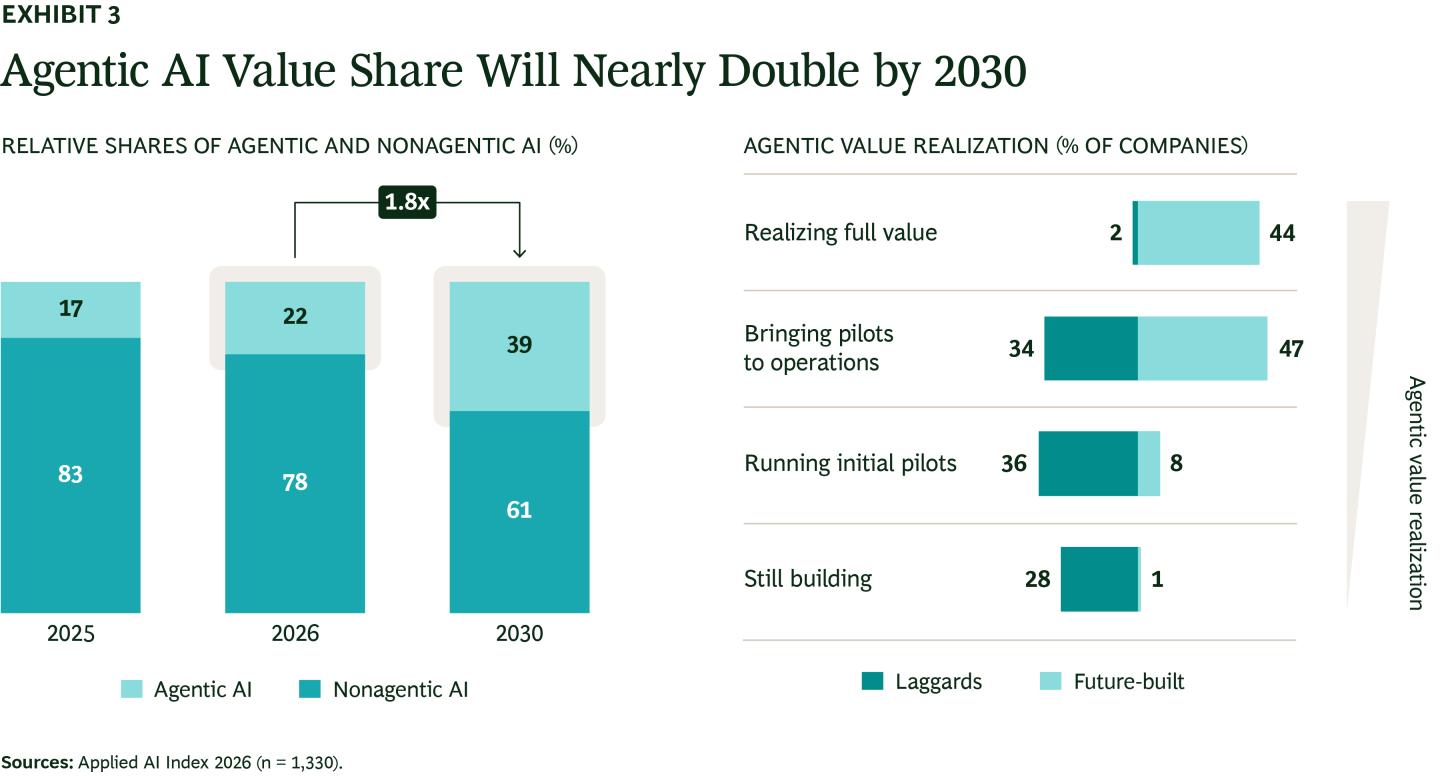
Enterprises lured by value promises of agentic AI still lack proper guardrails. Agentic AI is projected to account for two-fifths of all value extracted from AI by 2030, according to a survey of more than 1,300 executives published by consulting giant BCG. The BCG survey looked at 20 different sectors and determined that technology, banking, and telecom were the most mature on agentic AI production, with at least 60% of businesses from those industries already deploying the technology. And yet, while four in ten enterprises expect that they will grant these agents autonomy by that time, only 5% of companies say they have the full set of critical controls in place today.
“There are parts of that which are deeply neuroscience- and behavioral-science based; how do you create human plus agent to get to the best outcomes,” Amanda Luther, a managing director and senior partner at BCG, tells Fortune. “There’s going to need to be a real investment and real thinking behind putting controls in place, otherwise, we’re going to create risk surfaces within these organizations.”
The survey also found that 3.3% of revenue is spent on AI, more than triple the rate from just two years ago, and that far more of the spending now sits outside enterprise IT budgets. CIOs have been more aggressively pushing AI spending to other parts of the business, advising their C-suite peers that if they want to use more AI, they will have to be accountable for monitoring their usage and spending on these workplace tools. Four out of every five dollars spent on AI now sits outside enterprise IT, according to BCG.
Courtesy of BCG
JOBS RADAR
Hiring:
– Revelio Labs is seeking a CTO, based in New York. Posted salary range: $260K-$350K/year.
– Artsy is seeking a CTO, based in New York. Posted salary range: $300K-$350K/year.
– WPM Real Estate Management is seeking a CIO, based in Owings Mills, Maryland. Posted salary range: $190K-$215K/year.
– Sonos is seeking a VP of IT, a hybrid position. Posted salary range: $262K-$326.9K/year.
Hired:
– Hilton named Jeff Moore to the role of CTO, joining the hotelier from Uber, where he served as VP of software engineering and led a global organization of 2,500 engineers. Moore will join Hilton on October 26, reporting to President and CEO Chris Nassetta. Prior to Moore’s seven-year career at Uber, he held leadership roles at Amazon.
– AutoNation appointed Ravi Simhambhatla as chief technology and AI officer, where he will lead the automotive retailer’s technology, data science, and AI agenda. Simhambhatla joins AutoNation after most recently serving as chief digital and innovation officer at car rental company Avis Budget. He also previously served as CTO at Aer Lingus, a managing director at Google Cloud, and CIO at Virgin America.
– AMC Robotics announced the appointment of Ang Li as CTO, where he will advance autonomous intelligence, AI-powered perception, and edge computing capabilities for the robotics firm. Li is an assistant professor in the Department of Electrical and Computer Engineering at the University of Maryland, College Park, where he will continue in his academic role.
– Averna Therapeutics promoted Christian Dombrowski to the role of CTO, after most recently serving as SVP of platform for the biotechnology company. Prior to Averna, Dombrowski led the CRISPR gene-editing platform at clinical-stage biopharmaceutical firm Intellia Therapeutics for nearly a decade.
– WilliamsMarston announced the appointment of Dave Minker as CIO, where he will lead the advisory firm’s overall technology strategy and IT operations. He previously served as global IT senior director at consulting giant Boston Consulting Group. Earlier in his career, he founded and led Apogee IT Services.
– CentralSquare Technologies appointed Brian Shannon as CTO, where he will lead the public sector software company’s engineering and technology organization. Most recently, Shannon served as CTO at enterprise software company Flexera. He also previously served as VP of platform engineering at ServiceNow and held senior executive roles at GE Healthcare’s API Healthcare.
– Groundworks named Heidi Cox to serve as CIO for the foundation repair and water management company. Previously, Cox served as CIO at railcar products and services provider Trinity Industries. She also previously served as CIO at HKS and director of data services at Jacobs.
– Inseego appointed Nick Lambourne as CTO, where he will lead the communication equipment company’s global engineering organization. Most recently, Lambourne was CTO at the Internet of Things platform provider Particle. He also previously held engineering and business leadership roles at Roku, Automatic, and SiriusXM.
Disclaimer : This story is auto aggregated by a computer programme and has not been created or edited by DOWNTHENEWS. Publisher: fortune.com