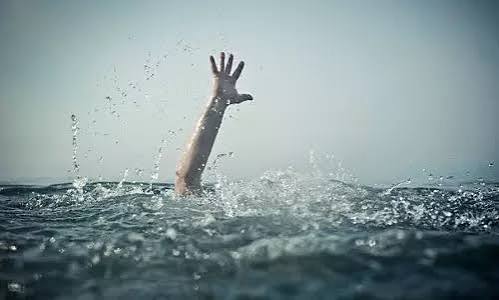
CHENNAI: Drowning deaths in India are rising and the scale of the problem remains largely overlooked because most incidents occur individually or in small numbers and do not attract wider public attention, says Dr. Muralee Thummarukudy, safety expert and former chief of disaster risk reduction at the United Nations Environment Programme (UNEP).
While India’s disaster-management systems have developed significantly to deal with floods, extreme rainfall and other climate-related events, routine drowning incidents, occurring across the country every day, remain a major challenge, he said.
Thummarukudy said the long-term indications from National Crime Records Bureau data suggest that drowning-related deaths have increased in India. Since most drowning deaths involve post-mortem examinations and police records, he said he was “very certain” that the recording of such deaths was fairly accurate.
He also stressed the need to treat drowning as a disaster-risk reduction and public-safety issue rather than merely an individual tragedy.
Excerpts:
Does research show that drowning deaths are actually rising in India, particularly in the southern states, or are we simply getting better at recording them?
Long-term indications from the National Crime Records Bureau suggest that there has, indeed, been an increase in drowning-related deaths in India. Since drowning deaths almost always involve a post-mortem examination and related police records, I am very certain that the recording is fairly accurate.
Why is drowning still largely treated as a public-health or individual safety issue rather than a disaster-risk reduction issue?
There are two reasons. First there is usually no preceding event such as a landslide, flood or earthquake that leads to most drowning deaths. Secondly, most deaths happen individually and occasionally in twos or threes. Therefore, they are mostly handled at the very local level and people do not come to hear about them.
Only when a large number of deaths occur together, most often due to a boat capsize or flash flood, does the issue attract wider attention.
How can the UN’s disaster-risk reduction framework be better integrated into India’s drowning-prevention strategy?
UN frameworks can certainly be applied to reduce drowning deaths. Risk assessment, risk mitigation measures, early warning, training and emergency response are all applicable to drowning as well.
With rapid urbanisation, bringing homes and children closer to lakes, tanks, canals and abandoned quarries, should these water bodies be formally mapped as disaster-risk zones?
Of course, all water bodies are potential drowning risks. This is not just about oceans and lakes, but also small pools at home and even a bucket of water in a bathroom. Marking water hazards wherever appropriate is important, but that alone will not be sufficient.
What does international research identify as the most effective and practical measures for preventing drownings in India — fencing, surveillance, swimming education, safe-rescue training or better enforcement?
Increasing water safety awareness is the most critical factor. Unlike fire, lightning or even a height, water gives no early warning of the approaching danger. Children and adults are often attracted to water bodies by their beauty and calmness. So, yes, fencing, surveillance and training are all important. But children can start drowning even before they learn to swim. Therefore, teaching adults about water safety and the importance of constant supervision, and teaching children about water safety as soon as they can understand it, are critical. Children should never be allowed to play around water unsupervised.
Are India’s existing disaster-management systems adequately prepared for the increased drowning risks associated with floods, extreme rainfall and other climate-related events?
Our disaster-management systems are well developed and continue to develop in relation to climate-linked extreme events. Our challenge is the normal, distributed drowning that happens every day across the country.
What are the biggest gaps in India’s drowning-prevention efforts — data, coordination, funding, enforcement or public awareness?
I would rate public awareness about the dangers of water as the primary concern. In the 2004 tsunami, which people still remember, Kerala had around 200 deaths. The 2018 floods, which were the biggest natural disaster in our recent recorded history, resulted in fewer than 500 deaths in Kerala.
Yet, in every year after 2004, Kerala lost more than 1,000 people to drowning. Since these deaths happen across the state and often do not go beyond a single column in local newspapers, most people are not aware of the scale of this calamity.
What three immediate measures would you recommend for cities such as Chennai and other rapidly urbanising areas in south India to reduce drowning deaths?
Make water-safety awareness mandatory in schools. Conduct water-safety campaigns in apartment blocks. Run public interest, water-safety campaigns on television and in cinemas. Teach children to swim and teach parents the importance of supervising them.
Disclaimer : This story is auto aggregated by a computer programme and has not been created or edited by DOWNTHENEWS. Publisher: deccanchronicle.com