
Dust settles in the arched corridor of an inner-city town hall, dark except for fingers of grey light stretching along the carpet. The air is musty, still. Quiet.
Except for the booming voice of Stephen Jolly, who is emphatically slapping a swipe card against a reader. “In here is the ballroom. It’s gigantic,” he says. The card reader beside the frosted glass door beeps disapprovingly.
Jolly pulls his phone out of his pocket, punching in a number before he holds it to his ear. “I told him ages ago that I was coming here today,” the Yarra mayor says, mildly annoyed.
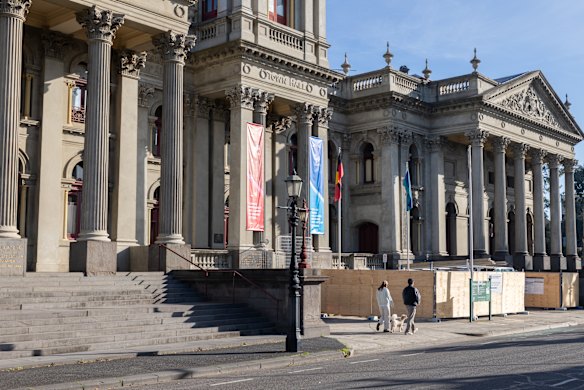
We’re inside the palatial Fitzroy Town Hall in Melbourne’s inner north, a relic of the city’s Victorian-era past, one which has sat largely empty since Liberal premier Jeff Kennett ordered statewide council amalgamations in the 1990s.
The City of Yarra’s council meetings resumed here in 2025 after a years-long hiatus, but – like many of Melbourne’s grand town halls – the height of its civil life is marooned in history. It may be time to reclaim it.
“If I wanted to write something, really concentrate on something, I would come here,” Jolly says. “[But] it’d be like coming to a morgue.
“Inner-city land is so expensive, and we have this here, and it’s just not fully utilised. I just hate seeing waste.”
Tea cups bearing the old City of Fitzroy emblem are stacked in a disused councillors’ room, left over from before it was consumed into the City of Yarra (along with Collingwood and Richmond). The walls of other rooms upstairs are coated in great swaths of dust, and paint is stripped where electrical wiring was torn out and replaced.
Curtains printed with pictures of books hang on ornate shelves in the reading room where hardbacks used to be. The Fitzroy Legal Service, a couple of NGOs and the local library are here, but the civil servants are long gone, leaving much of the building desolate (its high ceilings, while striking, make it difficult to heat and cool).
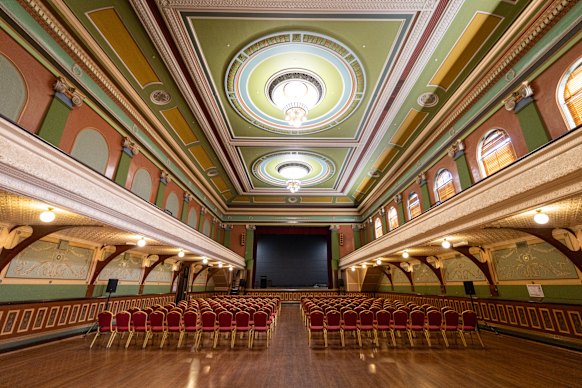
A woman arrives to let us into the ballroom, swinging open the frosted glass doors to reveal a cavernous, classical space fitted with bell flower chandeliers and balcony seating.
If Jolly had his way, this building would be humming again. Newer council offices in Richmond (“a white elephant”) would be sold off, and staff would work across the municipality’s three town halls, with Fitzroy upgraded to accommodate them.
Melbourne could restore many of its under-used and dilapidated town halls back to their former glory. But it would take time, money, forethought – and a good dose of imagination.
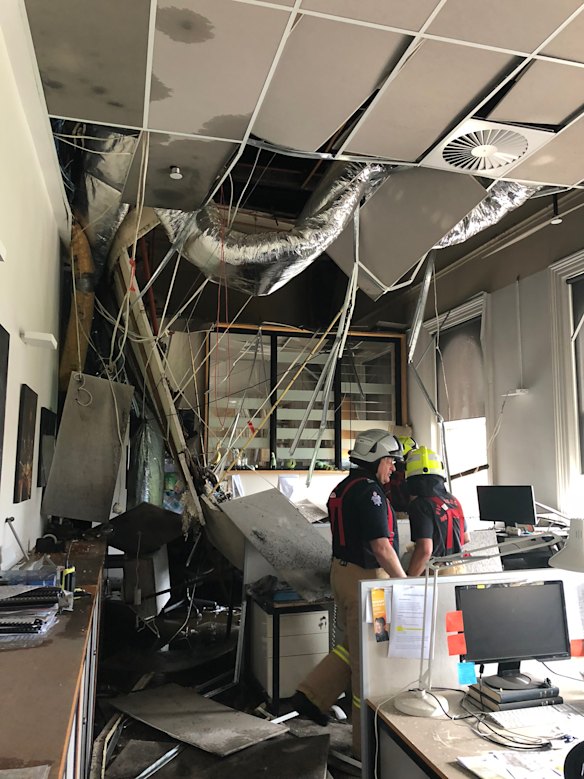
It was an average Thursday, springtime in leafy South Melbourne, and two music academy staff were settling in for an afternoon of work when a rotten structural beam collapsed the roof onto their desks.
The noise was cacophonous. The staff were almost taken out, forced to run from a mess of ceiling tiles, buckled steel joinery and electrical wiring brought down in the chaos. Then, the building flooded, the sprinkler system pouring in more than 12,000 litres of water.
This was October 2018 at South Melbourne Town Hall – the home of the Australian National Academy of Music.
“The building had not been cared for,” the music academy’s Nick Bailey says.
“It led us to: where do we want to be, is this building safe? It needs so much money, it needs so much love, and it’s just been let go.”
The training and performance arts company had inhabited the retired town hall since 1996, soon after South Melbourne merged with Port Melbourne and St Kilda to become the City of Port Phillip under Kennett.
The council owned the building, meaning it could lease it to whomever (a quirk when many other town halls are built on Crown land, which restricts them to municipal use). But the academy’s occupancy did not equate to upkeep, or celebrating its 1879 heritage.
Local historian Adair Bunnett recalls that when the community was occasionally allowed into the grand old hall, “we’d see that everything was knocked about.
“The hall had gaffer tape all over the floor,” Bunnett says. “There were cobwebs hanging from ceilings. The council chamber was a students’ lunchroom, and some of the leathers had got a bit old, and they were picked at, so there’s bits of stuffing coming out of the banquettes.
“It was just awful,” she says. “We didn’t like [the music academy] much.”
The roof collapse in 2018 triggered a plan to restore the building, which quickly grew in complexity and scale. The restoration, in turn, provoked a community revolt – with Bunnett a leading agitator, concerned the renovations would destroy the building’s character, and the music academy’s sole tenancy would keep it out of community hands.
“In South Melbourne Town Hall, you can actually place innovation in social welfare,” Bunnett says. “You can point to that building and say, ‘This is where the first infant welfare centre was. This was where Meals on Wheels were managed from.’
“All of these things, we can actually locate in a particular building. That’s pretty rare.”
But late last year, Bunnett stood alongside architect Peter Elliott in what will become the music academy’s main performance and training hall.
Shadows danced on the scaffolding in the cathedral-like space, which will eventually be bathed in light by the biggest double-sashed windows Elliott has ever seen (most of which, are boarded up for now).
Massive circular rigs containing sound and lighting equipment will be flown above musicians in the round.
Beyond just the academy, the idea is to have people in the restored building every night of the week, particularly with public events like the Melbourne International Comedy Festival and writers’ festivals, Bailey says.
In seeing the project with her own eyes, Bunnett has realised it is realistically the only way to save the building.
“I’m comfortable now that if I was run over tomorrow, if the big bus got me, I’d be happy,” Bunnett says. “I’d feel it’s in safe hands and will be developed properly.”
But the project hasn’t been without colossal expense and effort.
The cost has blown out from $65 million to $110 million, and students aren’t due to return until mid-2028 – meaning it is running four years behind schedule.
The City of Port Phillip has doubled its original contribution to $40 million, and the music academy itself is putting in $70 million – half from philanthropists, and the other half from government funding ($10 million is still in negotiation with the Victorian government).
Elliott says the restoration is a once-in-a-generation opportunity to bring the rundown building into its next 50 years. While a big part of the project is unique to a performance academy, half of the job is also ensuring the integrity of the building’s infrastructure.
“The roofs were completely shot. Virtually every service had to be replaced,” he says.
But when it’s complete and people step inside what still looks like an old civic building, “it’ll feel like a whole nother world”, Elliott says.
In March, Bailey stepped down as the academy’s managing director to focus purely on the South Melbourne Town Hall restoration. In his 17 years in the role, he worked through the roof collapse, relocating the academy to the Abbotsford Convent, and the aftermath of the infamously named “fax day”, when then-federal arts minister Peter Garrett informed the academy by fax in 2008 that he intended to shut it down by the year’s end.
But this project – currently an inconceivable maze of machinery, dust and demolition – may be Bailey’s greatest challenge yet.
“Sometimes they look about like, what the hell are we doing, taking this thing on?” Bailey says of the crews working on the restoration.
“But it’s magnificent.”
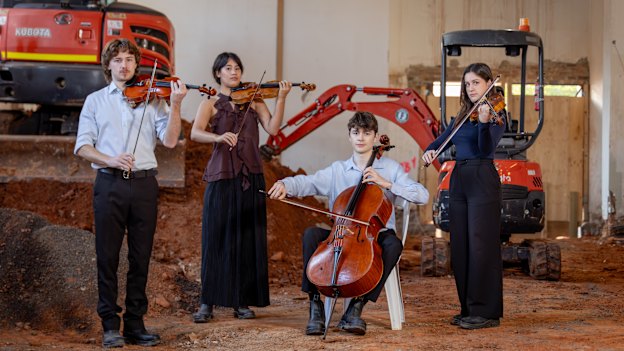
Four music students take position in a big dirt pit beside excavators, in what it is hoped will one day become the Barry Jones studio (an apt tribute to the former politician). They steady their instruments, then launch into play as a string quartet, mesmerising Elliott as he visualises the completed room; the acoustic panelling, designed to resemble books, like those in the former library here.
A second prompt to step aside for an interview snaps Elliott out of his daze. “Oh, sorry,” he says, sheepish.
The architect tears himself away from the music.
In the library of Prahran Town Hall, Rachel Westaway is sitting in a green armchair beside tall arched windows. They look out to a small courtyard – a bit of greenery here, a statue there. It’s closed off to the public with a sign warning “no access”.
“Civic buildings like this that have been around for well over 100 years were built in prime locations,” Westaway says.
“The difficulty we have when Chapel Street is in demise at the moment is that we’ve got a big building that isn’t being utilised effectively.”
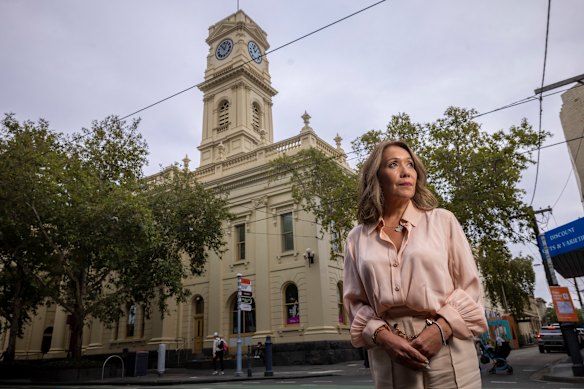
Last year, the local state MP toured the town hall’s upper storey, which is closed to the public. She found it in a state of disrepair.
The local council, the City of Stonnington, has a vision to transform the building into a cultural hub – but an accompanying business plan is indefinitely on hold while the council lacks the funds.
“There are future plans for a major redevelopment throughout the site,” a City of Stonnington spokeswoman says. “Council hopes to work in partnership with the state government to move these plans forward in the next 10 years.
“This support will be vital if council is to undertake a significant redevelopment.”
In Melbourne’s north, Merri-bek City Council is in a similar position, working with a modest $73,000 in next year’s budget to upgrade Brunswick Town Hall’s facilities. Mayor Nat Abboud’s ideal would be for it to become the “elder sibling” to Brunswick’s Mechanics Institute, which has been reborn as an arts venue. “Since COVID, the whole building has been underutilised,” Abboud says.
Westaway suggests it’s implausible for ratepayers to cover the necessary tens of millions of dollars to restore their town halls, and councils should collaborate with private businesses to bring life and community back into these places – lest the buildings rot.
Historian Chris McConville points to North Melbourne Town Hall as a well-executed example, one which combines theatre space, workspace, and linking retail and a library. These buildings’ utility shouldn’t be measured in dollars, he says, but rather in their value to the community instead.
“They are paid for by the community and kept intact through people’s rate payments, so their future life really belongs to the community in the first instance,” McConville says. “It’s a question of fitting economic value around that.”
Bunnett reflects on her scepticism of the music academy taking over South Melbourne Town Hall, and toiling over what this would mean for the future of a building she’s spent years fighting for. Ultimately, it took her sitting down with Bailey and Elliott to realise they had one thing in common, and it trumped all else – a respect for history.
“That’s really important – to have a ding-dong battle, but at the end of it, say, ‘Let’s have a cup of tea’,” she says.
If they pull this off, it will be a battle well fought.
Start the day with a summary of the day’s most important and interesting stories, analysis and insights. Sign up for our Morning Edition newsletter.
Disclaimer : This story is auto aggregated by a computer programme and has not been created or edited by DOWNTHENEWS. Publisher: www.smh.com.au


