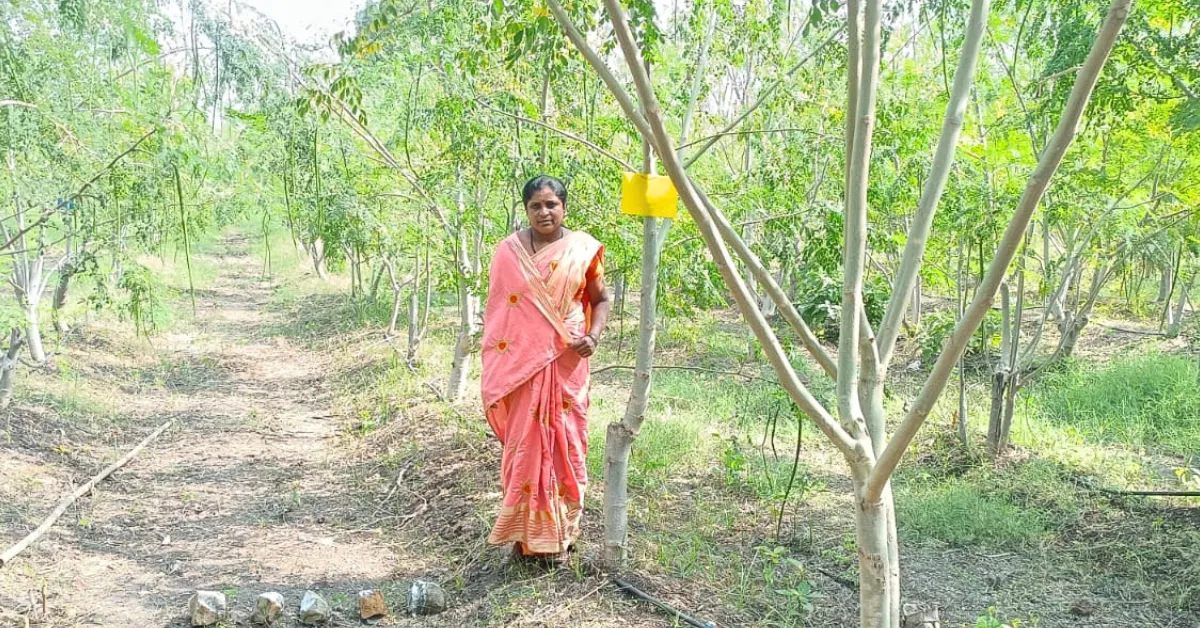
On a warm morning in Maharashtra, 47-year-old Jayashree Gorakh Mali bends over a small vermicompost pit on her farm, carefully lifting a handful of dark, crumbly soil. Beside her, her daughter watches closely, helping arrange the organic waste that will soon turn into nutrient-rich compost.
For Jayashree, this simple process represents something much bigger — confidence, independence, and a livelihood she once never imagined for herself.
“Earlier, I was scared even to step out and speak to people,” she tells The Better India.“Now I manage the entire farm. My family asks me before making decisions. That makes me very proud.”
Jayashree lives in Ter village in Maharashtra’s Dharashiv district, where her family owns just 1.5 acres of land. For years, she spent her days managing household work and helping on the farm, but without much say in how things were done.
That began to change in 2018, when she joined Sakhi Unique Resource Enterprise (SURE) — a network that trains rural women to become local entrepreneurs and leaders in climate-smart livelihoods.
Through SURE, women receive hands-on training in sustainable farming practices, clean energy technologies, and rural enterprises. The idea is simple but powerful: when rural women lead solutions in their own communities, both livelihoods and the environment benefit.
For Jayashree, those trainings opened the door to a completely new world, one where she could learn, experiment, and slowly transform both her farm and her confidence.
From hesitation to leadership
For most of her life, Jayashree’s world revolved around her home and the small family farm in Ter village in Maharashtra.
After completing her higher secondary education, she got married and moved into a household of five members with her in-laws. The family owned 1.5 acres of agricultural land, where they practised conventional farming using chemical fertilisers, a method that often brought uncertain results.
Jayashree spent her days managing household responsibilities and helping with farm work whenever needed. But stepping outside her comfort zone was never easy.
“I used to stay at home. I didn’t do any work outside,” she recalls.
At the time, her knowledge of farming was limited to what the family had always practised. Chemical fertilisers were commonly used, but they often increased costs without guaranteeing better returns.
Things began to shift in 2018, when Jayashree first heard about training programmes organised SURE in her village.
Encouraged by her family, she decided to attend.
The training sessions quickly became a turning point. Several times a month, Jayashree and other women from nearby villages would gather for day-long sessions that ran from 8 in the morning until evening.
“There were many trainings about organic farming,” she says. “We were taught how to make vermicompost and how to use it in farming.”
For Jayashree, these sessions were not just about agriculture — they were about discovering her own abilities.
“With every training, my knowledge increased,” she says. “I felt very good that I was learning so many things, and my confidence was growing.”
Slowly, she began applying these practices on her own farm. Instead of relying entirely on chemical fertilisers, she started using vermicompost and natural bio-inputs to improve soil health.
The difference soon became visible.
/filters:format(webp)/english-betterindia/media/media_files/2026/05/14/women-farmers-2026-05-14-18-45-02.png)
“Earlier, when we used chemical fertilisers, we didn’t get much profit,” she explains. “But now our crops are growing very well.”
At the same time, SURE introduced Jayashree to hydroponic fodder technology — a way of growing nutritious green fodder for livestock using very little water and no soil.
Initially, she was unsure if it would work.
“At first I was scared,” she says with a smile. “I kept thinking — will it grow properly or not? But after the training, I tried it.”
The experiment paid off.
Today, Jayashree produces three to four crates of hydroponic green fodder every day, feeding it to her cows and buffaloes. The improved nutrition has had a direct impact on her dairy business.
“My buffalo’s milk has increased,” she says. “Now I get five litres of milk in the morning and five litres in the evening.”
That means nearly 10 litres of milk every day, bringing in around ₹600 daily — a significant contribution to the household income.
“Earlier we didn’t get this much,” she says. “Now I feel very happy that more money is coming into the house.”
The change has also transformed her role within the family.
“Now I look after the entire farm,” Jayashree says proudly. “My husband and family know that I can manage it well. That’s why they ask me before doing anything.”
What began as a training session slowly turned into something much larger — a sense of confidence, respect, and a stable livelihood built through knowledge and persistence.
When rural women become climate entrepreneurs
Jayashree’s story is not an isolated one. It is part of a larger movement powered by Sakhi Unique Resource Enterprise (SURE) — a model built on a simple belief: when rural women lead solutions, change lasts.
Founded in 2009, SURE trains rural women — called Sakhis — to become local entrepreneurs who bring climate-friendly technologies and livelihood solutions to their own communities. These women introduce farmers and households to practical tools that improve incomes while reducing environmental impact.
/filters:format(webp)/english-betterindia/media/media_files/2026/05/14/women-farmers-2026-05-14-18-45-39.png)
“For the last 20 years, I have been visiting villages regularly,” says Prashant Manke, who has worked closely with rural communities for over two decades. “People in rural areas are simple but extremely sharp. They quickly understand the value of a product if it truly helps them.”
But historically, there has been a challenge.
“Over decades, there has been a trust deficit,” he explains. “Many people have come to villages promising solutions, but the products did not always deliver. That is why our idea was simple — the person promoting the solution must come from within the village itself.”
This is where the Sakhi model becomes powerful.
A Sakhi is a woman who lives in the community, understands its needs, and is trusted by local families. Instead of acting like a salesperson, she becomes a solution provider — demonstrating technologies, explaining their benefits, and helping families adopt them.
“The community believes her because she is one of them,” Prashant says. “She is not seen as a seller. She is seen as someone bringing useful solutions.”
Through this model, women also earn commissions on the products they promote — creating a new source of income while building local trust.
Changing lives, one sakhi at a time
Beyond technology and livelihoods, the Sakhi model is also quietly transforming women’s roles within their families and communities.
According to Prashant, the biggest shift often happens at home.
“The transformation within the family is very visible,” he says. “Earlier, many women would not even be allowed to step out for meetings. They would be questioned — why are you going out? They were rarely involved in decisions about spending, and many did not have any money of their own.”
But that begins to change once they become Sakhis.
“As she starts earning, the confidence grows within the family,” he explains. “She is respected more. She becomes part of decision-making — what to buy, what to spend on. And most importantly, she has some money of her own.”
/filters:format(webp)/english-betterindia/media/media_files/2026/05/14/women-farmers-2026-05-14-18-46-57.png)
Gradually, the perception shifts.
“There are no more questions about why she is going out,” he says. “She manages her family responsibilities; she may also be a farmer, and she is doing this work as well. That flexibility gives her independence.”
This ripple effect is one of the reasons the Sakhi network has continued to grow over the years.
Solutions designed for rural realities
At the heart of SURE’s work is a simple principle: solutions must match the realities of rural life.
“Our first question is always — what is not available in the village?” Prashant explains. “If people have to travel to a nearby town to buy something essential, that is an access gap. We try to solve that.”
The second focus is impact.
“Whatever we promote must benefit the farmer or the household,” he says. “And the third is fairness — the product must be sold at the right price.”
With this approach, SURE promotes a range of climate-friendly livelihood technologies — from solar-powered farm equipment and hydroponic fodder systems to vermicomposting solutions, biogas units, and renewable energy products that reduce both costs and carbon emissions.
Over the past 16 years, this model has helped bring such solutions to more than one million rural households while creating income opportunities for thousands of rural women entrepreneurs.
At its core, SURE operates at the intersection of three powerful forces.
/filters:format(webp)/english-betterindia/media/media_files/2026/05/14/women-farmers-2026-05-14-18-48-33.png)
“First is gender — because we work only with women,” Prashant explains. “Second is livelihood — we want Sakhis to earn income. And third is climate, because many of these technologies reduce emissions or support sustainable farming.”
Across villages, this network of women entrepreneurs is quietly building resilience — improving livelihoods, strengthening local economies, and accelerating climate-friendly practices.
And for women like Jayashree, it has meant something even more meaningful: the chance to step forward as leaders within their own communities.
Higher income, healthier crops, and a new identity
Today, Jayashree Gorakmali walks across her fields with a confidence that once felt impossible. The woman who once hesitated to step out alone now manages the family farm, experiments with organic practices, and helps other women in her village learn the same methods. Her crops are healthier, her buffalo now gives nearly 10 litres of milk a day, and the extra income from milk and vermicompost has brought a new sense of stability to her home.
But the change is not just visible in the fields — it is visible in the way people speak to her.
“Earlier, people just called me by my name,” Jayashree says with a smile. “Now the women in the village call me ‘madam’. It feels very good.”
Her daughter Apeksha, a 22-year-old law student, has watched this transformation up close. She remembers a time when farming brought little profit, and there was little financial planning at home. Since Jayashree began working with SURE, she says, the family has not only seen higher farm profits but also better money management.
More than the financial changes, it is her mother’s growing confidence that stands out to her.
/filters:format(webp)/english-betterindia/media/media_files/2026/05/14/women-farmers-2026-05-14-18-49-10.png)
“In our family, my mother has become the main decision-maker,” Apeksha says proudly. “She manages the farm, takes the important calls, and even guides other women in the village.”
Apeksha recalls how her mother once hesitated to travel outside the village. Today, Jayashree regularly attends meetings in the district and even represented her work at a biogas programme in Jaipur — something the family could hardly have imagined earlier.
“Seeing people in the village look up to my mother as a role model makes us very proud,” Apeksha adds. “Even I learn from her how to take initiative and believe in your work.”
Jayashree hopes her journey inspires many more women to take charge of their livelihoods. Her dream now is simple but powerful: to see 100–150 women in her village practising organic farming and starting their own businesses.
Because for Jayashree, empowerment is no longer an abstract idea. It is something she lives every day, in the soil she nurtures, the women she mentors, and the pride reflected in her daughter’s eyes.
All images courtesy SURE team
Disclaimer : This story is auto aggregated by a computer programme and has not been created or edited by DOWNTHENEWS. Publisher: thebetterindia.com