Golf instruction is ever-evolving, but the best advice stands the test of time. In GOLF.com’s series, Timeless Tips, we’re highlighting some of the greatest advice teachers and players have dispensed in the pages of GOLF Magazine. Today we look back to our September 1981 issue for driving accuracy tips from Ben Crenshaw.
Hitting the ball in the fairway is a skill that has lost a bit of its luster over the years, but it remains incredibly important. While it’s true that distance is a more premium skill than accuracy when it comes to the driver, that doesn’t mean you can ignore it. As legendary instructor Harvey Penick once said, “The woods are full of long hitters.”
Ben Crenshaw was a Penick disciple, and he took this advice of accuracy to heart. Although he was known for his putting prowess, his ability to keep the ball in the fairway cannot be overlooked.
Back in a 1981 issue of GOLF Magazine, Crenshaw shared some of his best advice for finding more fairways, which you can check out below.
<figure class="youtube-facade" data-content="
“>
Crenshaw’s driving accuracy tips
During the last four years or so, I have learned to drive the ball better. I had to do that to survive on the Tour. It was clear to me that had I continued driving the ball in the old way, my future was more than a little uncertain. As late as 1976, I was likely to miss as many as 10 fairways during a single round. This forced me to take a hard look at my driving and to analyze what I could do to improve it.
In comparing myself to the great drivers of the ball, it was immediately apparent that, unlike me, they hit the ball on a lower trajectory. My ball was flying out very high, and as a result, I had a lot of trouble playing in the wind.
There were technical reasons why I hit the ball too high and had a tendency to spray it. I’ll get into those on the next page, but here I should mention that my equipment was also hurting me. My stiff (S) shafted driver was much too flexible for me. By switching to a tipped extra-stiff (X) shaft, I not only got a lower trajectory but also more accurate drives. I’ve given up about 15 yards in making this change, but if I had to choose between my old 280 yards in the rough and my new 265 yards on the fairway, I’ll take the short grass any day, and so should you.
So, even though your first item of study should be the trajectory of your drives, if you’re hitting the ball too high or low or are inaccurate, you must also look at your equipment. You have to find a playable driver, one with which you can mishit the ball and still get it into the fairway. Your professional can help you find the driver with the right shaft and other specifications to suit your game.
I am also going to suggest what to key on when driving the ball, give some technical tricks and explain the art of targeting. So let’s go.
My swing problems and yours
GOLF Magazine
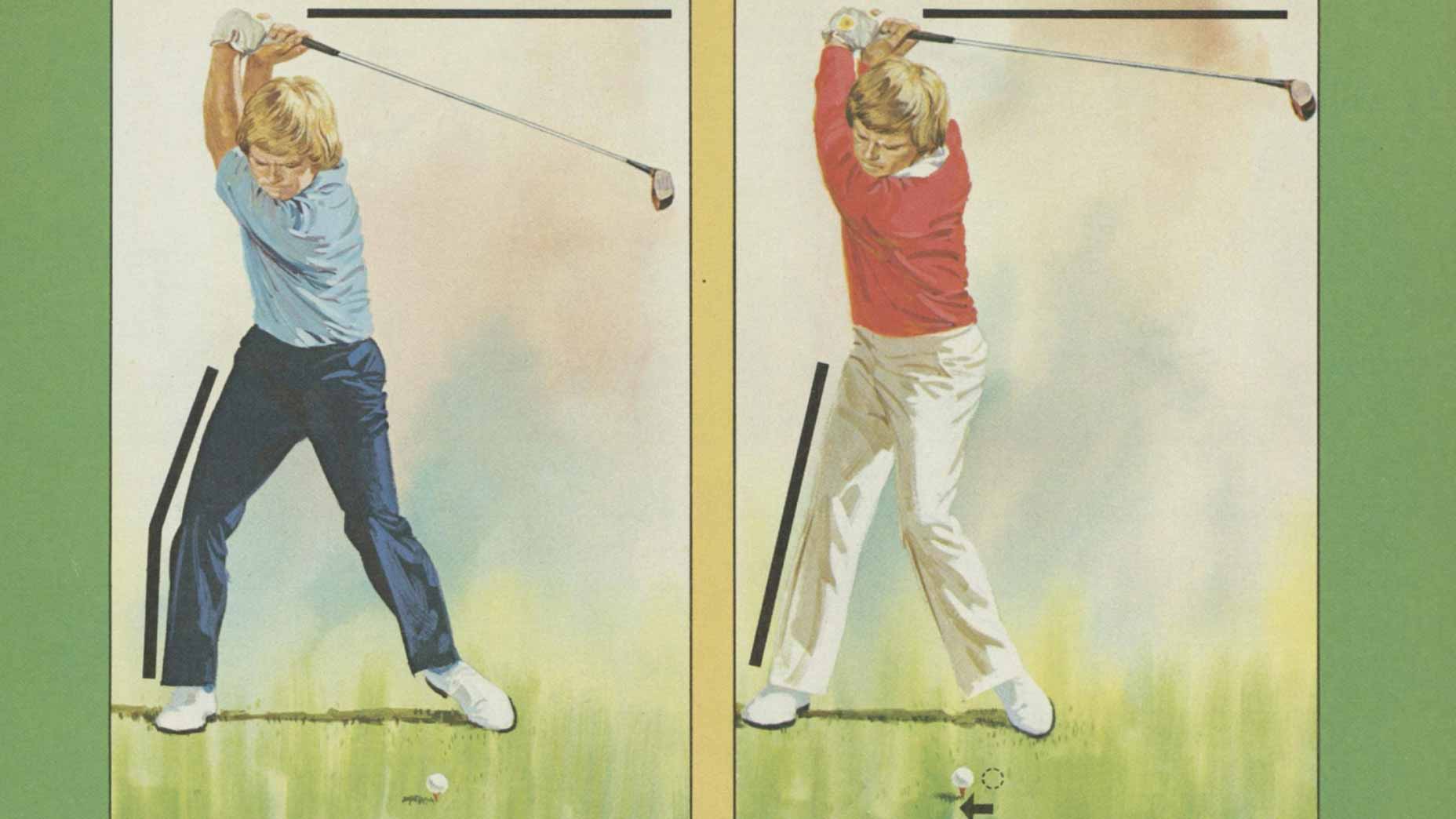
I used to set up with the ball very forward in my stance, approximately off my left instep and my head way behind the ball. I also had a gigantic turn, as well as too much lateral sway off the ball. As a result, I hit the ball too high, even though I could hit it a mile. I now play the ball off my left heel and set up more over the ball, with my right knee set slightly inward. I control my right leg better, as you can see above. This has also cut down the length of my backswing and the amount of my lateral sway. Everyone needs a little sideward motion with a tee shot, but not nearly as much as I had.
I found in my own game that the most important principle of good driving is to trust your swing. A fuller, freer swing enables you to release the club correctly and hit straight. If you’re hitting wildly, you’re probably trying to steer the ball. The club is not traveling at its maximum through impact, and that upsets your timing. That’s when you hit off target.
Another good rule is to avoid giving yourself technical advice when you’re actually on the course; reminders such as “Keep the left arm straight” only add to your problems. Key on simple concepts, on clubhead feel or tempo. If you find a swing key when warming up that seems to help, use it, but don’t use two or three keys at once. One is enough.
About the only technical point that can help you at times is grip pressure. When you’re driving badly and getting tense as a result, lighten the pressure to the point at which you can feel the clubhead. Then go ahead and swing it.
Technical tricks
The teeing ground is defined by the outside edges of the tee markers and is two club-lengths deep. That’s important to remember. Normally, you tee up from a flat spot, because then you can put your best swing on the ball. Some tees, however, have slight slopes. If you’re forced to tee up on a ball-above-feet slope, you’ll tend to draw the ball, and fade when the ball is below your feet. So allow for these when aiming. You can use these slopes creatively. Say you need a draw or fade to work the ball around a dogleg. Try to find the appropriate slope. If you want to guard against a hook or slice, pick the slope that will have the opposite effect.
The height of the tee also affects ball flight. Tee the ball lower on tight holes. You will get a lower-trajectory ball that gets on the ground faster and stays out of trouble better than a high ball. A lower tee also encourages a fade, which will bring the ball quickly to a stop. The converse of this is also true: Generally, a higher tee than normal encourages a high draw.
You should also realize that choking down on the driver stiffens the shaft a little, as well as reducing the size of your arc. This is a useful technique to have on tight holes. On long holes, grip more at the end of the grip. It gives you a bigger arc, and you can truly feel the clubhead.
In addition, the golf course architect usually has a few tricks up his sleeve. The sneakiest is the misaligned tee. For example, on the sixth tee at Merion, if you align yourself parallel to the sides of the tee, you’ll hit straight out-of-bounds. Don’t fall for this one.
Targeting
There are two basic steps to targeting. First, analyze how wide or tight the target area is and where the trouble is. Second, picture in your mind the ideal drive for you on that hole — see yourself setting up, swinging, and see the ball landing in your target area. The mind directs the body, and without good thinking and visualizing, the drive can go anywhere.
When targeting, it’s important that you recognize and compensate for the way you’re hitting the ball. I’ve played golf with amateurs who are slicing, and all day they target at the middle of the fairway and wind up in the right rough. Had they targeted more to the left, they could have played their second shots from the fairway.
It’s also vital to pick a target that you can realistically reach. If you’re a 220-yard hitter, target at a spot 220 yards out. Target farther out than that, and you’ll tend to swing too hard and ruin the shot.
When there’s trouble on one side of the hole, people say you should tee up on the same side as the trouble and hit away from it. This is excellent advice for the high handicapper. For the more skillful player, there is a second option. My teacher, Harvey Penick, used to tell me to line up at the trouble and then draw or fade the ball away from it. It still works for me.
On open holes, you have to work hard on your targeting. It’s very easy not to pick a target, and then you’ll often hit your wildest drives. Force yourself to find a focal point, even if it’s the difference in color between the edge of the fairway and the rough. In lining up, work off that point. With no focal point in the landing area or with a blind tee shot, find some distant object, such as a distinctively colored tree or a rock, a chimney or a church spire and line up on that. I should add that on wide holes there’s a great temptation to swing too hard. Resist it. Pick your spot and swing smoothly.
Tight holes, on the other hand, literally force you to target correctly and concentrate better. The temptation here is to steer. You have to make an effort to swing freely.
Last, never be too proud to drive with a 3-wood on tight holes. Think of it as the amateur’s one-iron.
Disclaimer : This story is auto aggregated by a computer programme and has not been created or edited by DOWNTHENEWS. Publisher: golf.com